Math Articles, tips & study guides
 6 Full-length TABE Math Practice Tests: Extra Test Prep to Help Ace the TABE Math Test Original price was: $18.99.$12.99Current price is: $12.99.Download
 TABE Math Workbook: Activities, Exercises, and Two Complete TABE Mathematics Practice Tests Original price was: $18.99.$12.99Current price is: $12.99.Download
 TABE 11&12 Subject Test Mathematics Level D: Student Practice Workbook + Two Realistic TABE 11&12 Math Tests Paperback Original price was: $18.99.$12.99Current price is: $12.99.Download
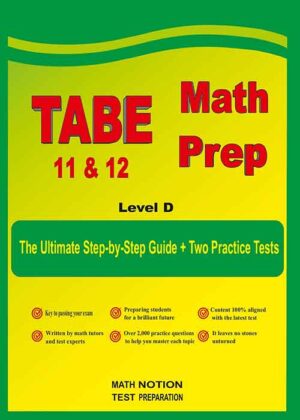 TABE 11&12 Math Prep (Level D): The Ultimate Step by Step Guide Plus Two Full-Length TABE Practice Tests Original price was: $18.99.$12.99Current price is: $12.99.Download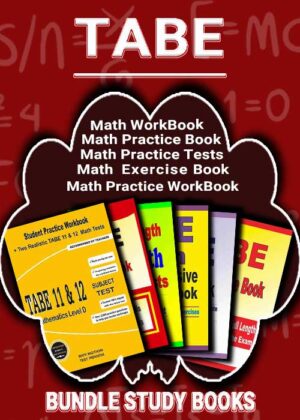
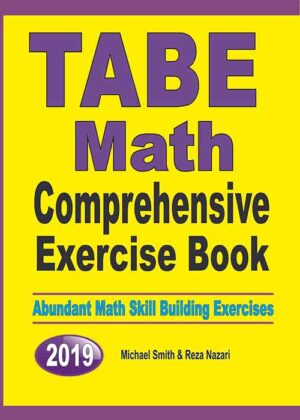 TABE Math Comprehensive Exercise Book: Abundant Math Skill Building Exercises Original price was: $18.99.$12.99Current price is: $12.99.Download
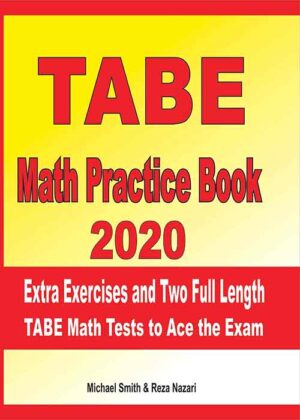 TABE Math Practice Book 2020: Extra Exercises and Two Full Length TABE Math Tests to Ace the Exam Original price was: $18.99.$12.99Current price is: $12.99.Download
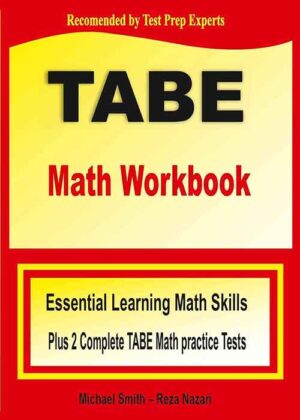 TABE Math Workbook: Essential Learning Math Skills Plus Two Complete TABE Math Practice Tests Paperback Original price was: $18.99.$12.99Current price is: $12.99.Download
 GED Math Practice Book 2020: Extra Exercises and Two Full Length GED Math Tests to Ace the Exam Original price was: $18.99.$12.99Current price is: $12.99.Download
 How to Prepare for the TABE Math Test
 Top 10 HESI Math Formulas You Must Memorize
 Big News: The Math Notion Blog Is Here
 SDCA Math Prep: South Dakota Student Guide
 WVGSA Math Prep: West Virginia Student Guide
What Is the TABE 11 and 12 Math Test?


If you’ve been asked to take the TABE, you may have seen it referred to as the “TABE 11 and 12” and wondered what that means. Understanding the TABE 11 and 12, what it is, how the math works, and how it’s scored, helps you prepare with confidence. The Test of Adult Basic Education is widely used to measure adult learners’ skills for education programs, job training, and workforce placement, and the “11 and 12” refers to its current edition. This guide explains everything you need to know about the TABE 11 and 12 math test and how to prepare.
The math portion measures practical, foundational skills, and the good news is that focused TABE math practice reliably improves results. Below we’ll cover what the TABE 11 and 12 is, its levels, what the math covers, how it’s scored, and how the right resources prepare you for a strong TABE math test result.
What the TABE 11 and 12 is
The TABE, or Test of Adult Basic Education, measures adult learners’ skills in reading, math, and language. “TABE 11 and 12” simply refers to the test’s current editions, the eleventh and twelfth versions, which replaced earlier ones and are aligned to college- and career-readiness standards. When people say they’re taking “the TABE 11/12,” they mean this current edition.
The TABE is used by adult education programs, job-training initiatives, community colleges, and employers to assess where an adult learner stands and to place them appropriately. It’s not a pass-or-fail test in the traditional sense; it measures your skill level, which determines placement into classes, programs, or jobs. Understanding this purpose helps you see what’s at stake and how to prepare.
The TABE levels explained
One distinctive feature of the TABE is that it comes in difficulty levels, typically labeled L (Literacy), E (Easy), M (Medium), D (Difficult), and A (Advanced). Each level targets a different skill range, and you take the level that matches your current ability, often determined by a locator test that finds the right starting point.
This level system means the TABE meets you where you are, rather than giving everyone the same test. Knowing which level you’re taking matters for preparation, because it tells you the difficulty range to expect. The Difficult (D) and Advanced (A) levels cover the most challenging content, while lower levels focus on more foundational skills.
What the TABE math test covers
The TABE 11 and 12 math test covers practical, foundational mathematics. At its core are number sense and operations, fractions, decimals, and percentages, ratios and proportions, and measurement and data. Higher levels add pre-algebra and algebra, including expressions, equations, and basic geometry, growing more demanding at the D and A levels.
The problems are framed in applied, real-world contexts, reflecting the skills adults actually use, which is fitting for a test designed for adult education and workforce readiness. Because the content is foundational and finite, it’s very learnable with practice, no advanced or obscure topics, just the core math that everyday life and further education require.
How the TABE math test works
The TABE 11 and 12 can be taken on a computer or on paper, depending on the testing site, and the math section includes a mix of question types. A calculator is permitted on certain portions, while other parts are designed to be done without one, so by-hand fluency matters alongside knowing when a calculator helps.
Knowing the format your testing site uses, computer or paper, and the calculator rules helps you prepare in matching ways. Practicing both with and without a calculator ensures you’re ready for each portion. Familiarity with the format removes a layer of test-day uncertainty, letting you focus on the math itself.
How the TABE is scored
The TABE reports scale scores that map to grade-level equivalents and to the difficulty levels, indicating roughly what grade level your skills correspond to. Programs use these results to place you into appropriate classes or to confirm you’ve reached a required skill level for a job or training program.
Because the TABE measures your level rather than passing or failing you, the goal is usually to reach the score or grade-level equivalent your program or employer requires. Knowing the target your specific program sets helps you aim your preparation, and reaching it is very achievable with focused practice on the foundational skills the test covers.
Why the TABE matters
The TABE plays an important role in many adults’ paths forward. It can determine placement in adult education or GED-preparation classes, qualify you for job-training programs, satisfy employer or licensing requirements, and help colleges place you appropriately. A strong TABE result can open doors to education and employment opportunities.
This is why preparing matters: a better score can mean placement into a higher-level class, qualification for a desired program, or meeting a job requirement. The effort you put into TABE preparation is really an investment in your education and career goals, which makes it well worth doing thoroughly.
Who takes the TABE
A wide range of adult learners take the TABE: those entering adult education or GED-prep programs, people applying for job-training or apprenticeship programs, individuals meeting employer or trade requirements, and students entering certain community college pathways. If math has been a while for you, you’re in very common company.
For all these learners, the TABE math test measures the same foundational skills, so preparation transfers across purposes. Whether you’re aiming for a class placement or a job qualification, building strong arithmetic, fractions, percentages, and basic algebra prepares you well, and a workbook designed for the TABE covers exactly that.
How to prepare for the TABE math test
Effective TABE preparation starts with knowing your level and the score your program requires, then focuses on the foundational skills the test covers. Build fluency with whole numbers, fractions, decimals, and percentages first, since these underpin everything, then work up through ratios, measurement, and any algebra your level includes.
Practice actively by working problems, not just reading, and review your mistakes to understand the method. Practice both with and without a calculator to match the test, and study consistently in short sessions rather than cramming. This steady, foundation-first approach reliably builds the skills the TABE measures.
Rebuild your fundamentals first
Because the TABE is foundational and many test-takers have been away from math for years, the fastest gains usually come from shoring up the basics. Make sure operations, fractions, decimals, and percentages feel automatic before tackling harder topics, since shaky fundamentals cause errors throughout the test.
This foundational work pays off immediately and broadly. When the basics are solid, the higher-level questions become far more approachable, and your confidence grows. For adult learners especially, investing first in the fundamentals is the most effective and least frustrating way to build toward a strong TABE math score.
Practice with TABE math worksheets
Targeted practice is the engine of improvement. Math Notion offers free, printable TABE math worksheets covering the arithmetic, fractions, percentages, and algebra the test measures, so you can drill exactly the skills you need at your own pace.
Browse the full library on our math worksheets page for more practice. Work each worksheet carefully, then review every problem, especially the misses, to understand where you went wrong. This focused, repeatable practice on the exact content the TABE measures is one of the most efficient ways to build readiness.
Manage test anxiety as an adult learner
For many adults returning to math, nerves are as much a hurdle as the content. The most effective antidote is thorough, familiar preparation: when the topics and question types feel routine from practice, the test holds far fewer surprises, and confidence grows from competence. Familiarity, not last-minute cramming, is what calms anxiety.
It also helps to remember that the TABE measures your level rather than passing or failing you, and that you can prepare and improve. Be patient and kind with yourself, celebrate progress, and trust that steady practice works. A calm, prepared adult learner performs much closer to their true ability than an anxious one.
The workbook that prepares you for the TABE
For complete, structured preparation, a workbook ties everything together. The TABE 11 & 12 Subject Test Mathematics workbook covers exactly the arithmetic, fractions, percentages, and algebra the TABE 11 and 12 measures, with clear lessons and step-by-step answer explanations you can follow on your own to rebuild any rusty skills.
Paired with the free TABE worksheets for targeted practice, a workbook gives you both complete instruction and focused drilling. It’s an instant download, so you can start preparing tonight, working from the fundamentals up to the level your program requires. Browse all our TABE math resources → to find the right fit.
A simple TABE study plan
A practical plan starts with finding your level, often through a locator test, and learning the score your program requires. In the first week or two, focus on rebuilding the fundamentals, whole numbers, fractions, decimals, and percentages, until they feel automatic, since everything else depends on them. Work problems by hand and check your answers against worked explanations.
Over the following weeks, move up through ratios, measurement, data, and any pre-algebra or algebra your level includes, drilling with worksheets and reviewing every mistake. Practice both with and without a calculator to match the test, and keep sessions short and regular. This foundation-first, level-appropriate plan reliably builds the skills the TABE measures and gets you to the score your program needs.
Turn the TABE into a stepping stone
It helps to keep the bigger picture in mind: the TABE isn’t an obstacle but a stepping stone toward your goals, whether that’s a GED, a training program, a job, or college. The foundational math skills you build preparing for it will serve you well beyond the test, in further education and in everyday life, so the effort pays off long after test day.
Approaching your TABE math practice as an investment in your future, rather than a hurdle to clear, makes the steady work feel worthwhile. With a clear target, foundation-first practice, and the right resources, the TABE 11 and 12 math test is very manageable, and reaching the level you need opens the door to whatever comes next.
Frequently asked questions
What does “TABE 11 and 12” mean?
It refers to the current editions, the eleventh and twelfth versions, of the Test of Adult Basic Education, aligned to college- and career-readiness standards and used for adult education and workforce placement.
What levels does the TABE have?
Typically L (Literacy), E (Easy), M (Medium), D (Difficult), and A (Advanced). You take the level matching your ability, often determined by a locator test.
Can I use a calculator on the TABE math test?
A calculator is permitted on certain portions, while other parts are done without one, so practicing both with and without a calculator is the safest preparation.
How is the TABE scored?
It reports scale scores mapped to grade-level equivalents and difficulty levels, used to place you into classes or confirm you’ve met a program or job requirement.
Math Notion makes standards-aligned math workbooks and test prep for learners at every level and across all 50 states. See the full collection.
Posted by Math Notion Team · Published on August 21, 2024