Math Articles, tips & study guides
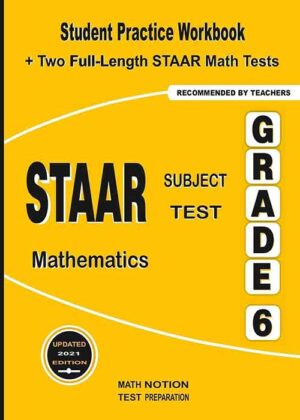 STAAR Subject Test Mathematics Grade 6: Student Practice Workbook + Two Full-Length STAAR Math Tests Original price was: $18.99.$12.99Current price is: $12.99.Download
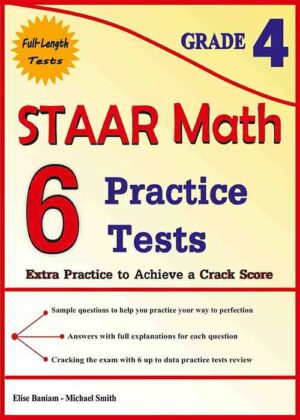 6 STAAR Math Practice Tests Grade 4: Extra Practice to Achieve a Crack Score Paperback Original price was: $18.99.$12.99Current price is: $12.99.Download
 STAAR Grade 8 Math Workbook: Review for the State of Texas Assessments of Academic Readiness With 2 Full-Length STAAR Math Exams Original price was: $18.99.$12.99Current price is: $12.99.Download
 7th Grade STAAR Math Exercise Book: Review of Essential Skills and Concepts With 2 STAAR Math Practice Tests Original price was: $18.99.$12.99Current price is: $12.99.Download
 STAAR Math Workbook: 5th Grade Math Exercises, Activities, and Two Full-Length STAAR Math Practice Tests Original price was: $18.99.$12.99Current price is: $12.99.Download
 STAAR Math Practice Grade 8: Complete Content Review Plus 2 Full-Length STAAR Math Tests Original price was: $18.99.$12.99Current price is: $12.99.Download
 STAAR Math Practice Grade 5: Complete Content Review Plus 2 Full-length STAAR Math Tests Original price was: $18.99.$12.99Current price is: $12.99.Download
 STAAR Subject Test Mathematics Grade 5: Student Practice Workbook + Two Full-Length STAAR Math Tests Original price was: $18.99.$12.99Current price is: $12.99.Download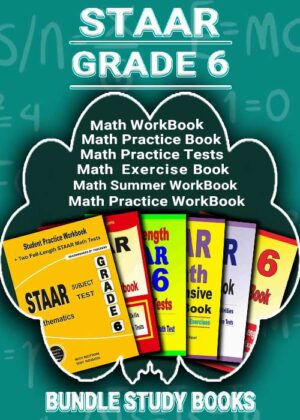
 6th Grade Texas Math: STAAR Guide (2026)
 STAAR Math Worksheets and Practice Guide (by Grade)
 STAAR Math Test: What Is Tested at Each Grade
 CMAS Scatter Plots Practice — Colorado Guide
 ILEARN Geometry Basics Practice — Indiana Guide
STAAR Math Test Prep for Grades 6-8: A Parent’s Guide (2026)


If your child is in middle school in Texas, the STAAR math test is one of the most important assessments they will take this year — and the right STAAR math test prep can turn it from a source of stress into a win. The good news for parents is simple: the STAAR is very beatable with steady, focused practice. This guide walks you through exactly what the STAAR math test covers in grades 6, 7, and 8, what changed in the redesign, when the 2026 testing window falls, and how to help your child prepare with confidence.
What is the STAAR test?
STAAR stands for the State of Texas Assessments of Academic Readiness. It is the state’s standardized test, given to students in grades 3–12 to measure how well they have mastered the Texas Essential Knowledge and Skills (TEKS). For middle schoolers, mathematics is tested every year in grades 6, 7, and 8. You can review the official program details on the Texas Education Agency’s STAAR page.
What changed in the STAAR redesign
Since the 2022–2023 school year, the STAAR has been a very different test from the one parents may remember. The redesign came out of House Bill 3906, and the changes matter for how your child should approach STAAR math practice:
- It is fully online. Students take the test digitally, using built-in tools like a calculator, graphing feature, and notes space.
- Fewer pure multiple-choice questions. Under the “multiple-choice cap,” no more than 75% of the points come from multiple-choice items. The rest come from new question types — typing answers into an equation editor, dragging items, “hot text” selection, and inline drop-down menus.
- More real-world reasoning. Students work through multi-step, real-world problems and show their thinking, rather than just recalling a formula.
The takeaway for parents: practicing with realistic, full-length questions — including the new digital formats — matters more than ever. A child who only drills simple multiple-choice may be caught off guard on test day.
What’s on the STAAR math test by grade
Grade 6 math
Sixth grade is a big conceptual jump from fifth. The test leans heavily on ratios and proportional relationships, rational numbers (including negative numbers), expressions and equations, and introductory statistics. Gaps in basic arithmetic show up quickly here, so a solid foundation is key. Targeted 6th grade Texas math practice built around the TEKS is the fastest way to close those gaps.
Grade 7 math
Seventh grade depends heavily on fluency with rational number operations — fractions, decimals, and integers — alongside proportional relationships, percentages, probability, and basic geometry. Because rational numbers run through the whole test, shaky fraction and decimal skills can drag down an entire score. A focused 7th grade Texas math workbook helps students build that fluency.
Grade 8 math
Eighth grade STAAR is essentially a readiness check for Algebra I. It covers linear equations and functions, the Pythagorean theorem, transformations, and data analysis. Doing well signals a student is ready for high school math, which is why 8th grade Texas math test prep is such a valuable investment before the leap to algebra.
How to help your child prepare
You don’t need to be a math teacher to make a real difference. A few practical steps go a long way:
- Start early and keep it short. Fifteen to twenty minutes of focused practice several times a week beats cramming. Begin in winter, well before the spring testing window.
- Practice one topic at a time. Identify weak spots — often fractions in grade 7 or proportional reasoning in grade 6 — and drill those before moving on.
- Use full-length practice tests. These build stamina and familiarity with the digital question types, so test day feels routine.
- Review the answer explanations, not just the score. Understanding why an answer was wrong is where the real learning happens.
- Keep it positive. Confidence is half the battle. Celebrate progress, not just correct answers.
Common STAAR math mistakes to avoid
A few habits quietly cost students points every year. Watch for these as your child practices:
- Skipping the digital tools. The online equation editor and graphing tool take practice. Students who wait until test day to learn them lose time and accuracy.
- Rushing word problems. Most STAAR math items are multi-step. Encourage your child to underline what’s being asked before solving.
- Ignoring units and labels. Ratios, rates, and measurement questions often hinge on a unit your child overlooked.
- Practicing only easy questions. Growth happens at the edge of difficulty — mix in the harder, reasoning-heavy items.
How parents can support STAAR math at home
You are your child’s most important study partner, and supporting STAAR math test prep doesn’t require advanced math of your own. A few habits make a big difference. First, build a consistent routine — the same time and quiet place each day signals that practice is normal, not a punishment. Second, talk through problems out loud; asking “what is the question really asking?” trains the careful reading that multi-step STAAR items demand. Third, normalize mistakes. When your child gets one wrong, treat it as useful information about what to practice next, not a failure. Fourth, connect math to real life — cooking, budgeting, sports stats, and travel all reinforce the ratios, rates, and proportional reasoning the test rewards. Finally, keep the tone calm and encouraging; a confident, low-stress student almost always outperforms an anxious one who studied the same amount.
It also helps to keep the test in perspective for your child. STAAR is one snapshot of progress, not a verdict on how “smart” they are. Children who understand that the test simply shows what to work on next tend to approach STAAR math practice with far less anxiety — and that mindset itself lifts scores.
STAAR math test prep workbooks built for the redesigned test
At Math Notion, we publish grade-specific STAAR math workbooks designed around the redesigned, digital test — with clear lessons, full-length practice, and step-by-step answer explanations your child can follow independently. They’re ideal for homeschool, after-school practice, or tutoring:
- 6th Grade Texas Math Practice Workbook — STAAR Test Prep
- 7th Grade Texas Math Practice Workbook — STAAR Test Prep
- 8th Grade Texas Math Practice Workbook — STAAR Test Prep
Each is an instant PDF download, so your child can start practicing today. Browse all our math practice books →
When is the STAAR math test in 2026?
For the 2025–2026 school year, the middle-school math testing window falls in the spring, typically from late April into early May. Exact dates vary by district, so confirm with your child’s school and check the official TEA 2025–2026 testing calendar. Because the window is in spring, the ideal time to begin steady STAAR math test prep is winter and early spring.
How STAAR math scores work
STAAR math results are reported in four performance levels, and knowing them helps you set realistic goals for your child’s STAAR math practice:
- Did Not Meet Grade Level — the student needs significant support with on-grade content.
- Approaches Grade Level — the student understands much of the material but has clear gaps to close.
- Meets Grade Level — the student is on track and ready for the next grade’s work.
- Masters Grade Level — the student shows strong command and is ready for advanced material.
Each student also receives a scale score and a Lexile/Quantile measure. The goal for most families is to move steadily from “Approaches” toward “Meets” and “Masters” — and consistent, targeted practice is what makes that climb happen.
A simple 8-week STAAR math study plan
You don’t need an elaborate system. This eight-week plan keeps STAAR math test prep manageable and steady:
- Weeks 1–2: Diagnose. Have your child take a full-length practice test. Note which reporting categories — numbers, algebra, geometry, data — are weakest.
- Weeks 3–4: Rebuild foundations. Spend most sessions on the two weakest areas. For grade 7, that’s often fractions and proportional reasoning; for grade 6, ratios and negative numbers.
- Weeks 5–6: Practice the new question types. Drill equation-editor, drag-and-drop, and inline-choice items so the digital format feels routine.
- Week 7: Full-length rehearsal. Take a second timed practice test under test-like conditions and review every missed item’s explanation.
- Week 8: Light review and rest. Short confidence-building sessions, then ease off the day before the test.
Fifteen to twenty minutes a day across eight weeks beats a frantic weekend of cramming every time.
Free STAAR math practice resources
Alongside a structured workbook, free official materials are worth using. The Texas Education Agency publishes released STAAR test questions so your child can practice with real, previously administered items and the exact online tools they’ll see on test day. Combining these with full-length STAAR math practice workbooks gives the best of both worlds: authentic items plus structured lessons and answer explanations.
Frequently asked questions
When is the STAAR math test in 2026?
The grade 6–8 math testing window is in late April to early May 2026. Check the TEA testing calendar and your child’s school for exact dates.
Is the STAAR test still on paper?
No. Since the redesign, STAAR is administered online, so practicing with digital question types is important.
How can my child practice the new question types?
Use full-length practice materials built for the redesigned STAAR — including equation-editor, drag-and-drop, and inline-choice questions — so the formats feel familiar on test day.
What is a passing STAAR math score?
There is no single “pass” mark, but reaching the “Meets Grade Level” performance level signals your child is on track for the next grade. Many families aim to move from “Approaches” to “Meets” with steady practice.
How many practice tests should my child take?
Two to three full-length practice tests across the prep window is ideal — one early to diagnose gaps, one mid-way, and one final rehearsal under test-like conditions.
How early should we start STAAR math prep?
Begin in winter with short, regular sessions. Steady practice over several months beats last-minute cramming and builds lasting confidence.
The bottom line on STAAR math prep
The redesigned STAAR math test asks more of students than the version many parents remember — it’s digital, it leans on real-world reasoning, and it mixes in question types beyond simple multiple choice. But none of that changes the fundamental truth: students who practice consistently with realistic, grade-aligned material walk in prepared and walk out confident. Start early, focus on the weak spots, rehearse the digital formats, and keep the tone encouraging. Pair a structured STAAR math practice workbook with the free released questions from the Texas Education Agency, follow a simple weekly plan, and your child will be ready to show what they know. With the right STAAR math test prep, “Meets” and “Masters” are well within reach.
Math Notion provides standards-aligned math practice workbooks and STAAR test prep eBooks for students in grades 6–8 across Texas and all 50 states. See our full collection.
Posted by Math Notion Team · Published on June 1, 2026