
Free ISEE Math Practice Test 2026 — Primary, Lower, Middle & Upper Levels
 ISEE Lower Level Math Practice Book 2020: Extra Exercises and Two Full Length ISEE Lower Level Math Tests to Ace the Exam Original price was: $18.99.$12.99Current price is: $12.99.Download
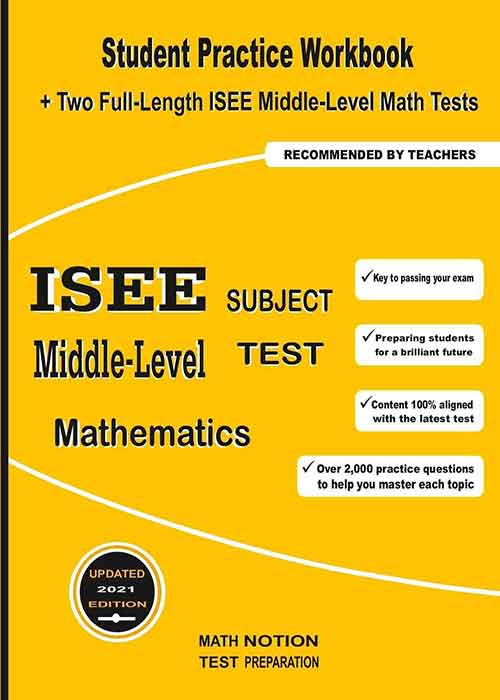
 ISEE Middle Level Math Practice book 2020: Extra Exercises and Two Full Length ISEE Middle Level Math Tests to Ace the Exam Original price was: $18.99.$12.99Current price is: $12.99.Download
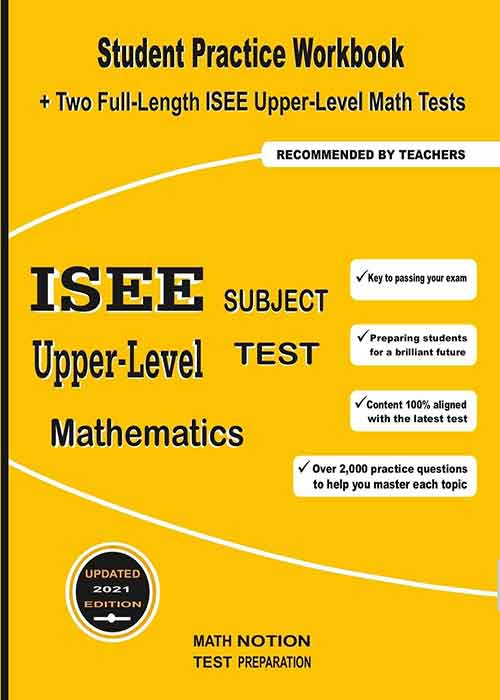
 ISEE Upper Level Math Practice Book 2020: Extra Exercises and Two Full Length ISEE Upper Level Math Tests to Ace the Exam Original price was: $18.99.$12.99Current price is: $12.99.Download
 ISEE Math Questions: Topics, Samples, and How to Practice
 ISEE Lower Level Math: How to Prepare Your Child
Free ISEE Math Practice Test
Realistic, by-level practice for the ISEE Primary, Lower, Middle, and Upper Levels — with worked answers, 4-week study plans, formulas, and free worksheets, from the team behind MathNotion’s ISEE prep books.
What’s on the ISEE Math Test?
The ISEE (Independent School Entrance Exam), administered by the ERB, measures math through two sections on the Lower, Middle, and Upper Levels: Quantitative Reasoning, which tests problem-solving and reasoning rather than speed, and Mathematics Achievement, which tests grade-level skills aligned to national standards. On the Middle and Upper Levels, Quantitative Reasoning also includes quantitative-comparison questions. The Primary Level uses a single, picture-supported Mathematics section.
The ISEE has four levels by entering grade: Primary (grades 2–4), Lower (entering grades 5–6), Middle (entering grades 7–8), and Upper (entering grades 9–12). This page covers all four — choose yours in the tabs below.
Section length depends on level. The Lower Level has 38 Quantitative Reasoning questions (35 minutes) and 30 Mathematics Achievement questions (30 minutes). The Middle and Upper Levels each have 37 Quantitative Reasoning questions (35 minutes) and 47 Mathematics Achievement questions (40 minutes). Primary math is shorter and picture-based.
On the Lower, Middle, and Upper Levels each math section is reported on a scaled score of 760–940, plus a percentile rank and a stanine from 1 to 9 that compares your child with other applicants. There is no penalty for wrong answers, so it always pays to answer every question.
ISEE Math Practice Test by Level
Choose your level below. Each level includes its own overview, 4-week study plan, practice quiz, score-boosting tips, topic list, key formulas, and recommended resources — all grouped in one tab.
The Primary Level (Primary 2, 3, and 4) has a single, picture-supported Mathematics section aligned to grade-level standards. All questions are multiple choice with four answer choices, and calculators are not allowed. It covers counting and number sense, basic addition and subtraction, shapes, patterns, and simple measurement.
Primary Level: 4-Week Study Plan
Primary Level: Practice Quiz
Which number comes next? 2, 4, 6, ___
- 7
- 8
- 9
- 10
Show answer
What is 7 + 5?
- 11
- 12
- 13
- 14
Show answer
How many sides does a triangle have?
- 2
- 3
- 4
- 5
Show answer
What is 10 − 4?
- 4
- 5
- 6
- 7
Show answer
Primary Level: Tips to Boost Your Score
- Count out loud and with objects like coins or blocks.
- Read or listen to each question slowly before answering.
- Draw a quick picture to solve word problems.
Primary Level: Practice by Topic
Counting, ordering, and comparing numbers.
Basic facts and simple word problems.
Recognizing shapes and continuing patterns.
Length, time, and reading simple charts.
Browse free Grade 3 worksheets →
Primary Level: Key Facts to Know
- A triangle has 3 sides; a square has 4 equal sides.
- Count by 2s: 2, 4, 6, 8, 10…
- Addition means putting groups together.
- Subtraction means taking away from a group.
Primary Level: Books & Free Resources
The Lower Level has two math sections: Quantitative Reasoning (38 questions, 35 minutes) and Mathematics Achievement (30 questions, 30 minutes). It focuses on whole numbers, fractions, decimals, basic geometry, measurement, and word problems.
Lower Level: 4-Week Study Plan
Lower Level: Practice Quiz
What is 1/2 + 1/4?
- 1/6
- 2/6
- 3/4
- 1/3
Show answer
Round 4,728 to the nearest hundred.
- 4,700
- 4,730
- 4,800
- 5,000
Show answer
A rectangle is 6 cm by 4 cm. What is its area?
- 10 cm²
- 20 cm²
- 24 cm²
- 48 cm²
Show answer
A pack has 8 pencils. How many pencils are in 5 packs?
- 13
- 35
- 40
- 45
Show answer
Lower Level: Tips to Boost Your Score
- Memorize your times tables through 12 — most questions build on them.
- Estimate the answer first, then compute, to catch careless mistakes.
- Show every step on scratch paper instead of doing math in your head.
Lower Level: Practice by Topic
Rounding, ordering, and multi-digit operations.
Comparing, converting, adding, and subtracting.
Perimeter, area, time, and money.
Translating real-world questions into math.
Browse all free Lower-Level worksheets →
Lower Level: Formulas to Know
- Area of a rectangle = length × width
- Perimeter of a rectangle = 2 × (length + width)
- Area of a triangle = ½ × base × height
- Fraction of a number = multiply (½ of 10 = 5)
Lower Level: Books & Free Resources
The Middle Level has Quantitative Reasoning (37 questions, 35 minutes) and Mathematics Achievement (47 questions, 40 minutes). Quantitative Reasoning includes quantitative-comparison questions. Content covers integers, ratios, percents, pre-algebra, algebra, geometry, and data.
Middle Level: 4-Week Study Plan
Middle Level: Practice Quiz
What is 25% of 80?
- 16
- 20
- 25
- 40
Show answer
Evaluate: −7 + 12.
- −19
- −5
- 5
- 19
Show answer
Solve: 3x = 21.
- x = 6
- x = 7
- x = 18
- x = 24
Show answer
The ratio of boys to girls is 2:3. If there are 12 boys, how many girls are there?
- 6
- 8
- 15
- 18
Show answer
Middle Level: Tips to Boost Your Score
- Learn percent shortcuts — 10% is just moving the decimal one place.
- For quantitative-comparison questions, plug in simple numbers to test each column.
- Rewrite each word problem as an equation before solving.
Middle Level: Practice by Topic
Order of operations, factors, and multiples.
Proportions and percent problems.
Expressions and one/two-step equations.
Angles, area, mean, median, and probability.
Browse all free Middle-Level worksheets →
Middle Level: Formulas to Know
- Percent = (part ÷ whole) × 100
- Area of a triangle = ½ × base × height
- Mean = sum of values ÷ number of values
- Proportion: a/b = c/d → a × d = b × c
Middle Level: Books & Free Resources
The Upper Level has Quantitative Reasoning (37 questions, 35 minutes) and Mathematics Achievement (47 questions, 40 minutes), including quantitative-comparison questions. Content covers algebra, quadratics, functions, exponents, coordinate and plane geometry, and statistics and probability.
Upper Level: 4-Week Study Plan
Upper Level: Practice Quiz
Solve: 2x − 5 = 11.
- x = 3
- x = 6
- x = 8
- x = 13
Show answer
Simplify: x³ · x⁴.
- x⁰
- x¹
- x⁷
- x¹²
Show answer
Find the slope of the line through (1, 2) and (3, 8).
- 2
- 3
- 4
- 6
Show answer
Factor: x² − 9.
- (x − 3)(x + 3)
- (x − 9)(x + 1)
- (x − 3)²
- (x + 9)(x − 1)
Show answer
Upper Level: Tips to Boost Your Score
- Get fast and accurate with factoring and the quadratic formula.
- When stuck, plug the answer choices back into the equation.
- Memorize core formulas so you spend time reasoning, not recalling.
Upper Level: Practice by Topic
Linear equations, inequalities, and exponents.
Factoring, solving, and evaluating functions.
Slope, area, and the Pythagorean theorem.
Mean, median, range, and probability.
Browse all free Upper-Level worksheets →
Upper Level: Formulas to Know
- Slope = (y₂ − y₁) ÷ (x₂ − x₁)
- Quadratic formula: x = [−b ± √(b² − 4ac)] ÷ 2a
- Difference of squares: a² − b² = (a − b)(a + b)
- Exponent rule: xᵃ · xᵇ = xᵃ⁺ᵇ
Upper Level: Books & Free Resources
Related ISEE Math Books
Go deeper with MathNotion’s step-by-step ISEE math workbooks and practice tests.
Frequently Asked Questions
Which ISEE levels does this page cover?
This page covers all four ISEE levels: Primary (entering grades 2–4), Lower (entering grades 5–6), Middle (entering grades 7–8), and Upper (entering grades 9–12).
What is on the ISEE Primary Level math test?
The Primary Level (Primary 2, 3, and 4) has a single, picture-supported Mathematics section covering counting, number sense, basic addition and subtraction, shapes, patterns, and simple measurement. All questions are multiple choice and calculators are not allowed.
How is the ISEE math scored?
On the Lower, Middle, and Upper Levels each math section is scaled from 760 to 940 and reported with a percentile and a stanine (1–9) comparing your child to other applicants. There is no penalty for wrong answers, so answer every question.
How many math questions are on the ISEE?
The Lower Level has 38 Quantitative Reasoning and 30 Mathematics Achievement questions. The Middle and Upper Levels each have 37 Quantitative Reasoning and 47 Mathematics Achievement questions. The Primary Level has one shorter Mathematics section.
Can I use a calculator on the ISEE?
No. Calculators are not permitted on any level of the ISEE, so practice doing arithmetic and algebra by hand.
How long should my child study?
Plan on about four weeks of consistent practice using the level study plan above. Short daily sessions with reviewed mistakes work far better than cramming.