Math Articles, tips & study guides
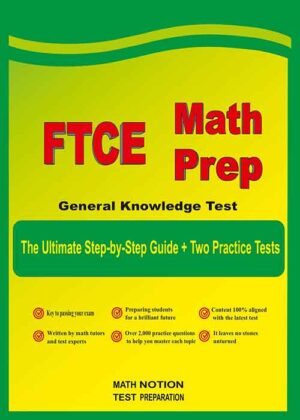 FTCE Math Prep (General Knowledge Test): The Ultimate Step by Step Guide Plus Two Full-Length FTCE Practice Tests Original price was: $18.99.$12.99Current price is: $12.99.Download
 6 Full-Length AFOQT Math Practice Tests: Extra Test Prep to Help Ace the AFOQT Math Test Original price was: $18.99.$12.99Current price is: $12.99.Download
 GED Math Workbook: Mathematical Reasoning for General Educational Development Exam With 2 Full-Length Practice Tests Original price was: $18.99.$12.99Current price is: $12.99.Download
 AFOQT Subject Test Mathematics: Student Practice Workbook + Two Realistic AFOQT Math Tests Paperback Original price was: $18.99.$12.99Current price is: $12.99.Download
 GED Subject Test Mathematics: Student Practice Workbook + Two Realistic GED Math Tests Original price was: $18.99.$12.99Current price is: $12.99.Download
 HiSET Math Workbook: Practice Questions for the High School Equivalency Test With 2 Full-Length HiSET Math Exams Original price was: $18.99.$12.99Current price is: $12.99.Download
 HiSET Math Workbook: Essential Learning Math Skills Plus Two Complete HiSET Math Practice Tests Original price was: $18.99.$12.99Current price is: $12.99.Download
 6 Full-Length GED Math Practice Tests: Extra Test Prep to Help Ace the GED Math Test Original price was: $18.99.$12.99Current price is: $12.99.Download
 6 GED Math Practice Tests: Extra Practice to Achieve a Crack Score Original price was: $18.99.$12.99Current price is: $12.99.Download
 SDCA Math Prep: South Dakota Student Guide
 WVGSA Math Prep: West Virginia Student Guide
 7 MCAs Math Prep Tips for Minnesota Students
 STAAR Math Test Prep for Grades 6-8: A Parent’s Guide (2026)
 7 Proven Accuplacer Math Prep Strategies
Math Anxiety in Children: How Parents Can Help

Watching your child shut down, melt into tears, or insist “I’m just dumb at math” over a homework sheet is heartbreaking, and more common than most parents realize. Math anxiety in children is a genuine, well-studied phenomenon, and the good news is that parents are in a uniquely powerful position to help. The way you respond at the kitchen table can either ease your child’s fear or, without meaning to, deepen it. This guide explains how to recognize math anxiety in your child, what causes it, and the concrete, supportive things you can do to help them build calm and confidence.
You don’t need to be a math whiz to make a real difference, in fact, your attitude often matters more than your algebra. With patience, the right words, and steady support, you can help your child overcome math anxiety and rebuild a healthy relationship with numbers. If you’d also like background on the condition itself, our companion guide on how to overcome math anxiety covers the fundamentals.
What math anxiety looks like in kids
Children rarely say “I have math anxiety.” Instead it shows up as behavior: tears or tantrums at homework time, stomachaches before a math test, or a flat refusal to even try. You might hear self-defeating talk like “I’m stupid” or “I’ll never get this,” or notice your child rushing through problems just to make the discomfort end. These are signs of fear, not laziness.
You may also see avoidance, suddenly “forgetting” math homework, dawdling endlessly, or claiming to feel sick. Physically, an anxious child might fidget, freeze, or seem to go blank when numbers appear. Learning to read these signals for what they are, distress rather than defiance, is the first and most important step, because it changes how you’ll respond.
Why children develop math anxiety
Math anxiety in kids has several common roots. Timed tests and pressure to answer quickly can teach a child that math equals stress. A single embarrassing moment, being called on and getting it wrong in front of classmates, can leave a lasting mark. And repeated struggles without enough support can convince a child they’re simply not capable.
Surprisingly, parents and teachers can pass anxiety along too. A well-meaning “I was never good at math either” tells a child that math failure runs in the family and is nothing to fight. Even an adult’s own visible stress around numbers can transmit. Understanding these causes helps you avoid reinforcing them and respond in ways that lower fear instead.
Check your own math attitude first
One of the most powerful things a parent can do is examine their own relationship with math. Children absorb our attitudes, so if you sigh, joke that you’re “hopeless at math,” or treat it as a dreaded chore, your child learns that math is something to fear and avoid. The opposite is also true: a calm, matter-of-fact attitude signals that math is just another learnable thing.
You don’t have to fake enthusiasm or pretend to love equations. Simply modeling that math is approachable, that mistakes are normal and problems are solvable, gives your child permission to feel the same way. When you treat a tricky problem as an interesting puzzle rather than a threat, you’re teaching emotional regulation around math far more effectively than any lecture could.
Replace “you’re so smart” with effort praise
How you praise matters more than you’d think. Telling a child “you’re so smart” ties their identity to being effortlessly clever, so when math gets hard, as it inevitably does, they conclude they must not be smart after all, and anxiety spikes. Praising effort and strategy instead, “I love how you kept trying different approaches”, teaches that ability grows with work.
This effort-focused, growth-mindset praise is one of the best research-backed tools against math anxiety in children. It frames struggle as a normal part of learning rather than evidence of failure, so a hard problem becomes a challenge to work at instead of a verdict on their worth. Over time, this reshapes how your child interprets difficulty across all of school.
Make mistakes safe and normal
Anxious children often fear mistakes above all else, so a transformative thing you can do is make errors feel safe. When your child gets something wrong, respond with curiosity rather than correction: “Interesting, let’s see what happened here.” Treat the mistake as useful information, a clue about what to practice, not a failure to be ashamed of.
You can even model this with your own mistakes, thinking out loud, “Oops, I added that wrong, let me try again,” so your child sees that errors are a normal, fixable part of doing math. When the fear of being wrong fades, children become willing to attempt hard problems, and that willingness is exactly what learning requires. A safe-to-fail home is fertile ground for confidence.
Ease the pressure of speed
Much childhood math anxiety is really anxiety about speed, the timed quiz, the flash cards, the race to answer first. Yet rushing has little to do with mathematical understanding, and for an anxious child it floods the brain with stress that blocks clear thinking. At home, take speed off the table entirely and let your child work at a comfortable pace.
Emphasize understanding over quickness: praise a thoughtful, correct approach even if it took a while. As genuine skill grows, speed tends to follow naturally, but it should never be the goal that drives the fear. Giving your child permission to slow down and think can dissolve a surprising amount of anxiety, because it removes the very pressure that created it.
Build confidence with the right level of challenge
Confidence is built through success, so help your child experience plenty of it. Start practice at a level where they can succeed comfortably, then increase difficulty gradually. Throwing a fearful child at problems far beyond their current level simply confirms their worst beliefs, while a ladder of achievable steps proves to them, again and again, that they can do this.
Celebrate the small wins along the way and point out concrete progress: “Last month this kind of problem stumped you, and now you’ve got it.” This visible evidence of growth is powerful medicine against the “I’ll never get it” mindset. Each success quietly rewrites your child’s story from “I’m bad at math” to “I can figure this out with practice.”
Make math part of everyday life
Math feels less scary when it lives outside the worksheet. Weave it naturally into daily routines, cooking and doubling a recipe, counting change at the store, figuring out how many minutes until a show starts, splitting a pizza fairly. These low-stakes, real-world moments show your child that math is a useful, ordinary tool, not a frightening school subject.
Games help enormously too. Board games, card games, dice games, and puzzles build number sense and logical thinking while feeling like play, not practice. When math is associated with fun family time rather than tense homework battles, the emotional charge around it softens, and your child gathers positive math experiences that counterbalance the stressful ones.
Create a calm homework routine
The homework environment shapes how your child feels about math, so make it as calm and supportive as possible. Choose a consistent time and a quiet, comfortable spot, and keep your own tone patient even when frustration rises, yours or theirs. If a session is dissolving into tears, it’s okay to pause, take a break, and return when everyone has reset.
Sit with your child when you can, not to take over, but to offer reassurance and encouragement. Break big assignments into smaller chunks so they feel manageable, and end on a positive note whenever possible. A homework routine that feels safe and supported, rather than rushed and tense, does enormous long-term good for an anxious child’s relationship with math.
Use supportive, well-explained materials
The materials your child practices with can either fuel anxiety or ease it. Confusing, cluttered, or too-advanced resources leave a child feeling lost and reinforce their fear, while clear, well-organized books that explain each concept gently and show worked solutions help them feel guided and capable. The right resource functions like a patient tutor your child can lean on.
Math Notion’s workbooks are designed with exactly this in mind, with approachable, plain-language lessons and step-by-step answer explanations matched to your child’s grade and state standards, so practice builds understanding instead of frustration. Pairing a calm home routine with supportive materials is a powerful combination. Browse the full Math Notion collection → to find the right book for your child’s level.
When to seek additional help
Your support will carry most children a long way, but sometimes extra help is warranted. If your child’s anxiety is intense, persistent, and seriously affecting their schoolwork or happiness, talk with their teacher about what’s happening in class, and consider a tutor who can provide patient, individual attention. For anxiety that spills beyond math into broader distress, a school counselor or mental-health professional can help.
Reaching out isn’t an admission of failure, it’s good parenting. Children often respond remarkably well to a little targeted support, and breaking the anxiety cycle early prevents it from hardening into a lifelong avoidance of math. Trust your instincts: you know your child, and seeking help when they need it is one of the most caring things you can do.
Patience is the real secret
Helping a child through math anxiety is a marathon, not a sprint, and your steady, patient presence is the most important factor of all. There will be good days and hard days, and progress may feel slow. But every calm homework session, every effort you praise, every mistake you treat as normal, adds up, gradually teaching your child that math is safe and that they are capable.
Keep the long view, and keep your faith in your child visible to them. Kids who feel believed in find the courage to keep trying, and trying is what builds skill and dissolves fear. With your support, your child can absolutely move from dread to confidence, and the calm, encouraging foundation you build now will serve them well for years to come.
Frequently asked questions
How do I know if my child has math anxiety?
Look for emotional and behavioral signs: tears or tantrums at math homework, stomachaches before tests, negative self-talk like “I’m dumb,” avoidance, or freezing when numbers appear. These signal fear rather than laziness.
I’m bad at math myself, can I still help?
Yes, and your attitude matters more than your skill. Stay calm, avoid saying you were “never good at math,” praise effort, and use clear, supportive practice materials together.
Should I use timed drills to help my child?
Generally no, for anxious children. Speed pressure tends to worsen fear. Emphasize understanding at a comfortable pace; speed usually follows as skill grows.
When should I get outside help?
If the anxiety is intense, persistent, and harming your child’s schoolwork or wellbeing, talk to their teacher, consider a patient tutor, or consult a school counselor or mental-health professional.
If your child’s anxiety extends beyond math into broader distress, consider reaching out to a counselor or mental-health professional. Math Notion makes standards-aligned math workbooks for learners at every level. See the full collection.
Posted by Math Notion Team · Published on January 9, 2019