
Math Articles, tips & study guides
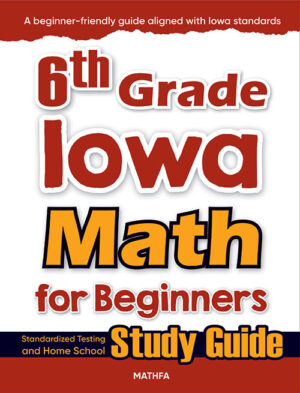 6th Grade Iowa Math for Beginners Original price was: $21.99.$14.99Current price is: $14.99.Download
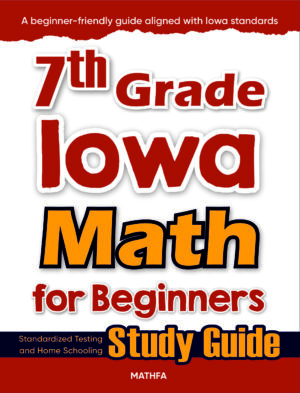 7th Grade Iowa Math for Beginners Original price was: $21.99.$14.99Current price is: $14.99.Download
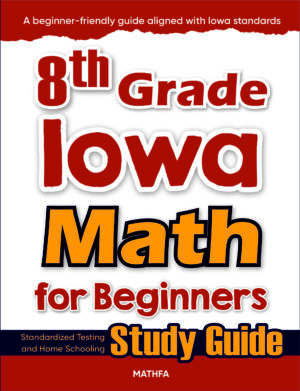 8th Grade Iowa Math for Beginners Original price was: $21.99.$14.99Current price is: $14.99.Download
 STAAR Subject Test Mathematics Grade 8: Student Practice Workbook + Two Full-Length STAAR Math Tests Original price was: $18.99.$12.99Current price is: $12.99.Download
 STAAR Grade 3 Summer Math Workbook: Essential Summer Learning Math Skills plus Two Complete STAAR Math Practice Tests Original price was: $18.99.$12.99Current price is: $12.99.Download
 STAAR Grade 5 Math Practice Book 2020: Extra Exercises and Two Full Length STAAR Math Tests to Ace the Exam Original price was: $18.99.$12.99Current price is: $12.99.Download
 STAAR Math Practice Grade 6: Complete Content Review Plus 2 Full-length STAAR Math Tests Original price was: $18.99.$12.99Current price is: $12.99.Download
 5th Grade STAAR Math Exercise Book: Review of Essential Skills and Concepts With 2 STAAR Math Practice Tests Original price was: $18.99.$12.99Current price is: $12.99.Download
 NSCAS Sequences & Series Practice — Nebraska Guide
 How to Pass the RISE Math Test in Utah
 WFE Rounding and Estimation Practice — Wisconsin Guide
 7 AK STAR Middle School Prep Tips (Alaska)
 How to Ace DAT Math Prep in 8 Weeks
Iowa ISASP Math Prep: A Student’s Roadmap


📖 Reading time: 11 min
Quick answer: Effective ISASP math prep focuses on Iowa’s five core math domains — number sense, algebraic thinking, geometry, measurement, and data analysis — with consistent daily practice problems, targeted review of weak areas, and a structured math study plan built around the test’s grade-level expectations.
Who this is for: Iowa students in grades 3–8 and grade 11 preparing for the ISASP assessment, parents supporting their child’s math review at home, and homeschool families following Iowa’s state math standards.
Did you know that according to the U.S. Department of Education, fewer than one-third of eighth-grade students nationally score at or above the proficient level on standardized math assessments? Iowa students face the same challenge — and the ISASP math test is the state’s primary measure of whether they’re meeting grade-level expectations. If your student is preparing for this assessment, having the right roadmap makes all the difference between walking in unprepared and walking in confident.
Iowa math test preparation doesn’t have to be overwhelming. The ISASP (Iowa Statewide Assessment of Student Progress) tests students on the same math concepts they’ve been building all year — but the format, pacing, and question types can feel unfamiliar without specific practice. That’s exactly where a focused study plan pays off.
In this guide, you’ll learn what the ISASP math test actually measures, how to build a practical Iowa math study plan from scratch, the most effective daily strategies to raise your score, and worked examples that mirror real test problems. Whether you’re starting review two months out or two weeks out, this post gives you a clear, actionable path forward.
What the ISASP Math Test Measures — Iowa Math Test Preparation Starts Here
Understanding the ISASP (Iowa Statewide Assessment of Student Progress)
The ISASP math test measures whether Iowa students have mastered the grade-level math concepts outlined in Iowa’s Core Standards. Administered annually to students in grades 3 through 8 and grade 11, the assessment covers a broad range of math domains and uses both multiple-choice and technology-enhanced question formats to evaluate conceptual understanding, procedural fluency, and mathematical reasoning.
The ISASP (Iowa Statewide Assessment of Student Progress) replaced the earlier Iowa Assessments as the state’s primary summative test. As the Iowa – ISASP Math Assessment page confirms, the test is aligned to Iowa Core Standards and is used to measure student achievement and growth over time. That alignment is critical for your prep — it means every concept on the test is something students were expected to learn during the school year, not something pulled out of thin air.
Understanding the structure of the test is the first step in any smart ISASP math prep plan. You can’t practice effectively if you don’t know what the test is actually asking. The ISASP math section covers five broad content areas, and each grade level emphasizes different domains based on the Iowa Core progression. Knowing which domains carry the most weight at your specific grade level lets you prioritize your study time and avoid wasting hours reviewing topics that rarely appear on the test.
Many students make the mistake of studying math in a general, unfocused way — reviewing everything equally without understanding where the test actually focuses. The ISASP rewards students who have deep, fluent command of grade-appropriate skills, not surface-level familiarity with every math topic ever taught. That distinction matters enormously when you’re deciding where to spend your prep time.
The Five Core Math Domains on the ISASP
The ISASP math test draws from five major content domains that span all tested grade levels. Here’s a breakdown of each domain and what students need to know:
- Number Sense and Operations: This domain covers place value, whole numbers, fractions, decimals, and operations. Students need strong mental math skills and the ability to reason about number relationships. For upper grades, this extends to rational and irrational numbers. Practice fluency drills and fraction conversion problems regularly — these show up across every tested grade level.
- Algebraic Thinking and Expressions: From pattern recognition in grade 3 to solving multi-step equations and working with functions in grades 7, 8, and 11, this domain builds progressively. Students should practice writing and evaluating algebraic expressions, solving one- and two-step equations, and identifying relationships in tables and graphs. In grade 11, algebraic reasoning is the most heavily tested domain.
- Geometry and Spatial Reasoning: This domain includes shapes, angles, area, perimeter, surface area, volume, and coordinate geometry. Students in grades 5 and up encounter problems involving the coordinate plane, and upper-grade students work with transformations and the Pythagorean theorem. Knowing your formulas cold — and understanding when to apply them — is essential.
- Measurement and Data Analysis: Students interpret graphs, tables, and data sets, and apply measurement concepts including unit conversions and estimation. In upper grades, this domain expands to include statistical reasoning, measures of center (mean, median, mode), and probability. Data analysis questions require careful reading — misinterpreting a graph axis is one of the most common sources of lost points.
- Mathematical Reasoning and Problem Solving: This cuts across all other domains and tests a student’s ability to apply multiple concepts to real-world problems. These multi-step problems are often the most challenging items on the test. Students who practice structured problem-solving strategies — identifying what’s given, what’s asked, and which operation applies — perform significantly better on this domain.
Grade-Level Emphasis and What That Means for Prep
The ISASP doesn’t weight every domain equally at every grade. In grades 3 and 4, number sense dominates. By grades 6 through 8, algebraic thinking and rational number operations take center stage. In grade 11, the test leans heavily on algebra, functions, and statistical reasoning. Before diving into math worksheets and practice problems, check your grade-level standards to confirm which domains are highest priority. Spending 60 percent of your prep time on the two or three most-tested domains is far more efficient than spreading your effort equally across all five.
Technology-enhanced question formats are worth practicing specifically. The ISASP includes items where students drag and drop answers, plot points on a coordinate grid, or enter numbers directly rather than selecting from answer choices. If your student has only practiced multiple-choice problems, these formats can be disorienting. Practicing with a variety of question formats builds the flexibility needed to handle whatever the test presents.
Building a Smart Iowa Math Study Plan
How to Structure Your Iowa ISASP Study Guide Timeline
A smart Iowa math study plan works backward from the test date, divides the content into manageable weekly goals, and builds in time for review and practice testing. The students who perform best on the ISASP are almost never the ones who crammed the night before — they’re the ones who followed a consistent, structured plan over several weeks.
Start with a diagnostic step. Before writing out a full schedule, take an ISASP math practice test or a set of grade-aligned practice problems across all five domains. This diagnostic reveals which areas need the most work and lets you build a study plan that’s truly personalized rather than generic. Spending three weeks reviewing geometry when your real weakness is fractions is a costly mistake. The diagnostic tells you exactly where your time will have the highest return.
A six-week study plan is ideal for most students who are starting with a foundational understanding of grade-level math. In weeks one and two, focus on your two weakest domains — work through math worksheets targeting those specific skills, identify the types of mistakes you’re making, and drill the procedures until they feel automatic. In weeks three and four, shift to your middle-strength areas and begin mixing problem types so you’re not just practicing in isolated categories. In weeks five and six, focus on timed ISASP math practice test sessions, review any persistent errors, and build the test-day stamina to work accurately under time pressure.
Students who are starting closer to test day — with two weeks or less — should narrow their focus aggressively. Choose the two or three most heavily weighted domains for your grade level and practice only those. Don’t try to cover everything. A focused two-week sprint on your highest-priority content will do more for your score than scattered review across all topics.
Daily Practice Habits That Build Math Mastery
Math mastery comes from consistency, not intensity. Short daily practice sessions outperform marathon study weekends almost every time. Research consistently shows that spaced repetition — returning to skills across multiple practice sessions separated by time — builds deeper, more durable memory than massed practice in a single sitting. For ISASP math prep, that means 20 to 30 focused minutes of math practice daily is more effective than a three-hour session once a week.
Structure each daily session around three components: a short warm-up on a skill you’ve already learned (to reinforce and maintain fluency), a focused practice block on your current target skill (new or weak), and a brief review of any mistakes made in previous sessions. This three-part structure keeps skills from fading while still building new competency every day. Over six weeks, that daily habit adds up to more than 12 hours of focused, purposeful math practice — which is more than enough to produce meaningful gains.
For students building algebra skills — whether in grade 7, grade 8, or grade 11 — structured practice with step-by-step guided solutions is especially effective. After working through the study plan components above, many students find that Iowa Algebra 1 for Beginners provides exactly the kind of scaffolded, concept-by-concept coverage they need to bridge gaps in algebraic thinking before the ISASP. It’s designed specifically for Iowa learners, which means the content aligns directly with what the state assessment expects.
Don’t neglect number sense warm-ups, even for older students. Strong number sense — the ability to estimate, recognize relationships between numbers, and check whether an answer is reasonable — helps students catch errors on the ISASP before they submit. A student who solves a geometry problem and gets an area of 0.5 square units for a large rectangle should immediately recognize that something went wrong. That kind of intuitive number checking comes from regular mental math practice, not from test-day luck.
📚 More from Math Notion
🎯 Recommended Math Book
Iowa Algebra 1 for Beginners — $16.99
Category: Algebra 1, General, Iowa, Test
Comprehensive Algebra 1 Study Guide & Workbook
Perfect for classroom learning, homeschooling,
or extra practice at home.
7 Proven ISASP Math Prep Strategies You Can Use Today
The most effective ISASP math prep strategies combine content review with deliberate test-taking practice. Here are seven methods that consistently help Iowa students raise their scores — each one is specific, actionable, and built for the realities of this assessment.
- Start with an honest diagnostic assessment. Before writing a single study schedule, work through 20 to 25 grade-level math problems that span all five ISASP domains. Time yourself. Don’t look anything up. When you review your results, categorize every mistake: Was it a concept you never learned? A procedure you forgot? A careless error under time pressure? That categorization tells you exactly what kind of practice you need — conceptual re-teaching, procedural drilling, or simply slowing down and checking your work. A diagnostic is the most honest thing you can do for your ISASP math prep, and most students skip it entirely.
- Practice with Iowa Core-aligned math worksheets by domain. Generic math practice is fine for building general fluency, but ISASP math prep is most efficient when your math worksheets are aligned to the specific Iowa Core Standards for your grade level. This means practicing the exact types of problems, question formats, and mathematical language that appear on the ISASP — not just solving random arithmetic. Look for worksheets that label the standard being practiced (such as 6.NS or 8.EE) so you can directly connect your practice to the content the test will assess.
- Master the formulas before you need them. The ISASP provides a reference sheet for some assessments, but the formulas students know from memory are applied faster, more accurately, and with less cognitive load under test conditions. Build a formula card for your grade level — area formulas, volume formulas, the Pythagorean theorem, the slope formula, properties of exponents — and review it for five minutes every day during your prep period. Don’t just memorize the formula; practice applying it to two or three different problem types so it feels automatic.
- Practice multi-step problems with a written solution structure. Multi-step word problems are among the most point-rich items on the ISASP, and they’re also among the most frequently missed. Students who solve these problems mentally or skip steps lose points even when their final answer is correct. Train yourself to write down every step: what’s given, what’s being asked, which operation or formula applies, the intermediate calculations, and the final answer with units. This habit catches errors before they become wrong answers and earns partial credit on constructed-response items.
- Simulate real test conditions at least twice before test day. Sitting down to a timed ISASP math practice test in a quiet environment — no phone, no breaks, full time limit — trains your brain and body for the actual testing experience. Many students perform significantly worse on test day than in casual review sessions simply because they’ve never practiced under time pressure. Two full timed simulations, spaced about a week apart, build the mental stamina and time-management instincts that make a measurable difference on the real assessment.
- Review every wrong answer with a focus on the why, not the what. After any practice session or timed simulation, don’t just look up the correct answer and move on. For every wrong answer, ask: Why did I get this wrong? Was it a missing concept, a calculation error, a misread problem, or a formula I didn’t know? Then practice three to five more problems of that exact type before moving on. This error-analysis habit turns every mistake into a learning opportunity and steadily eliminates the gaps that cost points on the real ISASP.
- Build a personalized math study plan with weekly milestones. Vague intentions to “study math more” don’t produce results. A written math study plan with specific weekly goals — “this week I will master solving two-step equations and complete 30 practice problems on rational number operations” — creates accountability, tracks progress, and makes it easy to see whether you’re on pace. Post it somewhere visible. Check off each milestone when you complete it. The act of tracking your progress builds momentum and confidence, which are both essential for test-day performance.
Beyond these seven strategies, one mindset shift makes a significant difference: treat every practice session as real preparation, not busywork. Students who engage actively with practice problems — trying hard before checking answers, writing out steps, asking why — learn far more per hour than students who passively read through solutions. Active engagement is what converts practice time into actual score gains.
Parents supporting an Iowa student through ISASP math prep can reinforce these strategies at home by keeping a consistent daily practice schedule, reviewing work together without judgment, and celebrating specific improvements rather than just final scores. When a student who struggled with fractions last month can now solve fraction division problems fluently, that’s a win worth acknowledging — it signals real mathematical growth, not just test score improvement.
Finally, don’t underestimate the value of talking through math problems out loud. Explaining your reasoning — even just to yourself — forces the kind of explicit, organized thinking that the ISASP rewards. Students who can articulate why they chose a particular operation or formula have developed the mathematical reasoning skills that separate proficient performers from advanced ones on Iowa’s state assessment.
Worked Examples: ISASP-Style Math Problems
The best way to prepare for any standardized test is to practice problems that closely mirror what you’ll actually see. The following three examples reflect the types of questions Iowa students encounter on the ISASP math test at middle-school and high-school levels. Work through each one yourself before reading the solution.
Example 1: Solving a Two-Step Equation (Algebraic Thinking — Grades 6–8)
Problem: Solve for x: 3x + 7 = 28
Step 1: Isolate the term with the variable by subtracting 7 from both sides.
3x + 7 − 7 = 28 − 7
3x = 21
Step 2: Divide both sides by 3 to solve for x.
3x ÷ 3 = 21 ÷ 3
x = 7
Step 3: Check your answer by substituting x = 7 back into the original equation.
3(7) + 7 = 21 + 7 = 28 ✓
Answer: x = 7. On the ISASP, always verify your solution — substituting back into the original equation takes less than 10 seconds and catches errors before they cost you points.
Example 2: Finding the Area of a Composite Figure (Geometry — Grades 5–8)
Problem: A figure is made up of a rectangle and a right triangle attached to one end. The rectangle measures 8 cm long and 5 cm wide. The right triangle has a base of 4 cm and a height of 5 cm. What is the total area of the figure?
Step 1: Calculate the area of the rectangle.
Area of rectangle = length × width
= 8 × 5 = 40 square cm
Step 2: Calculate the area of the right triangle.
Area of triangle = ½ × base × height
= ½ × 4 × 5 = ½ × 20 = 10 square cm
Step 3: Add the two areas together.
Total area = 40 + 10 = 50 square cm
Answer: The total area of the composite figure is 50 square centimeters. On ISASP geometry problems, always identify and separate each component shape before calculating — trying to solve a composite figure as a single shape is the most common source of errors on this question type.
Example 3: Interpreting a Data Set Using Mean and Median (Data Analysis — Grades 6–11)
Problem: A student recorded the number of math problems she solved each day for one week: 12, 15, 10, 18, 14, 20, 11. Find the mean and the median. Which measure better represents her typical daily practice?
Step 1: Find the mean (average).
Add all values: 12 + 15 + 10 + 18 + 14 + 20 + 11 = 100
Divide by the number of values (7): 100 ÷ 7 ≈ 14.3 problems per day
Step 2: Find the median (middle value).
Arrange the values in order from least to greatest:
10, 11, 12, 14, 15, 18, 20
The middle value (4th out of 7) is 14.
Step 3: Compare and interpret.
The mean is approximately 14.3 and the median is 14. Both are very close here, meaning either measure accurately represents her typical daily practice. However, if the data set contained an outlier (such as a day with 50 problems), the mean would be skewed upward while the median would remain more stable. ISASP data analysis questions often ask students to identify when the median is a more appropriate measure of center than the mean.
Answer: Mean ≈ 14.3, Median = 14. In this data set, both measures are appropriate, but the median is typically more robust when outliers are present.
Frequently Asked Questions
What does the ISASP math test cover at the high school level?
The ISASP math test for grade 11 focuses primarily on algebraic reasoning, functions, statistical analysis, and geometric proof — the same domains emphasized throughout high school Iowa Core math standards. The grade 11 assessment is more heavily weighted toward algebra and functions than the middle-school versions. Students should prioritize linear and quadratic functions, interpreting statistical data, and applying geometric formulas in multi-step problems. An Iowa ISASP study guide aligned to high school Iowa Core standards is the most efficient tool for focused preparation at this level.
How long should I spend on ISASP math prep each day?
Most students see meaningful improvement with 20 to 30 minutes of focused daily ISASP math practice. Consistency matters far more than session length — daily short sessions outperform occasional long ones because the brain retains information better through spaced repetition. Build your math study plan around a daily practice habit rather than trying to squeeze in all your preparation in a few large sessions close to test day. If time is limited, prioritize your two weakest domains and review errors from every session.
Is the ISASP math test different from the Iowa Assessments?
Yes — the ISASP replaced the Iowa Assessments as the state’s primary summative assessment. While both tests measure Iowa Core math standards, the ISASP uses updated question formats, including technology-enhanced items that require students to interact with digital tools rather than just selecting answer choices. Students preparing for the ISASP should specifically practice with these interactive formats in addition to standard math practice problems. Iowa math test preparation materials published after 2018 are generally aligned to the ISASP format.
Key Takeaways
- The ISASP math test measures mastery of five domains — number sense, algebraic thinking, geometry, measurement, and data analysis — aligned to Iowa Core Standards for grades 3–8 and grade 11.
- Effective ISASP math prep starts with a diagnostic assessment to identify your weakest domains, then builds a structured math study plan with specific weekly goals and daily 20–30 minute practice sessions.
- Students strengthening their algebra skills will find that Iowa Algebra 1 for Beginners provides step-by-step, Iowa-aligned coverage of every major algebraic concept tested on the ISASP.
- Simulating real test conditions at least twice before test day, reviewing every error with an emphasis on understanding why it happened, and practicing multi-step problems with written solution steps are the three habits that consistently separate higher-scoring students from lower-scoring ones.
Your ISASP math score is a reflection of what you practice, not just what you’re capable of. Students who follow a focused Iowa math test preparation plan — identifying weak areas early, practicing daily with grade-aligned problems, and reviewing their mistakes honestly — consistently outperform students who rely on general familiarity with math content. The strategies in this guide give you a concrete starting point. The key is to begin today, not the week before the test.
Ready to take the next step in your ISASP math prep? Explore the full collection of Iowa-aligned math resources at Math Notion’s test prep book library — built specifically for students who want to walk into test day prepared and confident.
Posted by Math Notion Team · Published on June 11, 2026