Math Articles, tips & study guides
 7th Grade Kentucky Math for Beginners Original price was: $21.99.$14.99Current price is: $14.99.Download
 8th Grade Kentucky Math for Beginners Original price was: $21.99.$14.99Current price is: $14.99.Download
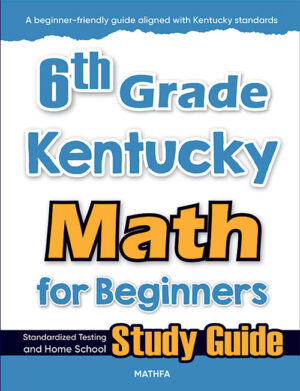 6th Grade Kentucky Math for Beginners Original price was: $21.99.$14.99Current price is: $14.99.Download
 7th Grade Alabama Math for Beginners Original price was: $21.99.$14.99Current price is: $14.99.Download
 6th Grade Alabama Math for Beginners Original price was: $21.99.$14.99Current price is: $14.99.Download
 8th Grade Alabama Math for Beginners Original price was: $21.99.$14.99Current price is: $14.99.Download
 Algebra 1: Student Practice Workbook + Two Full-Length Algebra 1 Exams Original price was: $18.99.$12.99Current price is: $12.99.Download
 KSA 4th Grade Prep: Kentucky Math Guide
 NSCAS Sequences & Series Practice — Nebraska Guide
 How to Pass the RISE Math Test in Utah
 WFE Rounding and Estimation Practice — Wisconsin Guide
 7 AK STAR Middle School Prep Tips (Alaska)
KSA Math Prep: How Kentucky Students Pass the Test


Focused KSA math prep is how Kentucky students walk into the Kentucky Summative Assessment ready to succeed.
📖 Reading time: 11 min
What separates Kentucky students who pass the KSA math section from those who struggle? According to the Kentucky Department of Education, the Kentucky Summative Assessment measures student mastery across critical mathematical domains—and students who prepare strategically consistently outperform those who rely on classroom instruction alone. If you’re feeling anxious about this test, you’re not alone, and you’re in the right place.
KSA math prep isn’t about memorizing formulas or cramming the night before. It’s about building genuine mathematical reasoning skills that carry you through every question type the test throws at you. The good news? With the right approach, consistent practice, and targeted resources, you can walk into test day with real confidence—not the nervous kind, but the kind that comes from knowing you’ve done the work.
In this guide, you’ll learn exactly what’s on the KSA math section, which topics deserve your focused attention, and how to structure your study time for maximum results. You’ll also discover specific practice strategies that Kentucky students use to build math mastery, along with worked examples you can study today. Whether you’re a 6th grader preparing for your first KSA or a parent helping your child get ready, this comprehensive Kentucky math test preparation guide gives you everything you need to succeed.
Understanding the KSA Math Section Structure
What Is the Kentucky Summative Assessment?
The Kentucky Summative Assessment (KSA) is the state’s primary standardized test used to measure student proficiency in mathematics and other core subjects. Kentucky administers this assessment annually to students in grades 3 through 8, with each grade level tested on age-appropriate mathematical concepts aligned to Kentucky Academic Standards. Understanding exactly what you’re facing is the first step toward effective KSA math prep.
The KSA math section evaluates students across multiple mathematical domains, including operations and algebraic thinking, number sense and base-ten operations, fractions, measurement and data, and geometry. For middle school students, the test expands to include ratios and proportional relationships, expressions and equations, statistics and probability, and the number system. Each domain carries significant weight, which means skipping any single area puts your overall score at risk.
Unlike some standardized tests that focus heavily on multiple choice questions, the KSA includes a variety of question types designed to assess deeper mathematical reasoning. You’ll encounter traditional multiple choice items, but also multi-select questions where more than one answer may be correct, constructed response questions requiring written explanations, and technology-enhanced items that ask you to drag and drop, graph points, or complete equations. This variety means your Kentucky math test preparation must go beyond simple answer recognition.
The test is administered on computers in most Kentucky schools, which adds another layer to your preparation. Familiarity with the testing platform, including how to use the built-in calculator (available for certain sections), how to navigate between questions, and how to flag items for review, can reduce test-day anxiety and help you perform at your best. Practice with online math problems whenever possible to build comfort with digital testing environments.
How KSA Math Scores Are Reported
Kentucky reports KSA math scores using four performance levels: Novice, Apprentice, Proficient, and Distinguished. The goal for every student is to reach at least Proficient, which indicates grade-level mastery of mathematical concepts. Students scoring at the Distinguished level demonstrate advanced understanding that exceeds grade-level expectations.
Your score report breaks down performance by domain, giving you valuable insight into specific strengths and areas needing improvement. For example, a student might score Proficient overall but show Apprentice-level performance in geometry specifically. This detailed feedback makes score reports excellent diagnostic tools for targeted review. If you’ve taken the KSA before, reviewing your domain scores can help you focus your current KSA math prep on the areas where you’ll gain the most points.
Parents and teachers receive the same detailed reports, which facilitates collaborative support for student improvement. Many Kentucky schools use KSA results to identify students who need additional math intervention services or who qualify for advanced mathematics coursework. Taking this test seriously—and preparing thoroughly—can open doors to academic opportunities throughout your school career.
Key Skills the KSA Math Section Measures
Beyond content knowledge, the KSA math section assesses critical thinking skills that form the foundation of mathematical reasoning. Here are the core competencies every Kentucky student needs to demonstrate:
- Conceptual understanding: You must show that you understand why mathematical procedures work, not just how to execute them. For instance, knowing that division by a fraction means multiplying by its reciprocal isn’t enough—you should understand why this rule makes mathematical sense. Questions often ask you to explain your reasoning or choose explanations that demonstrate understanding.
- Procedural fluency: While understanding matters, you also need to execute mathematical operations accurately and efficiently. This means knowing your multiplication facts automatically, being able to solve multi-step equations without error, and completing calculations within reasonable time limits. Speed comes from practice, so building math fluency through daily drills is essential.
- Application and problem solving: Real-world math problems require you to identify which operations and strategies apply to given situations. The KSA includes word problems that test your ability to translate everyday scenarios into mathematical expressions and solve them correctly. Strong problem solving skills develop through repeated exposure to varied problem types.
- Mathematical communication: Constructed response questions require you to explain your thinking clearly using mathematical vocabulary. Terms like “equivalent fractions,” “variable,” “expression,” and “equation” should be part of your working vocabulary. Practice writing clear explanations of how you solve problems—this skill often separates Proficient scores from Distinguished ones.
Essential Math Topics for Kentucky Test Preparation
Priority Content Areas by Grade Level
Effective Kentucky math test preparation targets the specific content standards assessed at your grade level. While every grade tests core arithmetic and number sense, the emphasis shifts significantly as students progress through middle school. Knowing exactly which topics carry the most weight helps you allocate study time wisely.
For elementary students in grades 3 through 5, place value understanding forms the foundation for nearly everything else. You must demonstrate fluency with multi-digit addition, subtraction, multiplication, and division. Fraction concepts receive heavy emphasis starting in third grade, progressing from basic understanding of numerators and denominators through operations with fractions and mixed numbers by fifth grade. Geometry at these levels focuses on properties of shapes, area, perimeter, and volume calculations.
Sixth grade marks a significant transition point in KSA math content. According to the U.S. Department of Education, middle school mathematics standards nationwide—including Kentucky’s—shift toward pre-algebraic concepts that prepare students for high school coursework. Sixth graders encounter ratios and proportional relationships, expressions with variables, one-step equations, and statistical concepts including mean, median, mode, and data distribution. If you’re preparing for the 6th grade KSA, these topics deserve focused attention in your study plan.
The transition from arithmetic to algebraic thinking challenges many students, which is why structured practice materials become especially valuable at this stage. For students who want comprehensive coverage of every sixth-grade math concept tested on the KSA, 6th Grade Kentucky Math for Beginners provides step-by-step instruction through each topic area—making it an excellent companion resource for building the math confidence needed on test day.
Fractions, Decimals, and Percents
No single topic causes more student anxiety than fractions, yet this content area appears heavily across every grade level of the KSA math section. Mastering fractions isn’t optional—it’s essential for achieving Proficient status. The good news is that fraction skills respond extremely well to targeted practice, and students who invest time here see significant score improvements.
Start with foundational concepts: understanding what a fraction represents (parts of a whole), identifying equivalent fractions, and comparing fractions with different denominators. Many students can perform fraction operations mechanically but struggle when asked to explain why procedures work or to apply fraction concepts in word problems. Your KSA math prep should include both computational practice and conceptual questions.
The connection between fractions, decimals, and percents represents another critical skill area. You should be able to convert fluently between these three representations—recognizing that 1/4, 0.25, and 25% all represent the same value. KSA questions often present information in one form and ask for answers in another, testing your flexibility with number representations. Practice conversion problems until these translations feel automatic.
Word problems involving fractions test both your computational skills and your reading comprehension. When you encounter a fraction word problem, identify the whole quantity first, determine what fractional part is being discussed, and set up your equation before calculating. Many errors come from misreading problems rather than computational mistakes. Read carefully, underline key information, and verify that your answer makes logical sense in context.
Algebraic Thinking and Expressions
Even elementary KSA math sections include questions that assess early algebraic thinking, such as understanding number patterns, using symbols to represent unknown quantities, and recognizing relationships between numbers. By middle school, algebraic concepts become central to the assessment. Building strong algebraic thinking skills now prevents struggles in high school mathematics courses.
Variables often confuse students who are accustomed to arithmetic where every quantity has a specific value. A variable simply represents a number you don’t know yet—and the goal of solving an equation is to find that number. Practice writing expressions from word problems: if a problem says “five more than a number,” you should immediately recognize this as n + 5 or x + 5. Translating words to mathematical symbols is a testable skill.
One-step and two-step equations appear frequently on middle school KSA math sections. The key to solving equations is maintaining balance—whatever operation you perform on one side must be performed on the other side. Practice solving equations using inverse operations: addition undoes subtraction, multiplication undoes division. Work through many examples until the process becomes automatic, freeing your mental energy for more complex problem solving.
Evaluating expressions for given variable values tests both your algebraic understanding and your computational accuracy. When a problem provides a value for x and asks you to evaluate an expression, substitute carefully and follow order of operations precisely. Parentheses first, then exponents, then multiplication and division from left to right, finally addition and subtraction from left to right. The acronym PEMDAS helps many students remember this sequence.
Proven KSA Math Practice Strategies
Knowing what’s on the test matters, but knowing how to prepare effectively matters even more. These seven strategies represent the most effective approaches Kentucky students use to build math mastery and achieve Proficient or Distinguished scores on the KSA math section. Implement these techniques consistently, and you’ll see measurable improvement in your mathematical reasoning abilities.
- Create a consistent daily practice schedule. Math skills develop through regular practice, not through occasional cramming sessions. Set aside 20-30 minutes daily for focused math work rather than longer sessions once or twice per week. Consistency builds the neural pathways that make mathematical thinking automatic. Use a timer to stay focused, and work in a quiet environment free from phone notifications and other distractions. Even on busy days, ten minutes of practice maintains momentum better than skipping entirely.
- Use a KSA math practice test to identify weak areas. Before diving into general review, take a diagnostic assessment that mirrors actual KSA content and format. Analyze your results carefully—not just which questions you missed, but why you missed them. Did you misread the problem? Make a computational error? Lack knowledge of the underlying concept? Understanding your error patterns allows you to target your study time effectively rather than reviewing material you’ve already mastered.
- Focus practice on your two or three weakest domains. While comprehensive review has value, concentrated practice on weak areas produces the biggest score gains. If your diagnostic shows strong performance in number sense but weakness in geometry, spend 60% of your practice time on geometry concepts. Return to stronger areas periodically to maintain skills, but prioritize the domains where improvement is most needed. This targeted approach maximizes the return on every minute you invest in KSA math prep.
- Work through problems step by step in writing. Mental math has its place, but complex problems require written work. Show every step of your solution process on paper. This habit catches errors that occur between steps, creates a record you can review to understand mistakes, and prepares you for constructed response questions that require showing work. Students who write out solutions consistently outperform those who try to solve problems entirely in their heads.
- Review incorrect answers immediately and completely. When you get a problem wrong, don’t just note the correct answer and move on. Identify exactly where your solution diverged from the correct process. Rework the problem correctly, then find two or three similar problems and solve those to reinforce the correct approach. This immediate correction prevents incorrect methods from becoming habits. Keep an error log to track patterns in your mistakes.
- Practice explaining your mathematical reasoning aloud. Teaching concepts to someone else—even an imaginary student—deepens your own understanding. After solving a problem, explain your solution process as if you were tutoring a classmate. This verbal processing reveals gaps in your understanding that silent work might miss. The KSA rewards students who can articulate mathematical thinking clearly, making this practice directly relevant to test performance.
- Time yourself on practice sets as test day approaches. Early in your preparation, focus on accuracy without time pressure. As the test approaches, introduce timing constraints that simulate actual testing conditions. This builds the mental stamina needed for sustained focus and helps you develop a sense of how long to spend on individual problems. If a problem is taking too long, skip it, mark it for review, and return if time permits—this test-taking strategy prevents one difficult problem from derailing your entire test.
Beyond these strategies, the physical and mental aspects of test preparation matter more than many students realize. Sleep deprivation significantly impairs mathematical reasoning, so prioritize eight or more hours of sleep during the weeks leading up to the test—and especially the night before. Eat a nutritious breakfast on test day that includes protein to sustain energy and focus. Arrive at school with time to spare so you can settle in calmly rather than rushing to your seat already stressed.
Test anxiety affects many students and can cause underperformance despite thorough preparation. If you notice anxiety symptoms—racing heart, difficulty concentrating, blanking on material you know—practice deep breathing techniques during your preparation sessions so they feel natural when you need them. Four slow breaths (in for four counts, hold for four, out for four) can reset your nervous system and restore clear thinking. The more you practice these techniques alongside your math practice, the more automatically they’ll work when needed.
Finally, maintain perspective on what this test represents. The KSA measures where you are right now in your mathematical development—it doesn’t define your potential or determine your future. Students who approach the test with calm confidence, having done their preparation work, consistently perform better than those who view it as a high-stakes judgment of their worth. You’ve prepared, you know the material, and you’re ready to show what you can do.
Worked Examples: KSA Math Problems
The best way to build problem-solving skills is to study worked examples that show exactly how successful students approach KSA-style questions. Review each example carefully, noting not just the answer but the strategic thinking at each step. Then find similar problems to practice on your own.
Example 1: Ratio and Proportional Reasoning
Problem: A recipe calls for 2 cups of flour for every 3 cups of sugar. If Maria uses 9 cups of sugar, how many cups of flour does she need?
Step 1: Identify the given ratio. The recipe establishes a ratio of flour to sugar as 2:3, meaning for every 2 cups of flour, you use 3 cups of sugar.
Step 2: Set up a proportion. Let f represent the unknown cups of flour. The proportion is 2/3 = f/9, because the ratio of flour to sugar must remain constant.
Step 3: Solve using cross multiplication. Cross multiplying gives 3 × f = 2 × 9, which simplifies to 3f = 18.
Step 4: Isolate the variable. Divide both sides by 3: f = 18 ÷ 3 = 6.
Answer: Maria needs 6 cups of flour. You can verify this answer by checking that 6:9 simplifies to 2:3, confirming the ratio is maintained.
Example 2: Evaluating Expressions with Variables
Problem: Evaluate the expression 4x² – 3x + 7 when x = 2.
Step 1: Write out the substitution clearly. Replace every x in the expression with 2: 4(2)² – 3(2) + 7.
Step 2: Apply order of operations—exponents first. Calculate 2² = 4, so the expression becomes 4(4) – 3(2) + 7.
Step 3: Perform multiplication. Calculate 4 × 4 = 16 and 3 × 2 = 6, giving you 16 – 6 + 7.
Step 4: Complete addition and subtraction from left to right. Calculate 16 – 6 = 10, then 10 + 7 = 17.
Answer: When x = 2, the expression 4x² – 3x + 7 equals 17. Common errors include forgetting to square before multiplying by 4, or applying operations out of order.
Example 3: Fraction Word Problem
Problem: Jackson read 3/5 of his book on Monday and 1/4 of the remaining pages on Tuesday. What fraction of the entire book did Jackson read on Tuesday?
Step 1: Determine what fraction of the book remained after Monday. If Jackson read 3/5, then 1 – 3/5 = 5/5 – 3/5 = 2/5 of the book remained.
Step 2: Find 1/4 of the remaining portion. Jackson read 1/4 of the remaining 2/5, so multiply: 1/4 × 2/5 = 2/20.
Step 3: Simplify the fraction. The fraction 2/20 simplifies to 1/10 when you divide both numerator and denominator by 2.
Answer: Jackson read 1/10 of the entire book on Tuesday. The key insight is recognizing that “1/4 of the remaining pages” requires finding a fraction of a fraction through multiplication, not addition.
Frequently Asked Questions
What topics are most important for KSA math prep?
The most critical topics for KSA math prep are number sense, fractions, algebraic expressions, and geometry—with emphasis shifting based on grade level. Elementary students should prioritize place value and fraction operations, while middle schoolers must focus heavily on ratios, proportional reasoning, and solving equations. Review your previous score report if available to identify your personal priority areas, then allocate study time accordingly.
How long should students prepare for the KSA math section?
Most students benefit from four to six weeks of consistent daily practice before taking the KSA math section. Dedicate 20-30 minutes daily rather than longer, infrequent sessions. This timeline allows sufficient practice to reinforce weak areas while avoiding burnout. Students starting with significant skill gaps may need longer preparation periods, while those with strong foundations might achieve readiness in three weeks of focused review.
Can calculators be used on the KSA math test?
Calculator availability on the KSA varies by grade level and section. Some portions of the middle school assessment allow use of an online calculator tool built into the testing platform, while other sections require mental math and paper-pencil computation. During your KSA math practice test sessions, simulate actual testing conditions by only using calculators when they would be available on the real exam. Building strong mental math skills ensures success on no-calculator sections.
Key Takeaways
- The KSA math section assesses multiple domains including number sense, algebraic thinking, fractions, geometry, and statistics—comprehensive Kentucky math test preparation addresses all these areas with emphasis on your weakest domains.
- Consistent daily practice of 20-30 minutes produces better results than occasional long study sessions, building the mathematical fluency and problem-solving skills the test measures.
- Using a KSA math practice test early in your preparation reveals specific weak areas to target, maximizing the effectiveness of your study time.
- Structured resources like 6th Grade Kentucky Math for Beginners provide step-by-step coverage of tested concepts, offering valuable support for students who benefit from organized, comprehensive practice materials.
Success on the KSA math section comes from strategic preparation that targets the specific skills Kentucky Academic Standards assess at your grade level. By understanding the test structure, focusing on high-priority content areas, and implementing proven practice strategies, you build the genuine math confidence that translates into strong performance. Every student has the capacity to improve their mathematical reasoning—what separates those who succeed is the commitment to consistent, focused practice.
Ready to start your KSA math prep journey? Explore the complete collection of Kentucky-aligned math practice resources at Math Notion’s test prep library and find the workbooks, practice tests, and study guides that match your grade level and learning needs.
📚 More from Math Notion
🎯 Recommended Math Book
6th Grade Kentucky Math for Beginners — $14.99
Category: Others
Kentucky Math
KSA Success
Perfect for classroom learning, homeschooling, or extra practice at home.
KSA math prep workbooks for Kentucky
The fastest way to turn this guide into results is steady practice. Our Kentucky math workbooks are built for KSA test prep, with full-length Kentucky KSA math practice, worksheets, and step-by-step answer explanations — ideal for homeschool, classroom, or after-school KSA math test prep.
- 6th Grade Kentucky Math Practice Workbook
- 7th Grade Kentucky Math Practice Workbook
- 8th Grade Kentucky Math Practice Workbook
Browse all Math Notion math practice books →
Official source: For the latest test details and dates, visit the Kentucky Department of Education Summative Assessment page.
Posted by Math Notion Team · Published on April 28, 2026