
Math Articles, tips & study guides
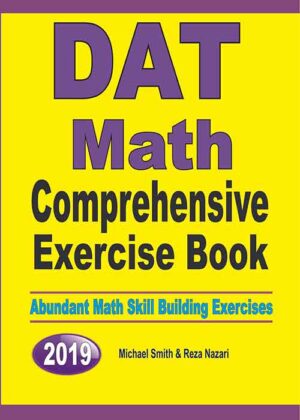 DAT Math Comprehensive Exercise Book Original price was: $18.99.$12.99Current price is: $12.99.Download
 6 Full-Length DAT Math Practice Tests: Extra Test Prep to Help Ace the DAT Math Test Original price was: $18.99.$12.99Current price is: $12.99.Download
 DAT Subject Test Mathematics: Student Practice Workbook + Two Full-Length DAT Math Tests Original price was: $18.99.$12.99Current price is: $12.99.Download
 DAT Math Practice Book 2020: Extra Exercises and Two Full Length DAT Math Tests to Ace the Exam Original price was: $18.99.$12.99Current price is: $12.99.Download
 DAT Math Workbook: Essential Learning Math Skills Plus Two Complete DAT Math Practice Tests Original price was: $18.99.$12.99Current price is: $12.99.Download
 DAT Math Workbook: Exercises, Activities, and Two Full-Length DAT Math Practice Tests Original price was: $18.99.$12.99Current price is: $12.99.Download
 MCAS Subject Test Mathematics Grade 4: Student Practice Workbook + Two Full-Length MCAS Math Tests Paperback – Original price was: $18.99.$12.99Current price is: $12.99.Download
 STAAR Math Workbook: 5th Grade Math Exercises, Activities, and Two Full-Length STAAR Math Practice Tests Original price was: $18.99.$12.99Current price is: $12.99.Download
 ACT Aspire Subject Test Mathematics Grade 8: Student Practice Workbook + Two Full-Length ACT Aspire Math Tests Original price was: $18.99.$12.99Current price is: $12.99.Download
 How to Ace DAT Math Prep in 8 Weeks
 DAT Math Score: What Is a Good Quantitative Reasoning Score?
 Foundational Math Skills: What They Are and Why They Matter
 NSCAS Sequences & Series Practice — Nebraska Guide
 KSA 4th Grade Prep: Kentucky Math Guide
How to Prepare for the DAT Math Test (Quantitative Reasoning)


For aspiring dental students, the Dental Admission Test is a major milestone, and its Quantitative Reasoning section is where a lot of applicants feel the pressure. Learning how to prepare for the DAT math test matters because a strong quantitative score strengthens your overall application to competitive dental programs. The reassuring news is that the math is built around a defined set of skills, mostly algebra, applied problem-solving, and some geometry and statistics, and with focused practice you can raise your score meaningfully. This guide explains what the DAT Quantitative Reasoning section covers, how it works, and exactly how to get ready.
The most reliable way to improve is steady DAT math practice on the specific skills the test measures, paired with timed practice to build speed. Below we’ll walk through the format, the content, scoring, common mistakes, a study plan, and the free worksheets that make your DAT quantitative reasoning preparation easy to start today.
What the DAT Quantitative Reasoning section is
The Dental Admission Test, administered by the American Dental Association, is a multi-part exam covering natural sciences, perceptual ability, reading comprehension, and quantitative reasoning. The Quantitative Reasoning section, the math portion, measures your ability to solve mathematical problems and apply math to practical, word-problem situations within a tight time limit.
For applicants, the key point is that this section tests foundational, college-level math rather than advanced calculus. That’s encouraging, because it means the content is finite and learnable. A strong quantitative score signals to dental schools that you have the numerical reasoning skills the profession depends on, which makes preparation a worthwhile investment in your application.
How the section works
The Quantitative Reasoning section gives you a set number of questions within a fixed time, so pacing is a central part of the challenge. A basic on-screen calculator is provided, which helps with computation, but you still need to know how to set up each problem and which method to use. Speed and accuracy together are what the section rewards.
Because the section is tightly timed, practicing under realistic timed conditions is essential, you want to build the ability to move efficiently without sacrificing accuracy. Knowing the format in advance, a fixed number of questions, a strict clock, and a basic calculator, lets you plan your pacing and focus your energy on solving problems rather than adjusting to the format on test day.
What’s on the DAT math test
The Quantitative Reasoning content falls into two broad areas. Mathematical problems cover algebra, equations, inequalities, exponents, and functions; numerical calculations and conversions; probability and statistics; and geometry and trigonometry. Applied mathematics covers word problems that ask you to translate a real-world situation into a calculation, the kind of practical reasoning dentistry requires.
None of it is beyond a well-prepared college student, but the breadth means balanced practice across all these areas pays off. You want to be solid on algebra and applied word problems especially, since these make up a large share of the section. A complete set of practice materials covers every area in a logical order so no topic catches you off guard.
How the DAT is scored
DAT scores, including Quantitative Reasoning, are reported on a standardized scale that typically runs from 1 to 30, with the score reflecting your performance relative to other test-takers. Dental schools look at your scores as part of a holistic application, and competitive programs favor higher numbers, so your goal is to score as well as you can rather than merely clearing a minimum.
Because scoring is comparative and the stakes are high, thorough preparation is well worth the effort. It also helps to know the DAT can be retaken after a waiting period if needed, though there are limits, so it pays to prepare seriously and aim for your best result rather than counting on multiple attempts to get there.
Why targeted practice beats scattered studying
Many applicants prepare by reviewing notes or working random problems, and the results are uneven. Targeted practice solves this by focusing your effort on exactly the skills the section tests, in a logical order, so you won’t waste time on irrelevant material or hit a wall because a problem assumed knowledge you skipped. Structure makes your limited study time far more productive.
That structure is especially valuable when you’re balancing DAT prep with demanding coursework. Work a focused set of problems, check your solutions, and review every miss to understand the method. Steady, organized DAT math practice rather than scattered cramming is what produces reliable score gains, and it keeps preparation manageable alongside everything else on your plate.
Build speed for the timed section
Because the Quantitative Reasoning section is tightly timed, building speed is essential, but speed should never come at the cost of accuracy. The right way to get faster is through repetition: the more you practice a given problem type, the more automatic it becomes, and speed follows naturally. Drilling algebra moves, conversions, and common word-problem setups until they’re second nature directly improves your pace.
Practice timed sets so you learn to manage the clock without panicking, and develop the discipline to mark a tough question and move on rather than burning minutes on it. When time is short, answering every question you can, and making educated guesses on the rest, protects your score. Building these habits in practice makes them automatic on test day.
Free DAT math worksheets to practice with
A great way to start building these skills is with focused practice problems. Math Notion offers free, printable DAT math worksheets covering the algebra, applied problems, and quantitative reasoning the section tests, so you can rehearse exactly the right material at your own pace.
Browse the full library on our math worksheets page for additional practice. Work each worksheet carefully, then review every problem, especially the misses, to understand why an answer was wrong. This focused, repeatable practice on the exact content the DAT tests is one of the most efficient ways to lift your Quantitative Reasoning score.
Common mistakes and how to avoid them
DAT test-takers tend to lose points in predictable ways. The biggest is poor time management, spending too long on hard questions and running out of time for easier ones. Another is weak fundamentals, shaky algebra or conversions, that slow you down and cause errors under pressure. A third is relying on the calculator for thinking rather than just computation.
By practicing the exact question styles under timed conditions and reviewing every miss, you train yourself out of these habits before they cost you. Thorough preparation turns vague weaknesses into specific, fixable skills, and building speed through repetition ensures you can actually finish. Preparation is what separates a strong quantitative score from a disappointing one.
A simple study plan
Start by taking a diagnostic set to see where you stand and which topics need work. In the first week or two, shore up algebra fundamentals and the conversions and numerical skills the section rewards, since these underpin everything and offer quick gains. Work problems with and without the calculator so you’re comfortable either way.
Over the following weeks, move systematically through functions, geometry, trigonometry, probability, statistics, and applied word problems, spending extra time on weak areas. Reserve time near the end for full, timed practice sections and a careful review of every miss. Short, regular sessions beat cramming, because skills consolidate with steady, spaced repetition.
Managing test-day pressure
With so much riding on the DAT, nerves are natural, but thorough, familiar preparation is the most reliable antidote. When the question types and timing feel routine from practice, there are far fewer surprises to trigger anxiety, and confidence grows out of competence rather than wishful thinking. The work you put in beforehand is what steadies you on the day.
On test day, get good rest beforehand, pace yourself, and start by quickly handling the questions you find easiest to build momentum. Remember the scoring is comparative, so every correct answer helps your standing. Trust your preparation, work steadily, and let your practiced skills carry you through the section.
Keep your fundamentals sharp
Because the DAT Quantitative Reasoning section rests on foundational math, the fastest gains often come from making sure your fundamentals are rock solid. Fluency with algebra, fractions, percentages, and unit conversions speeds up nearly every problem and prevents the small errors that quietly lower scores. Time spent solidifying these basics pays off across the whole section.
From there, layer in the applied word problems that make up so much of the section, practicing the skill of translating a situation into the right calculation. This combination, strong fundamentals plus practiced applied reasoning, is exactly what the DAT measures, and steady practice on both is the surest route to the quantitative score your dental-school goals require.
Make every practice session count
The applicants who improve most treat each practice problem as a learning opportunity rather than just a test of what they already know. Work each problem carefully, check the worked solution, and when you miss one, figure out exactly why before moving on. This habit of deliberate review turns scattered practice into steady, measurable improvement, because every mistake becomes a specific skill to strengthen rather than a vague worry.
Pair that careful review with timed practice as the test approaches, so you build both accuracy and speed together. Steady, focused DAT math practice, a little each day with honest review, builds the fluency the timed Quantitative Reasoning section demands far better than last-minute cramming. Because the worksheets and problems target exactly the content the DAT tests, every minute of practice is directly relevant to the score you need.
Why the quantitative section is worth your focus
It can be tempting to pour all your energy into the science sections and treat the math as an afterthought, but that’s a missed opportunity. Because the Quantitative Reasoning section rests on finite, learnable skills, it’s often one of the most improvable parts of the DAT, meaning focused practice here can yield a meaningful score bump for relatively predictable effort. For many applicants, strengthening the math is the fastest way to lift an overall application. Treating the quantitative section as a genuine priority, with steady practice on its specific content, is a smart, high-return strategy on the path to dental school.
Frequently asked questions
Can I use a calculator on the DAT math test?
Yes, a basic on-screen calculator is provided for the Quantitative Reasoning section. You still need to know how to set up each problem and which method to use.
What math is on the DAT?
The Quantitative Reasoning section covers algebra, numerical calculations and conversions, probability and statistics, geometry and trigonometry, and applied word problems.
What is a good DAT quantitative score?
Scores are reported on a standardized scale (about 1 to 30) relative to other test-takers, so aim as high as you can; competitive dental programs favor higher scores.
Where can I find DAT math practice?
Math Notion offers free printable DAT math worksheets covering the algebra and applied reasoning the section tests, available on our worksheets page.
Math Notion makes standards-aligned math workbooks and test prep for learners at every level and across all 50 states. See the full collection.
Posted by Math Notion Team · Published on October 13, 2021