
Math Articles, tips & study guides
 PERT Math Practice Book: Complete Content Review Plus 2 Full-length PERT Math Tests Original price was: $18.99.$12.99Current price is: $12.99.Download
 PERT Math Workbook: Practice Questions for the Florida Postsecondary Education Readiness Test With 2 Full-Length PERT Math Exams Original price was: $18.99.$12.99Current price is: $12.99.Download
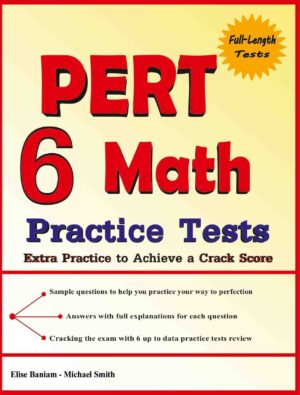 6 PERT Math Practice Tests: Extra Practice to Achieve a Crack Score Original price was: $18.99.$12.99Current price is: $12.99.Download
 PERT Math Workbook: The Most Effective Exercises and Review PERT Math Questions Original price was: $18.99.$12.99Current price is: $12.99.Download
 PERT Math Exercise Book: Review of Essential Skills and Concepts With 2 PERT Math Practice Tests Original price was: $18.99.$12.99Current price is: $12.99.Download
 ACT Summer Math Workbook: Essential Summer Learning Math Skills plus Two Complete ACT Math Practice Tests Original price was: $18.99.$12.99Current price is: $12.99.Download
 SAT Math Practice Book 2020: Extra Exercises and Two Full Length SAT Math Tests to Ace the Exam Original price was: $18.99.$12.99Current price is: $12.99.Download
 5 PERT Math Prep Secrets Nobody Tells You
 What Is on the PERT Math Test? Topics and How to Prepare
 PERT Math Formulas You Need to Know
 Your PSAT Math Prep Roadmap: Tips That Work
 GED Math Prep: 7 Facts That Help You Pass First Try
How to Prepare for the PERT Math Test (Florida Placement)

If you’re heading to a Florida college, the PERT is often the test that decides which math class you’ll start in, and that makes it more important than many students realize. Learning how to prepare for the PERT math test can be the difference between placing straight into college-level math and spending a semester (and tuition) on a developmental course first. The reassuring news is that the PERT covers a defined set of skills, and with focused practice you can place higher than you might expect. This guide explains what the PERT is, what its math section covers, how placement works, and exactly how to get ready.
The single most reliable way to raise your placement is consistent PERT math practice with a resource built for this exact test. Below we’ll walk through the format, the content, common mistakes, a realistic study plan, and the workbook that ties your PERT math prep together so you can study confidently on your own schedule.
What the PERT is and why it matters
PERT stands for the Postsecondary Education Readiness Test, and it’s Florida’s common placement test for students entering the Florida College System. Rather than testing for a pass-or-fail grade, the PERT measures whether you’re ready for college-level coursework in math, reading, and writing, and uses your results to place you into the appropriate course.
For math specifically, your PERT score determines whether you start in college-level math like College Algebra or whether you’re routed into a developmental or preparatory course first. That placement has real consequences: developmental courses cost time and money and don’t always count toward your degree, so a strong PERT math score can literally save you a semester. That’s why preparation is so worthwhile.
How the PERT math section works
The PERT is computer-adaptive, meaning the difficulty adjusts to your answers as you go. The math section contains roughly thirty questions and is untimed, so you can work at your own pace, a real advantage if you read carefully and check your work. There’s no penalty for taking your time, and rushing is one of the most common ways students underperform.
Because the test is adaptive, you’ll see questions that climb in difficulty as you answer correctly, which is how it pinpoints your placement level. Knowing the format ahead of time removes surprises, and since the test is untimed, you can focus entirely on getting each question right rather than racing the clock. Practicing in this same patient, careful style pays off directly.
What’s on the PERT math test
The PERT math content centers on algebra, the gateway skill for college math. You’ll encounter linear equations and inequalities, including solving and graphing them, along with operations on algebraic expressions and polynomials. Factoring, working with exponents, and simplifying expressions all show up, as do literal equations where you solve for one variable in terms of others.
Beyond core algebra, the test includes coordinate-plane work, evaluating and manipulating expressions, and applied word problems that ask you to translate a situation into an equation. None of it is calculus or advanced trigonometry; it’s the foundational algebra that college-level courses assume. A complete workbook covers all of these areas in a logical order, so you’re never blindsided by a topic that quietly assumed an earlier skill.
How PERT placement works
Your PERT math score falls into ranges that Florida institutions map to specific course placements. A higher score places you into college-level math, while lower scores route you into developmental or preparatory courses designed to build readiness first. Many programs and majors require you to reach college-level math, so your target should be the score that clears that bar at your school.
It’s worth checking your specific college’s placement chart, since cutoffs can vary slightly, and asking whether they accept other scores (like the SAT or ACT) for placement too. But for most students, doing well on the PERT is the most direct route, and that means aiming comfortably above the minimum so a single tricky question doesn’t drop you below the line.
Why a dedicated workbook beats scattered studying
Many students prepare by grabbing random algebra worksheets or watching scattered videos, and the results are uneven. A well-built workbook solves this by laying out the material so each concept builds on the one before, which means you won’t hit a wall because a question assumed knowledge you skipped. It also answers the daily question of what to study next with a clear path from start to finish.
That structure is invaluable when you’re balancing the PERT with work, family, or a busy class schedule. Open the book, work the next lesson, check your answers against worked explanations, and move on. The plan is already there, which keeps your PERT math practice steady and efficient rather than scattered and stressful.
Clear lessons and step-by-step explanations
A common worry is whether you can rebuild your algebra without a tutor, especially if it’s been a while since your last math class. The right workbook is built for exactly that, with plain-language lessons that explain each concept before the practice begins and step-by-step answer explanations that show not just the correct answer but the method behind it.
This matters because an answer key with only final answers tells you nothing about where you went wrong. Worked-out solutions let you pinpoint your mistake, understand the proper approach, and close the gap, which is how real improvement happens. For someone studying alone, that built-in guidance works like a patient tutor available whenever you sit down.
Common mistakes and how to avoid them
PERT test-takers tend to lose placement points in predictable ways. The biggest is rushing, even though the test is untimed; careless sign errors and misread questions cost easy points that careful work would have caught. Another is weak algebra fundamentals, shaky factoring or fraction skills, that quietly undermine the harder problems built on them.
A third pitfall is skipping preparation entirely because the PERT isn’t a pass-fail exam, only to land in a developmental course that costs a semester. Treating the PERT seriously and practicing the exact skills it tests avoids all three traps. Thorough PERT math prep turns vague algebra weaknesses into specific, fixable skills before they affect your placement.
A simple four-week study plan
Because the PERT is algebra-focused, a few focused weeks can make a real difference. In week one, take a diagnostic practice set to find your weak areas, then review the basics of expressions, integers, and fractions. In week two, work through linear equations and inequalities, solving and graphing them until the steps feel automatic.
In week three, tackle polynomials, factoring, exponents, and literal equations, the areas that trip up the most students. Reserve week four for mixed practice and a full practice section under realistic, careful conditions, followed by a thorough review of every miss. Short daily sessions throughout beat cramming, because algebra skills consolidate with steady, spaced repetition.
The workbook that pulls your prep together
The most reliable way to prepare is a workbook built specifically for the PERT. The PERT Math Practice Workbook covers exactly the algebra, equations, polynomials, and coordinate-plane skills the test uses to place you, with clear lessons, ample practice, and step-by-step answer explanations you can follow on your own. It’s an instant download, so you can start tonight and aim for college-level placement from the first try. Browse all our math practice books → to find the right fit.
Take advantage of the untimed format
One of the PERT’s most useful features is that the math section isn’t timed, and smart students lean into this. Because there’s no clock, you can afford to read each question twice, write out your steps, and sanity-check your answer before moving on. The students who struggle are often the ones who rush anyway out of nervous habit, throwing away the very advantage the format hands them.
Practice in the same deliberate style you’ll use on test day. When you do PERT math practice at home, slow down, show your work, and double-check, so that careful pacing becomes automatic. Building this habit now means that when you sit the real PERT, working methodically will feel natural, and you’ll catch the small errors that otherwise quietly lower a placement score.
Brush up on algebra fundamentals first
Because the PERT is so heavily algebra-based, the fastest gains usually come from shoring up the fundamentals that everything else rests on. Make sure you’re solid with integer operations, fractions, and order of operations before tackling equations, because a shaky foundation there shows up as repeated errors in the harder problems. Many students discover that fixing these basics lifts their performance across the whole test.
From there, focus on the core algebra moves the PERT loves: solving linear equations and inequalities, factoring, working with exponents and polynomials, and rearranging literal equations. These are finite, learnable skills, and steady PERT math prep on exactly these topics is the most efficient route to a college-level placement. A workbook organized around them keeps your effort pointed at what actually matters.
What placing into college-level math saves you
It’s worth keeping the stakes in mind, because they make preparation feel worthwhile. Placing into a developmental or preparatory math course can add a semester of study and tuition that often doesn’t count toward your degree, delaying your progress and adding cost. Placing directly into college-level math avoids that detour entirely and gets you moving toward graduation sooner.
Viewed that way, a few weeks of focused PERT preparation is one of the highest-return investments you can make before college. The effort you put in now, learning the algebra the test measures and practicing it until it’s automatic, can pay off in saved time, saved money, and a faster path through your program. That’s a strong reason to take the PERT seriously rather than walking in cold.
Frequently asked questions
Is the PERT math test timed?
No, the math section is untimed, so you can work carefully. Use that to your advantage by reading each question closely and checking your work rather than rushing.
Can I use a calculator on the PERT?
The PERT does not allow an outside calculator; some questions may provide an on-screen tool. Practicing the algebra by hand so you’re confident without one is the safest preparation.
What score do I need on the PERT math test?
It depends on your college’s placement chart, but you’ll want to reach the range for college-level math. Aim comfortably above the minimum to be safe.
How long should I study for the PERT?
A focused few weeks is realistic for most students, especially if you target your weakest algebra topics first and practice the exact skills the test covers.
Math Notion makes standards-aligned math workbooks and test prep for learners at every level and across all 50 states. See the full collection.
Posted by Math Notion Team · Published on October 11, 2021