
Math Articles, tips & study guides
 6 Full-Length DAT Math Practice Tests: Extra Test Prep to Help Ace the DAT Math Test Original price was: $18.99.$12.99Current price is: $12.99.Download
 DAT Subject Test Mathematics: Student Practice Workbook + Two Full-Length DAT Math Tests Original price was: $18.99.$12.99Current price is: $12.99.Download
 DAT Math Workbook: Essential Learning Math Skills Plus Two Complete DAT Math Practice Tests Original price was: $18.99.$12.99Current price is: $12.99.Download
 DAT Math Practice Book 2020: Extra Exercises and Two Full Length DAT Math Tests to Ace the Exam Original price was: $18.99.$12.99Current price is: $12.99.Download
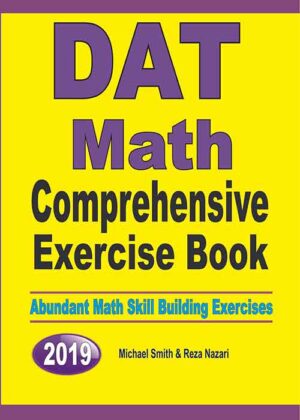 DAT Math Comprehensive Exercise Book Original price was: $18.99.$12.99Current price is: $12.99.Download
 DAT Math Workbook: Exercises, Activities, and Two Full-Length DAT Math Practice Tests Original price was: $18.99.$12.99Current price is: $12.99.Download
 6th Grade New Jersey Math for Beginners Original price was: $21.99.$14.99Current price is: $14.99.Download
 PSSA Grade 8 Math Practice Book 2020: Extra Exercises and Two Full Length PSSA Math Tests to Ace the Exam Original price was: $18.99.$12.99Current price is: $12.99.Download
 7th Grade Mississippi Math for Beginners Original price was: $21.99.$14.99Current price is: $14.99.Download
 How to Ace DAT Math Prep in 8 Weeks
 Foundational Math Skills: What They Are and Why They Matter
 How to Prepare for the DAT Math Test (Quantitative Reasoning)
 CMAS Scatter Plots Practice — Colorado Guide
 NSCAS Sequences & Series Practice — Nebraska Guide
DAT Math Score: What Is a Good Quantitative Reasoning Score?


For dental school applicants, the Quantitative Reasoning section of the DAT produces a number that can weigh on your mind: your math score. Understanding the DAT math score, how it’s calculated, what counts as competitive, and how dental schools use it, helps you set the right target and prepare strategically. This guide explains the DAT quantitative scoring system in plain language, so you know exactly what you’re aiming for and how to get there.
The DAT’s Quantitative Reasoning section tests algebra, applied problem-solving, and related math, and your performance is reported on a standardized scale that admissions committees read alongside the rest of your application. Below we’ll break down how the scoring works, what a good score looks like, how schools weigh it, and how targeted DAT math practice raises your DAT quantitative reasoning score.
How DAT scoring works
The DAT reports scores on a standardized scale that runs from 1 to 30 for each section, including Quantitative Reasoning. These are scaled scores, not raw counts or percentages, designed so they can be compared across different versions of the test. Your scaled score reflects your performance relative to a calibrated standard.
Crucially, the DAT scale is built so that a score around the middle of the range represents roughly average performance among test-takers, who are themselves a competitive, science-focused group. Understanding that these are scaled, comparable scores, not percentages, is the first step to interpreting your Quantitative Reasoning result correctly and setting a realistic target.
What the average DAT math score is
On the 1-to-30 scale, the average DAT score in each section tends to fall in the upper teens, around 17 or 18, with that midpoint representing typical performance among the pool of dental school applicants. Because applicants are already a strong, motivated group, an average score still reflects solid ability.
Knowing the average gives you a reference point: a Quantitative Reasoning score at or above the high teens is respectable, while scores in the low twenties and above are increasingly competitive. But averages are just context, what matters most is how your score compares to the expectations of the specific dental schools you’re targeting.
What counts as a good DAT math score
A good DAT math score depends on your goals, but generally a Quantitative Reasoning score in the high teens is solid, the low twenties is strong, and the mid-twenties and above is excellent and competitive at selective programs. Many successful applicants aim for scores around 19 to 21 or higher across sections.
The best approach is to research the average DAT scores of admitted students at the dental schools you’re interested in and aim for or above that range. This gives you a concrete, motivating target tailored to your goals, rather than chasing an arbitrary number. Aiming comfortably within your target schools’ range strengthens your application.
How dental schools use your math score
Dental schools consider the DAT as part of a holistic application that also includes your GPA, science coursework, experiences, and personal qualities. The Quantitative Reasoning score is one piece, but math ability matters for dental coursework and signals quantitative readiness, so a strong score helps your overall profile.
Schools often look at your Academic Average and your individual section scores, including Quantitative Reasoning, so a weak math score can stand out even if other sections are strong. This is why it’s worth ensuring your QR score is at least solid, even if science is your strength, balanced scores present the strongest application.
Why the quantitative section is improvable
Here’s encouraging news: the Quantitative Reasoning section is often one of the most improvable parts of the DAT. Because it tests a finite, learnable set of math skills, algebra, applied problems, conversions, and basic geometry and statistics, focused practice can raise your score in a relatively predictable way, more so than sections requiring broad knowledge.
This means that if your math score is lower than you’d like, targeted practice can lift it meaningfully. For many applicants, strengthening Quantitative Reasoning is the most efficient way to raise their overall DAT profile. Treating the math section as a genuine, improvable priority is a smart, high-return strategy.
What the quantitative section covers
The Quantitative Reasoning section tests mathematical problems, algebra, equations, exponents, functions, numerical calculations and conversions, probability and statistics, and geometry and trigonometry, plus applied word problems that ask you to translate real situations into calculations. A basic on-screen calculator is provided.
None of it goes beyond foundational, college-level math, so it’s all learnable with practice. Because the section spans these connected areas, balanced practice across all of them, with extra attention to algebra and applied problems, which make up a large share, is the most effective way to raise your score.
How to raise your DAT math score
Raising your Quantitative Reasoning score comes down to targeted, timed practice. Drill the specific skills the section tests, work plenty of practice problems, and review every mistake to understand the method. Because the section is timed, also practice building speed without sacrificing accuracy, since pacing affects many applicants’ scores.
Focus your early effort on shoring up algebra fundamentals and applied problem-solving, the highest-value areas, then round out the rest. This focused, practice-heavy approach reliably lifts scores, because the DAT rewards familiarity with its question types and the efficient application of foundational math under time pressure.
Practice with DAT math worksheets
Focused practice is the engine of score improvement. Math Notion offers free, printable DAT math worksheets covering the algebra, applied problems, and quantitative reasoning the section tests, so you can rehearse exactly the right content at your own pace and build toward your target score.
Browse the full library on our math worksheets page for more practice. Work each worksheet carefully, then review every problem, especially the misses, to understand why an answer was wrong. This targeted, repeatable practice on the exact content the DAT measures is one of the most efficient ways to lift your Quantitative Reasoning score.
Build speed for the timed section
Because Quantitative Reasoning is timed, pacing affects your score as much as knowledge. The way to build speed is repetition: the more you practice a problem type, the more automatic it becomes, and speed follows naturally. Drill algebra moves, conversions, and common word-problem setups until they’re second nature.
Practice timed sets so you learn to manage the clock without panic, and develop the discipline to mark a tough question and move on rather than burning minutes. Answering everything you can and making educated guesses on the rest protects your score. Building these habits in practice makes them automatic on test day, which directly supports a higher score.
Can you retake the DAT?
If your math score comes in lower than your target, the DAT can be retaken after a waiting period, though there are limits on the number of attempts. This means a disappointing score isn’t necessarily final, but it also means it’s wise to prepare thoroughly and aim for your best result rather than counting on multiple tries.
If you do retake, use your previous score to target exactly the areas that held you back, which makes the retake far more productive than a blind second attempt. Many applicants raise their Quantitative Reasoning score on a retake after focused practice, so a low first score can become a strong final one with the right preparation.
Keep the score in perspective
While your DAT math score matters, remember it’s one part of a holistic application. A strong Quantitative Reasoning score helps, but admissions committees weigh many factors. The goal is to present a balanced, competitive profile, which usually means ensuring no single section, including math, drags down your overall picture.
So aim for a solid, competitive QR score that complements the rest of your application, rather than obsessing over a perfect number. Thorough, targeted preparation gets you to a score that strengthens your candidacy, and that, combined with your GPA, experiences, and other sections, is what builds a compelling application to dental school.
Practice resources for a higher score
For thorough preparation, pair the free DAT worksheets with structured practice on the underlying math. Math Notion’s math resources build the algebra, problem-solving, and quantitative skills the Quantitative Reasoning section rewards, with clear explanations and step-by-step solutions that turn practice into real score gains.
Because the materials target exactly the content the DAT tests, every minute of practice is relevant to your score. Browse the full Math Notion collection → to find resources that build the quantitative skills your dental-school goals require, and start working toward your target DAT math score today.
Balancing the math score with the rest of the DAT
One strategic point worth keeping in mind is balance across the DAT’s sections. Because dental schools often look at your Academic Average alongside individual scores, a single weak section can pull down your profile even if others are strong. For applicants whose strengths lie in the sciences, this means the Quantitative Reasoning score deserves deliberate attention so it doesn’t become the outlier.
The encouraging flip side is that, because math is so improvable, bringing a lagging Quantitative Reasoning score up to match your other sections is often very achievable with focused practice. Investing time here can lift your Academic Average and present a more even, competitive picture, which is exactly what admissions committees like to see. A balanced set of scores, with no obvious weak spot, frequently strengthens an application more than an exceptionally high score in one area paired with a low one in another.
In the end, your DAT math score is both important and improvable. Set a target based on your dream schools, prepare with focused, timed practice on the exact skills the Quantitative Reasoning section tests, and aim for a score that strengthens, rather than weakens, your overall application. With steady effort, a competitive math score is well within reach.
Frequently asked questions
How is the DAT math score calculated?
The Quantitative Reasoning section is reported on a standardized scale from 1 to 30, a scaled score designed to be comparable across test versions, not a raw count or percentage.
What is a good DAT math score?
The average is around the high teens; a score in the low twenties is strong, and the mid-twenties or above is excellent. Aim for or above the average of your target dental schools.
How do dental schools use the math score?
As part of a holistic review alongside GPA, science scores, and experiences. A solid Quantitative Reasoning score strengthens your profile, while a weak one can stand out, so balanced scores help.
Can I improve my DAT math score?
Yes. Because the section tests finite, learnable skills, targeted, timed practice can raise it meaningfully, and the DAT can be retaken if needed. Free DAT worksheets and structured practice both help.
Math Notion makes standards-aligned math workbooks and test prep for learners at every level and across all 50 states. See the full collection.
Posted by Math Notion Team · Published on October 3, 2024