Math Articles, tips & study guides
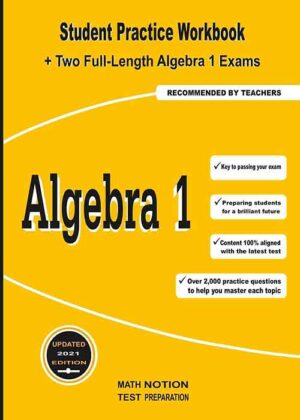 Algebra 1: Student Practice Workbook + Two Full-Length Algebra 1 Exams Original price was: $18.99.$12.99Current price is: $12.99.Download
 6 Full-Length GED Math Practice Tests: Extra Test Prep to Help Ace the GED Math Test Original price was: $18.99.$12.99Current price is: $12.99.Download
 6 Full-Length PSSA Grade 4 Math Practice Tests: Extra Test Prep to Help Ace the PSSA Grade 4 Math Test Original price was: $18.99.$12.99Current price is: $12.99.Download
 Algebra 2: Student Practice Workbook + Two Full-Length Algebra 2 Exams Original price was: $18.99.$12.99Current price is: $12.99.Download
 Algebra 2 Workbook: Essential Learning Math Skills Plus Two Algebra 2 Practice Tests Original price was: $18.99.$12.99Current price is: $12.99.Download
 SSAT Upper Level Math Workbook: Exercises, Activities, and Two Full-Length SSAT Upper Level Math Practice Tests Original price was: $18.99.$12.99Current price is: $12.99.Download
 6 GED Math Practice Tests: Extra Practice to Achieve a Crack Score Original price was: $18.99.$12.99Current price is: $12.99.Download
 6 Full-length Georgia Milestones Assessment System Grade 6 Math Practice Tests: Extra Test Prep to Help Ace the GMAS Grade 6 Math Test Original price was: $18.99.$12.99Current price is: $12.99.Download
 SDCA Math Prep: South Dakota Student Guide
 WVGSA Math Prep: West Virginia Student Guide
 7 MCAs Math Prep Tips for Minnesota Students
 STAAR Math Test Prep for Grades 6-8: A Parent’s Guide (2026)
 7 Proven Accuplacer Math Prep Strategies
A Mathematical Approach to Essay Writing


It might sound surprising, but the logical, structured thinking developed through mathematics can make you a far better writer. A mathematical approach to essay writing means applying the same skills that solve equations, clear structure, logical sequencing, precision, and evidence, to constructing arguments and organizing ideas. Students who study math often have analytical strengths they can bring directly to writing, and anyone can learn to write more clearly by thinking a bit more like a mathematician. This guide explores how mathematical thinking improves essay writing and how to put it into practice.
The connection runs deeper than it first appears: good math and good writing both depend on logic, structure, and clarity. Below we’ll explore how the habits of mathematical thinking, building arguments step by step, supporting claims with evidence, and organizing ideas logically, translate into stronger essays, and how building analytical skills benefits writing as much as math.
Why math and writing are connected
At first glance, math and essay writing seem like opposites, one numerical, the other verbal. But both are fundamentally about clear, logical communication of ideas. A math proof builds from premises to a conclusion through valid steps; a good essay builds from a thesis through supporting points to a conclusion. The underlying logic is remarkably similar.
This is why students strong in mathematical reasoning often have untapped potential as writers, and why approaching writing with a mathematician’s eye for logic and structure can transform muddled essays into clear, compelling ones. Recognizing the shared foundation of logic and structure is the first step to bringing mathematical thinking to your writing.
Structure your essay like a proof
A mathematical proof has a clear structure: a statement to prove, a logical sequence of steps, and a conclusion that follows. An essay benefits from the same architecture: a clear thesis (what you’re arguing), body paragraphs that build the case step by step, and a conclusion that follows from what came before. Thinking of your essay as an argument to prove brings welcome rigor.
Just as a proof’s steps must connect logically, an essay’s paragraphs should follow a deliberate order, each building on the last toward the conclusion. Approaching essay structure with this proof-like discipline, where every part serves the overall argument, produces writing that’s organized, coherent, and persuasive rather than rambling.
Start with a clear thesis
In math, you know exactly what you’re trying to prove before you begin. Bringing this to writing means starting with a clear, specific thesis, the central claim your essay will support. A vague thesis leads to a vague essay, just as an unclear goal leads to a meandering proof. Defining precisely what you’re arguing focuses everything that follows.
A strong thesis acts like the statement of a theorem: it tells the reader exactly what you intend to demonstrate. With that clear target, every paragraph has a job, supporting the thesis, and you can evaluate whether each part contributes. This mathematical clarity of purpose is one of the most powerful things you can bring to essay writing.
Build arguments step by step
Mathematical reasoning proceeds in logical steps, each justified and following from the last. Applying this to writing means building your argument step by step, ensuring each point logically supports your thesis and connects to the next. Skipping steps or making leaps weakens an argument just as it would invalidate a proof.
This step-by-step discipline helps you spot gaps in your reasoning, points that need more support, or jumps the reader won’t follow. By treating each paragraph as a logical step in your overall argument, you build essays that are not only organized but genuinely convincing, because the reader can follow your reasoning from start to finish.
Support claims with evidence
In math, every claim must be justified; you can’t simply assert that something is true. This translates directly to essay writing, where strong arguments require evidence, facts, examples, quotations, and reasoning, to support each claim. The mathematical habit of demanding justification makes for far more rigorous, credible writing.
Approaching writing this way means asking, of every claim you make, “what’s my evidence?”, just as a mathematician asks “what’s my justification?” This discipline prevents unsupported assertions and builds essays grounded in solid support. The result is writing that persuades through evidence and reasoning rather than mere opinion.
Value precision and clarity
Mathematics prizes precision: a small ambiguity can change everything. Bringing this value to writing means choosing words carefully, expressing ideas clearly, and avoiding vagueness. Precise, clear writing communicates ideas effectively, while imprecise writing confuses readers, just as sloppy notation causes errors in math.
This doesn’t mean writing should be dry or robotic; it means every sentence should say exactly what you intend, clearly. The mathematician’s care for precision, applied to word choice and sentence construction, produces writing that’s sharp and easy to follow. Clarity, in both math and writing, is a form of respect for your audience.
Eliminate the unnecessary
Good mathematical solutions are elegant, free of unnecessary steps. Good writing is similarly economical, free of filler, repetition, and tangents that don’t serve the argument. The mathematical instinct to streamline, to find the most direct path, helps writers cut the clutter that weakens essays.
Applying this means reviewing your writing and removing anything that doesn’t advance your thesis: redundant sentences, vague filler, off-topic asides. Just as a mathematician seeks the cleanest proof, a writer should seek the clearest, most efficient expression of their argument. This discipline of elimination makes essays tighter and more powerful.
Use logical transitions
In a proof, each step connects clearly to the next, often with words like “therefore” or “since.” Essays need the same logical connective tissue: transitions that show how ideas relate, this point leads to that, this evidence supports that claim. Logical transitions guide the reader through your argument the way a proof’s connectives guide through the reasoning.
Without clear transitions, even good points feel disconnected; with them, an essay flows as a coherent argument. Bringing the mathematical attention to logical connection to your writing, making sure each idea links clearly to the next, is what transforms a list of points into a unified, persuasive whole.
Check your work
Mathematicians check their work, verifying each step and confirming the answer makes sense. Writers should do the same: revising and proofreading to ensure the argument holds together, the logic is sound, and the writing is clear and error-free. This habit of checking, second nature in math, dramatically improves writing quality.
Reviewing an essay with a critical eye, does each point support the thesis? does the logic flow? is anything unclear or unsupported?, catches the weaknesses a first draft inevitably contains. Just as checking work prevents math errors, careful revision prevents writing flaws. The mathematical discipline of verification is one of the best writing habits you can adopt.
How building analytical skills helps both
The deeper truth is that math and writing both draw on the same analytical skills, logical reasoning, structured thinking, and clear communication, so developing those skills benefits both. A student who builds strong reasoning through math gains abilities that strengthen their writing, and vice versa. The skills are transferable across both domains.
This is why studying math, done for understanding, pays dividends well beyond math class, including in writing. Building the analytical habits of mind, careful reasoning, demanding evidence, organizing logically, makes a person both a better mathematician and a better writer. The connection works in both directions, enriching each through the other.
Practice the underlying thinking skills
Since the analytical skills behind both math and writing are built through practice, working on either strengthens the shared foundation. Practicing math problems that require reasoning and multi-step solutions builds the logical, structured thinking that also serves writing. Math Notion’s free, grade-level math worksheets develop exactly these reasoning skills.
Browse the library by grade to find practice that builds logical, step-by-step thinking. While they’re math worksheets, the reasoning they develop, breaking down problems, proceeding logically, justifying answers, transfers to constructing arguments in writing. Strengthening these analytical abilities benefits a student across subjects, including the essays they write.
Putting the mathematical approach into practice
To bring this to your own writing, try it concretely: before writing, state your thesis as precisely as a theorem. Outline your argument as a sequence of logical steps. Support each point with evidence. Use clear transitions to connect ideas, eliminate anything unnecessary, and check your work through revision. This mathematical discipline reliably produces clearer, stronger essays.
Over time, thinking this way becomes natural, and your writing grows more logical, organized, and persuasive. The analytical mind that math develops is a genuine asset to writing, and approaching essays with a mathematician’s eye for structure, logic, and clarity is a powerful, often overlooked, way to write better.
Why this matters for students
For students juggling many subjects, recognizing the link between math and writing is genuinely freeing. It means the effort put into one discipline strengthens the other, and that a student who feels confident in math’s logical thinking can carry that confidence into writing, a subject they might otherwise dread. The same mind that solves problems can construct arguments.
It also helps students who lean verbal: approaching math with the clarity and structure they value in writing can make math feel more approachable, just as a mathematical approach makes writing more rigorous. Seeing the two as connected, rather than as separate worlds, helps students bring their full set of analytical skills to both, and to appreciate that clear, logical thinking is valuable everywhere, not just in a single subject.
So the next time you sit down to write an essay, try thinking like a mathematician: define your point precisely, build your case step by step, support every claim, and check your reasoning. You may be surprised how much clearer and more persuasive your writing becomes.
Frequently asked questions
How does math help with essay writing?
Math builds logical reasoning, structured thinking, and a demand for evidence and clarity, all of which directly improve essay writing. Both disciplines rest on the same foundation of clear, logical communication.
What is a mathematical approach to essay writing?
Applying math-like discipline to writing: starting with a precise thesis, building arguments step by step, supporting claims with evidence, using logical transitions, eliminating the unnecessary, and checking your work.
Can studying math make me a better writer?
Yes, indirectly. Math develops analytical skills, logical reasoning, structured thinking, precision, that transfer to writing, since both draw on the same underlying abilities to reason and communicate clearly.
How do I start applying this approach?
State your thesis precisely, outline your argument as logical steps, support each with evidence, connect ideas with clear transitions, cut anything unnecessary, and revise carefully, just as you would check a math solution.
Math Notion makes standards-aligned math workbooks and test prep for learners at every level and across all 50 states. See the full collection.
Posted by Math Notion Team · Published on January 26, 2025