Math Articles, tips & study guides
 Minnesota Algebra 1 for Beginners Original price was: $22.99.$16.99Current price is: $16.99.Download
 6th Grade Minnesota Math for Beginners Original price was: $21.99.$14.99Current price is: $14.99.Download
 7th Grade Minnesota Math for Beginners Original price was: $21.99.$14.99Current price is: $14.99.Download
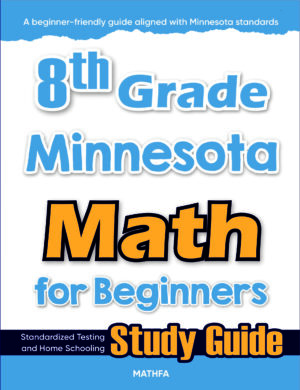 8th Grade Minnesota Math for Beginners Original price was: $21.99.$14.99Current price is: $14.99.Download
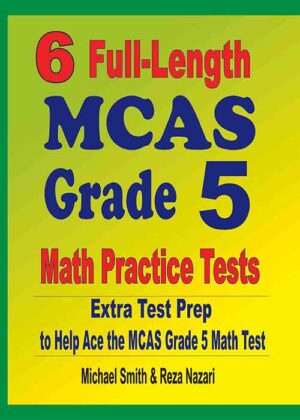 6 Full-Length MCAS Grade 5 Math Practice Tests: Extra Test Prep to Help Ace the MCAS Grade 5 Math Test Original price was: $18.99.$12.99Current price is: $12.99.Download
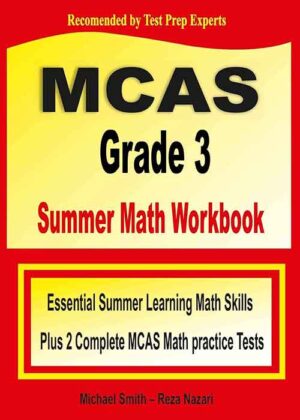 MCAS Grade 3 Summer Math Workbook: Essential Summer Learning Math Skills plus Two Complete MCAS Math Practice Tests Original price was: $18.99.$12.99Current price is: $12.99.Download
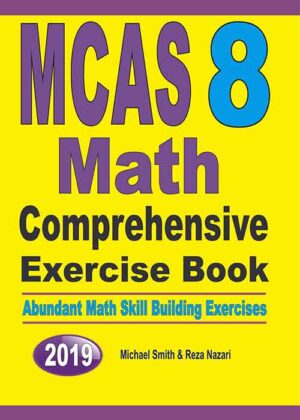 MCAS Grade 8 Math Comprehensive Exercise Book: Abundant Math Skill Building Exercises Original price was: $18.99.$12.99Current price is: $12.99.Download
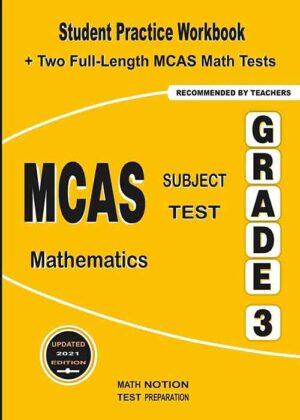 MCAS Subject Test Mathematics Grade 3: Student Practice Workbook + Two Full-Length MCAS Math Tests Paperback Original price was: $18.99.$12.99Current price is: $12.99.Download
 MCAS Grade 3 Math Comprehensive Exercise Book: Abundant Math Skill Building Exercises Original price was: $18.99.$12.99Current price is: $12.99.Download
 ACAP Business Math Practice — Alabama Guide
 How to Pass the RISE Math Test in Utah
 OSTP Math Prep: A Step-by-Step Oklahoma Guide
 STAAR Math Test Prep for Grades 6-8: A Parent’s Guide (2026)
 7 Proven Accuplacer Math Prep Strategies
7 MCAs Math Prep Tips for Minnesota Students


📖 Reading time: 11 min
Quick answer: Effective MCAs math prep for Minnesota students means mastering the MCA-III math standards across number sense, algebra, geometry, and data analysis — then practicing with grade-aligned problems at least four days a week for six to eight weeks before test day.
Who this is for: Minnesota students in grades 3–8 and grade 11 preparing for the MCAs math test, parents supporting their child’s math practice at home, and teachers looking for actionable test-prep strategies to use in the classroom.
Nearly one in three Minnesota students does not score at the proficient level on the state math assessment — and for many of them, the gap isn’t about ability. It’s about preparation. If you’re a student staring down the MCA math test, or a parent trying to help your child build the right study habits, you’re already doing the most important thing: looking for a plan that works.
Minnesota MCAs math prep can feel overwhelming at first. The test covers a wide range of topics — from basic number operations in the early grades all the way to linear functions and statistical reasoning by grade 11. Without a clear sense of what’s on the test and how to practice efficiently, even hardworking students can feel like they’re spinning their wheels. That frustration is real, and you’re not alone in feeling it.
This guide walks you through seven targeted strategies to make your Minnesota math test preparation count. You’ll learn exactly what the MCA math test covers, which topics earn the most points, how to structure your practice sessions, and how to manage math anxiety so it doesn’t derail your performance on test day. Every tip here is concrete, actionable, and grounded in what the test actually asks students to do.
What the Minnesota MCAs Math Test Actually Covers
Test Format, Grade Levels, and Standards Alignment
The MCAs math test measures how well Minnesota students have learned the state’s academic math standards — and understanding that structure is the first step in smart MCAs math prep. The Minnesota – MCAs Math Assessment is administered to students in grades 3 through 8 and again in grade 11, with each test aligned to the Minnesota Academic Standards in Mathematics for that grade level.
The MCA-III (Minnesota Comprehensive Assessments, Third Edition) is the current version of the test. Each test session is computer-adaptive, meaning the difficulty of questions adjusts based on how a student answers. That design rewards consistent, accurate performance over guessing — so building genuine math proficiency across all tested topics matters more than trying to memorize any single trick or shortcut.
The time limit varies by grade, but most students have approximately 80 minutes split across two sessions. The test includes both multiple-choice and technology-enhanced items (drag-and-drop, equation entry, and graphic response). Knowing these formats ahead of time removes a major source of test-day surprise, which is why taking a real MCAs math practice test before your test date is so valuable.
Students are scored on a scale that ranges from roughly 1,000 to 1,500, with performance levels labeled Does Not Meet, Partially Meets, Meets, and Exceeds the Standards. The “Meets the Standards” benchmark is the proficiency target every student is working toward, and understanding where you currently fall on that scale helps you set a realistic preparation timeline.
Key Math Domains Tested at Each Grade Band
The math content shifts meaningfully as students move through the grades. In grades 3 through 5, the heaviest emphasis falls on number sense and operations — place value, multiplication and division facts, fractions, and early decimal work. Students in these grades should spend the majority of their practice time building fact fluency and understanding the meaning behind operations, not just the procedures.
Grades 6 through 8 shift toward proportional reasoning, algebraic thinking, and geometry. At this stage, students work with ratios and proportions, expressions and equations, linear relationships, and the properties of two- and three-dimensional figures. Data analysis — including mean, median, mode, probability, and interpreting graphs — also becomes a significant portion of the test in these grades.
By grade 11, the MCAs math test draws from the full breadth of high school mathematics. That means functions, linear and quadratic equations, statistics, geometric proofs, and trigonometric ratios. Grade 11 students often find the sheer scope of the test daunting, but organizing preparation around the four major high school math strands — number and operation, algebra, geometry, and data analysis and probability — makes the workload manageable.
- Grades 3–5 focus areas: Number sense, place value, multiplication and division, fractions, early geometry (area, perimeter, basic shapes). Build fact fluency and fraction understanding first — these underpin everything that follows.
- Grades 6–8 focus areas: Ratios and proportional reasoning, expressions and equations, functions, geometry (angle relationships, surface area, volume), and statistics and probability. Pay special attention to proportional reasoning, which threads through nearly every other domain at this level.
- Grade 11 focus areas: Linear and quadratic functions, systems of equations, geometric proof and measurement, statistics and data analysis. Prioritize algebra and functions — they represent the largest share of grade 11 test items.
- All grades: Mathematical reasoning and problem solving. The MCAs consistently asks students to explain their thinking, justify a solution, or interpret a result in context. Practicing word problems and multi-step problems is essential at every grade level.
Minnesota Math Test Preparation: Building a Study Plan That Works
How to Diagnose Your Starting Point
The most effective Minnesota math test preparation starts with an honest assessment of where you are right now — not where you hope you are. Before you crack open a practice book or start watching tutorial videos, take a full-length MCAs math practice test under timed conditions. Your results will show you exactly which domains need the most attention, and they’ll save you from spending valuable study time reviewing topics you’ve already mastered.
Once you’ve completed a diagnostic practice test, sort your errors into two categories: content gaps (you never learned this topic or forgot it completely) and careless mistakes (you know the material but made an error under pressure). These two categories require completely different responses. Content gaps need direct instruction and repeated practice. Careless mistakes need slower, more deliberate work with a focus on checking your calculations and re-reading each problem carefully before choosing an answer.
Many students skip the diagnostic step and jump straight into random practice problems. That approach wastes time and creates a false sense of progress. A student who drills fraction problems for two weeks while ignoring a major gap in algebraic thinking will still struggle on test day — even though they feel busy and productive. The diagnostic test gives your preparation direction and focus.
According to data tracked by the U.S. Department of Education, students who receive structured, targeted academic support in mathematics show measurably stronger outcomes on state assessments than those who study without a clear plan. That finding applies directly here: targeted preparation beats generic practice every time.
Structuring Your Weekly Practice Schedule
Once you have your diagnostic results, build a six- to eight-week study schedule that allocates the most time to your weakest domains while keeping your stronger areas sharp with lighter weekly review. A realistic schedule for most students looks like four focused study sessions per week, each running 30 to 45 minutes. Shorter, consistent sessions produce better retention than marathon weekend cramming sessions that leave students mentally exhausted.
Structure each session around a single topic. For example: Monday — fraction operations; Wednesday — algebraic expressions; Friday — data interpretation; Saturday — mixed review with timed practice problems. The mixed review session is important because the MCAs does not organize its questions by topic — you’ll face a fraction question followed immediately by a geometry question, then an algebra question. Regular mixed practice trains your brain to switch between math topics quickly and accurately.
Students who work through structured, grade-aligned practice materials consistently outperform those who rely on random internet searches for practice problems. For students looking for structured practice materials, mathnotion.com offers over 500 math workbooks and practice tests covering every major exam and grade level — including grade-specific practice aligned to the kinds of problems that appear on state assessments like the MCAs. A Minnesota MCAs study guide that mirrors the actual test format is one of the most efficient tools you can add to your preparation plan.
Managing Math Anxiety During Preparation
Math anxiety affects a significant number of students at every grade level, and it’s worth addressing directly as part of your Minnesota math test preparation. Research consistently shows that math anxiety isn’t a reflection of ability — it’s a response to perceived threat, and it can be reduced with the right preparation strategies. The single most effective antidote to math anxiety is familiarity: the more you’ve seen a problem type before, the less threatening it feels on test day.
One practical strategy is to end every study session with two or three problems you already know how to solve confidently. This creates a positive experience associated with math practice and builds the kind of calm confidence that transfers to actual test performance. Over time, your baseline comfort level rises, and test-day nerves have less power to derail your thinking.
7 Proven MCAs Math Prep Strategies You Can Use Today
Strong MCAs math prep comes down to consistent habits applied to the right content. These seven strategies are specific, practical, and grounded in how the MCA-III actually tests mathematical thinking.
- Take an official or full-length MCAs math practice test before you start studying.
A diagnostic practice test is the single highest-leverage action you can take at the start of your preparation. It shows you exactly which math domains are costing you points and which ones you can maintain with light review. Without this baseline, you’re guessing at what to study — and guessing is the least efficient way to prepare. Treat this first practice test as data collection, not performance: your score doesn’t matter yet. What matters is the pattern of errors it reveals. - Study one math topic per session, then mix topics in review.
Focused single-topic sessions build the deep procedural fluency you need to solve problems quickly and accurately under time pressure. However, the MCAs tests topics in a mixed, unpredictable order — so weekly mixed-review sessions are equally important. Think of single-topic sessions as loading individual tools into your toolbox, and mixed-review sessions as practicing how to grab the right tool quickly when the problem changes. - Master the four operations with fractions and decimals before anything else.
Fraction and decimal fluency is foundational for every grade band above third grade. Students who struggle with proportional reasoning, algebraic expressions, geometric measurement, and statistical calculations almost always have an underlying gap in fraction and decimal operations. Spend the first week or two of your preparation ensuring you can add, subtract, multiply, and divide fractions and decimals accurately and quickly — including mixed numbers and negative values. - Practice word problems daily, not just computation exercises.
The MCAs places heavy emphasis on mathematical reasoning — reading a real-world scenario, identifying the relevant information, choosing the right operation or strategy, and interpreting the result. Pure computation practice doesn’t develop this skill. Every study session should include at least a few multi-step word problems that require you to think through the context, not just execute a procedure. This is where many students lose points, and where targeted practice pays off most. - Learn to use estimation as a checking tool, not just an approximation strategy.
Many MCAs questions — especially in the middle grades — can be answered or double-checked using estimation and number sense. Before committing to a calculated answer, ask yourself: does this answer make sense given the numbers in the problem? A student who estimates that 48% of 200 is roughly 100 will immediately recognize if their calculator gives them 960 as a result. That kind of number sense catches errors and saves points. - Review every wrong answer on every practice test — especially the ones that feel obvious in hindsight.
Error review is where the real learning happens. After every MCAs math practice test or practice session, go back through every incorrect answer and identify the exact point where your reasoning broke down. Was it a misread of the problem? A procedural error in the middle of the solution? A conceptual misunderstanding of the underlying math? Each type of error calls for a different correction strategy, and making that distinction sharpens your preparation considerably. - Simulate real test conditions at least twice before your test date.
Complete at least two full-length timed practice sessions under conditions that mirror the actual test: same time of day, no phone, no music, no stopping to look things up. This builds the mental stamina and time-management habits that real test performance requires. Students who have never experienced timed test conditions often find their performance drops significantly on test day — not because they don’t know the math, but because the pressure feels unfamiliar. Practice removes that unfamiliarity.
Beyond these seven strategies, two habits separate high-scoring students from the rest. First, they track their progress. Keeping a simple error log — a notebook or spreadsheet that records every missed problem, the topic it belongs to, and the reason for the error — creates a personalized Minnesota MCAs study guide built entirely from your own weak points. Second, they review math vocabulary deliberately. The MCA-III uses precise mathematical language, and students who don’t know what “proportional relationship,” “rational number,” or “statistical variability” means will struggle to understand what certain questions are even asking.
Math proficiency doesn’t come from a single intense week of preparation — it comes from consistent, well-directed effort over several weeks. The students who score at the “Meets” or “Exceeds” level on the MCAs are rarely the most naturally gifted math students in the room. They’re the ones who practiced the right things, reviewed their mistakes honestly, and built real mathematical reasoning skills rather than surface-level test-taking tricks. That kind of preparation is available to every student willing to put in the work.
Worked Examples: MCAs-Style Math Problems by Grade Band
The best way to understand what MCAs math prep should target is to work through the kinds of problems the test actually asks. The three examples below represent common problem types across the grade bands — each worked out step by step so you can see exactly how to approach the reasoning, not just the calculation.
Example 1: Grade 5 — Fraction Division Word Problem
Problem: A ribbon is 3/4 of a yard long. You need to cut pieces that are each 1/8 of a yard. How many pieces can you cut?
Step 1: Recognize this as a division problem. You’re dividing the total length by the size of each piece: 3/4 ÷ 1/8
Step 2: Apply the “keep, change, flip” rule for dividing fractions. Keep the first fraction, change division to multiplication, flip the second fraction: 3/4 × 8/1
Step 3: Multiply numerators and denominators: (3 × 8) ÷ (4 × 1) = 24/4 = 6
Answer: You can cut 6 pieces. This is a classic grade 5 MCAs item because it requires students to interpret a real-world situation, choose the correct operation, and apply fraction division accurately — not just follow a memorized procedure.
Example 2: Grade 7 — Proportional Reasoning with Percent
Problem: A store marks up the price of a backpack by 35%. The original cost is $40. What is the selling price?
Step 1: Find 35% of $40. Convert the percent to a decimal: 35% = 0.35
Step 2: Multiply: 0.35 × 40 = 14. The markup is $14.
Step 3: Add the markup to the original price: $40 + $14 = $54
Answer: The selling price is $54. Grade 7 MCAs items frequently embed percent problems in consumer math contexts like this one. Students who practice the conversion from percent to decimal first — before multiplying — make far fewer errors than those who try to do both steps mentally at once.
Example 3: Grade 11 — Interpreting a Linear Function
Problem: A car rental company charges a flat fee of $25 plus $0.18 per mile driven. Write a function C(m) that represents the total cost for m miles. Then find the cost for a 120-mile trip.
Step 1: Identify the components of the linear function. The flat fee is the y-intercept (starting value): 25. The per-mile rate is the slope: 0.18. The function is: C(m) = 0.18m + 25
Step 2: Substitute m = 120 into the function: C(120) = 0.18 × 120 + 25
Step 3: Calculate: 0.18 × 120 = 21.6. Then: 21.6 + 25 = 46.6
Answer: The total cost for a 120-mile trip is $46.60. Grade 11 MCAs items test whether students can both write and evaluate functions in context — not just solve pre-written equations. Practicing function interpretation alongside function evaluation is essential for students targeting the “Meets” or “Exceeds” performance level.
Frequently Asked Questions
What topics should I focus on most for MCAs math prep?
Focus first on the math domains that carry the heaviest weight for your specific grade level. For grades 3–5, prioritize number sense, fraction operations, and early geometry. For grades 6–8, concentrate on proportional reasoning, algebraic expressions and equations, and data analysis. For grade 11, algebra and functions represent the largest share of test items. In every grade, multi-step word problems that require mathematical reasoning appear throughout the test — so daily word problem practice should be part of every student’s Minnesota math test preparation plan regardless of grade.
How many weeks before the test should I start MCAs math preparation?
Most students benefit from six to eight weeks of structured MCAs math prep before their test date. That timeline allows enough time to diagnose weak areas, address content gaps through focused practice, and complete two or more full-length timed practice tests before the real assessment. Students with significant content gaps — particularly in grades 8 and 11 — may benefit from starting ten to twelve weeks out. Starting earlier is always better; it’s far easier to reinforce preparation than to cram new content in the final week.
Is there an official MCAs math practice test available?
Yes. The Minnesota Department of Education provides sample test items and tools to help students and families understand the MCAs test format. Visiting the official Minnesota education resources page gives students access to released test items organized by grade and strand. Beyond official materials, using a structured Minnesota MCAs study guide with grade-aligned practice problems — particularly one that mirrors the technology-enhanced item formats used on the computer-adaptive test — provides the additional volume of practice problems most students need to build real math proficiency before test day.
📚 More from Math Notion
🎯 Explore Our Math Books
Browse 500+ math eBooks at Math Notion — for every grade, exam, and skill level.
Key Takeaways
- The MCAs math test is administered in grades 3–8 and grade 11, with each test aligned to the Minnesota Academic Standards — knowing your grade-level content domains is the foundation of effective MCAs math prep.
- Start with a full-length diagnostic practice test to identify your specific content gaps before building a six- to eight-week study schedule organized by domain and difficulty.
- Daily word problem practice and regular mixed-topic review sessions are the two habits that most consistently separate high-scoring students from those who struggle on test day.
- For students who want structured, grade-aligned practice materials, mathnotion.com offers over 500 math workbooks and practice tests covering every major exam and grade level — a reliable foundation for any Minnesota math test preparation plan.
Smart, consistent MCAs math prep is the clearest path to a proficient score on the Minnesota math assessment. Every strategy in this guide — from the diagnostic test to the timed simulation sessions — is designed to build the real math proficiency the MCA-III rewards. Start with one tip today, add another this week, and keep going. The students who score at the top are the ones who started early and practiced with a plan.
Ready to find practice materials matched to your grade level and test? Visit mathnotion.com/math-practice/ to browse the full collection of math prep books and workbooks.
Posted by Math Notion Team · Published on June 4, 2026