Math Articles, tips & study guides
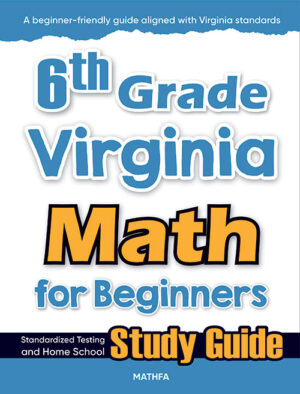 6th Grade Virginia Math for Beginners Original price was: $21.99.$14.99Current price is: $14.99.Download
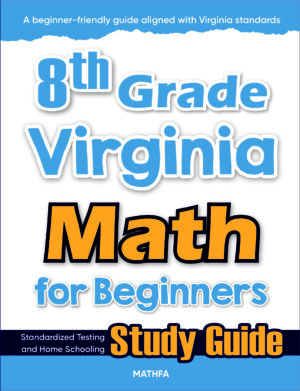 8th Grade Virginia Math for Beginners Original price was: $21.99.$14.99Current price is: $14.99.Download
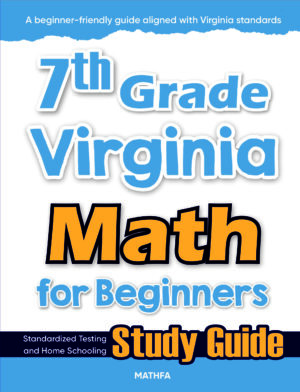 7th Grade Virginia Math for Beginners Original price was: $21.99.$14.99Current price is: $14.99.Download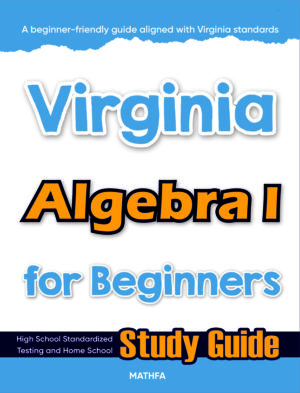
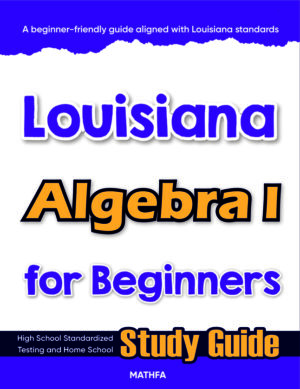 Louisiana Algebra 1 for Beginners Original price was: $22.99.$16.99Current price is: $16.99.Download
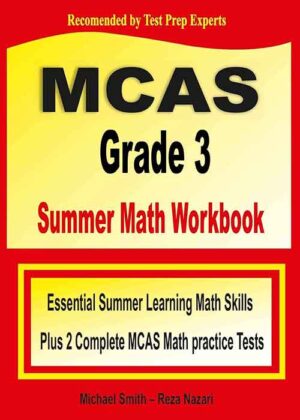 MCAS Grade 3 Summer Math Workbook: Essential Summer Learning Math Skills plus Two Complete MCAS Math Practice Tests Original price was: $18.99.$12.99Current price is: $12.99.Download
 8th Grade STAAR Math Exercise Book: Review of Essential Skills and Concepts With 2 STAAR Math Practice Tests Original price was: $18.99.$12.99Current price is: $12.99.Download
 GED Math Prep: The Ultimate Step by Step Guide Plus Two Full-Length GED Practice Tests Original price was: $18.99.$12.99Current price is: $12.99.Download
 Georgia Milestones Assessment System Subject Test Mathematics Grade 6: Student Practice Workbook + Two Full-Length GMAS Math Tests Original price was: $18.99.$12.99Current price is: $12.99.Download
 WVGSA Math Prep: West Virginia Student Guide
 6th Grade West Virginia Math: WVGSA Guide (2026)
 WFE Rounding and Estimation Practice — Wisconsin Guide
 How to Pass the RISE Math Test in Utah
 7 AK STAR Middle School Prep Tips (Alaska)
7 SOL Math Prep Strategies for Virginia Students


📖 Reading time: 11 min
Quick answer: Effective SOL math prep for Virginia students means mastering the five VDOE math strands, working through timed SOL math practice tests, and building a consistent weekly study schedule that targets your weakest skill areas at least six weeks before test day.
Who this is for: Virginia students in grades 3 through 8 and high school preparing for the SOL math test, parents supporting their child’s Virginia math test preparation at home, and teachers looking for targeted math strategies to use in the classroom.
More than 1 in 5 Virginia students does not pass the SOL Math test on the first attempt — and the students who do pass share one thing in common: they prepared with a plan, not just a prayer. If you’ve ever stared at an SOL math practice test and felt your confidence slip, you’re not alone. The Standards of Learning (SOL) math assessments can feel overwhelming precisely because they cover so many topics, from number sense and fractions in the early grades all the way through algebraic functions and data analysis in high school.
The good news is that SOL math prep doesn’t have to feel like guesswork. Virginia’s Department of Education publishes detailed blueprints for every grade-level math test, which means you can study strategically — focusing the most time on the strands that carry the most weight on test day. This post walks you through seven proven strategies, explains exactly what the SOL math test measures, and shows you how to build a study schedule that actually works.
By the time you finish reading, you’ll know which math topics to prioritize, how to use practice tests effectively, and where to find the best structured math resources for Virginia students at every grade level.
What the Virginia SOL Math Assessment Actually Measures
Understanding the Test Structure and Reporting Categories
The Virginia SOL Math Assessment measures student mastery across specific math strands defined by the Virginia Department of Education’s Standards of Learning — and knowing exactly which strands appear on your grade’s test is the single most powerful thing you can do before you start studying. Each grade-level test has a published blueprint that tells you precisely how many questions come from each reporting category, so you’re never guessing about what matters most.
The SOL (Standards of Learning) math assessments are Virginia’s primary tool for measuring whether students have mastered grade-level mathematics. Tests are administered in grades 3 through 8 and at the high school level for courses including Algebra I, Algebra II, and Geometry. Each test is computer-adaptive, meaning the difficulty of questions adjusts based on your responses — a feature that makes consistent math fluency across all tested topics especially important.
According to the Virginia SOL Math Assessment page maintained by the Virginia Department of Education (VDOE), the math assessments are aligned to the 2023 Mathematics Standards of Learning and assess students across reporting categories that vary by grade. For example, the Grade 5 Math SOL covers number and number sense, computation and estimation, measurement and geometry, probability and statistics, and patterns, functions, and algebra. High school Algebra I tests focus heavily on expressions, equations, and inequalities, as well as functions and statistics.
Understanding this structure matters because it tells you exactly where to invest your study time. A student who spends equal time on every math topic they’ve ever learned is far less efficient than one who targets the three or four reporting categories that together make up 70–80% of the test. Pull up the VDOE’s released test blueprints and highlight the highest-weighted strands for your specific grade and course — that list becomes your personal SOL math prep roadmap.
The Computer-Adaptive Format and What It Means for Your Prep
Because the SOL math test is computer-adaptive, the questions you see depend on how you answer earlier ones. Answer correctly and the test presents harder questions; answer incorrectly and it adjusts downward. This design means that math fluency — the ability to work accurately across the full range of topics — matters more than “cramming” a single concept to perfection.
Students who do best on the computer-adaptive SOL are those who have reviewed all tested strands at least once and can apply basic reasoning skills even when a question looks unfamiliar. That kind of broad, confident math mastery comes from consistent, spaced practice over several weeks — not from a single night of reviewing notes. Building that fluency is the foundation of every effective SOL math prep strategy in this post.
One practical implication: don’t skip the math topics you find difficult just because they feel uncomfortable. In a computer-adaptive test, consistent weakness in one strand can affect your overall score more than you’d expect. Use released SOL practice items from the VDOE to identify your specific weak spots, then dedicate extra practice time to those areas before test day.
Building Your Virginia Math Test Preparation Plan
How to Structure a SOL Math Study Schedule That Works
A strong Virginia math test preparation plan starts with a realistic timeline and a clear weekly structure. Most students need at least six weeks of dedicated SOL math prep to see meaningful improvement — and eight weeks is ideal if you’re starting from a significant gap in any of the tested strands.
Research consistently supports spaced practice over massed study. Rather than spending five hours on math the night before a test, students who spread practice across multiple shorter sessions perform better on assessments that require retrieval and application — exactly what the SOL math test demands. A schedule of 30–45 minutes of focused math practice, five days a week, outperforms weekend cramming by a significant margin.
Here’s a simple way to build your math study schedule across six weeks. In weeks one and two, complete a diagnostic SOL math practice test under timed conditions. Review every incorrect answer carefully and categorize your mistakes by reporting strand. In weeks three and four, work intensively on your two weakest strands, using practice problems that mirror the exact question formats on the real test. In weeks five and six, return to mixed practice — pulling questions from all tested strands — to build the retrieval fluency the computer-adaptive format rewards.
Tracking your progress matters as much as the practice itself. Keep a simple error log: each time you miss a problem, write down the topic, the type of mistake (conceptual misunderstanding vs. careless arithmetic), and the correct method. Reviewing that log weekly ensures you’re not repeating the same errors on test day. Students who use this kind of structured reflection as part of their Virginia math test preparation consistently report stronger scores compared to those who simply “do more problems” without analysis.
Using Released SOL Practice Tests Strategically
The VDOE releases official SOL math practice items and released tests for every grade and course at no cost. These are the single most valuable preparation resource available because they use the exact same question formats, vocabulary, and reasoning demands as the real assessment. Working through released items isn’t just practice — it’s direct exposure to the test itself.
When you use an SOL math practice test, simulate real test conditions as closely as possible: sit quietly, use only the approved tools (a calculator is provided for specific sections), and work within the time limit. After you finish, don’t just check which answers were right or wrong — study the VDOE’s answer explanations carefully. Understanding why a correct answer is correct builds the mathematical reasoning that transfers to new problems on test day.
The U.S. Department of Education emphasizes that regular formative assessment — checking your own understanding frequently during the study process — is one of the highest-impact learning strategies available to students at every level. Using released SOL practice tests as formative checkpoints every two weeks during your prep period gives you exactly that kind of ongoing feedback loop.
For students who want a more structured approach to SOL math prep, a dedicated Virginia SOL study guide can provide the scaffolding that released items alone don’t offer. A well-designed study guide organizes practice by strand, provides worked examples with detailed explanations, and includes progress-tracking tools that keep your preparation focused. For students looking for structured practice materials, mathnotion.com offers over 500 math workbooks and practice tests covering every major exam and grade level, including state assessments aligned to Virginia’s math standards.
7 SOL Math Prep Strategies You Can Start Today
Effective SOL math prep comes down to consistent, strategic action — not wishful thinking. Each of the following strategies is specific, immediately usable, and grounded in how students actually improve their math scores on Virginia’s Standards of Learning assessments.
- Download the VDOE test blueprint for your specific grade or course.
The blueprint tells you exactly which math strands are tested and how many questions come from each one. This is the most important document in your entire SOL math prep toolkit. Visit the VDOE website, find your grade-level or course assessment page, and print the blueprint. Highlight the two or three highest-weighted strands — these are where your study time delivers the greatest return. Without this document, you’re studying blind. - Take a full timed SOL math practice test before you study anything else.
A diagnostic practice test taken before you begin reviewing reveals your actual starting point — not the one you assume. Many students spend weeks reviewing concepts they already know while neglecting the strands where they consistently lose points. Take a released VDOE practice test under realistic conditions, score it by strand, and let the results guide your entire study plan. This one step can save you weeks of misdirected effort. - Practice mental math and number sense daily, even for five minutes.
Mental math skills — including estimation, rounding, and quick multiplication — directly affect your speed and accuracy on the SOL math test. Students who struggle with number sense often spend too much time on straightforward calculations, leaving too little time for multi-step problems. A daily five-minute mental math drill, focused on operations relevant to your grade level, builds the fluency that makes everything else faster and easier on test day. - Work one new word problem from each tested strand every study session.
The SOL math test includes a significant proportion of word problems that require students to translate a real-world situation into a mathematical operation or equation. Practicing word problems from every tested strand — not just the ones you find comfortable — builds the reading-plus-reasoning skill that word problems demand. Focus especially on problems involving ratios, proportions, algebraic expressions, and data interpretation, which appear across multiple grade levels. - Learn to use the on-screen calculator efficiently — and know when not to use it.
The SOL math test provides a calculator for certain sections, but many students either over-rely on it or waste time on it for simple calculations. Practice the exact calculator model provided on the VDOE’s testing platform ahead of time so there are no surprises on test day. More importantly, develop the habit of estimating your answer mentally before calculating — this catches input errors and keeps your reasoning sharp throughout the test. - Review your error log weekly and rework missed problems from scratch.
Reviewing incorrect answers is valuable — but reworking them completely, without looking at the solution, is far more powerful. When you redo a missed problem from scratch, you’re practicing the exact retrieval process the test demands. Set aside time at the end of each study week to pull three to five problems from your error log and solve them again independently. If you still can’t solve them correctly, that strand needs more direct instruction before test day. - Simulate full test conditions at least twice before the real assessment.
Two full-length, timed, distraction-free SOL math practice tests in the final two weeks of your prep build the test-taking stamina and time management skills that make a real difference on assessment day. Students who simulate test conditions report less anxiety and better pacing on the actual exam. Use released VDOE practice tests, remove all distractions, and treat each simulation exactly as you would the real thing — including following the same morning routine you plan to use on test day.
These seven strategies work best when they’re layered — not treated as a checklist to rush through. Students who achieve math mastery on the SOL don’t just do more practice; they practice with intention. They know which strand they’re working on, why it matters on the test, and what a correct solution actually looks like. That level of focused awareness is what separates a passing score from a high score.
Parents supporting younger students at home can implement many of these same strategies by working through released practice problems alongside their child, asking questions about the reasoning process rather than just checking the answer, and celebrating steady improvement in specific strands rather than fixating only on total scores. Math confidence builds incrementally, and every correctly solved problem — no matter how small — is a genuine step toward math mastery on the SOL.
Teachers can use these strategies to structure small-group intervention sessions, particularly the error-log review and strand-specific practice approaches. Identifying the two or three reporting categories where a class as a whole is underperforming and dedicating dedicated math practice blocks to those areas is one of the highest-leverage instructional moves available in the weeks before the assessment window opens.
Worked Examples: SOL-Style Math Problems
Seeing SOL math problems worked through step by step is one of the best ways to internalize the reasoning process the test rewards. The following examples are modeled on the question formats and content strands that appear across Virginia’s grade-level and high school SOL math assessments.
Example 1: Proportional Reasoning (Grade 7 / Algebra I)
Problem: A car travels 150 miles in 2.5 hours at a constant speed. At the same rate, how many miles will the car travel in 4 hours?
Step 1: Find the unit rate (miles per hour). 150 ÷ 2.5 = 60 miles per hour.
Step 2: Multiply the unit rate by the new time. 60 × 4 = 240 miles.
Answer: The car will travel 240 miles in 4 hours. On the SOL math test, proportional reasoning problems like this one often appear as word problems — practice identifying the unit rate first, then scaling up or down.
Example 2: Solving a Two-Step Equation (Algebra I SOL)
Problem: Solve for x: 3x + 7 = 22
Step 1: Subtract 7 from both sides of the equation. 3x + 7 − 7 = 22 − 7, which gives 3x = 15.
Step 2: Divide both sides by 3. 3x ÷ 3 = 15 ÷ 3, which gives x = 5.
Step 3: Check your answer by substituting back into the original equation. 3(5) + 7 = 15 + 7 = 22 ✓
Answer: x = 5. The Algebra I SOL tests two-step equations frequently — always verify your solution by substituting back into the original equation. This habit catches arithmetic errors before they cost you points.
Example 3: Area and Perimeter (Grade 5–6 Geometry Strand)
Problem: A rectangular garden has a length of 12 meters and a width of 7 meters. What is the area of the garden, and what length of fencing is needed to enclose it completely?
Step 1: Calculate the area. Area = length × width = 12 × 7 = 84 square meters.
Step 2: Calculate the perimeter (total fencing needed). Perimeter = 2 × (length + width) = 2 × (12 + 7) = 2 × 19 = 38 meters.
Answer: The garden has an area of 84 square meters and requires 38 meters of fencing. On the SOL math test, geometry word problems frequently ask for both area and perimeter in the same item — read every question carefully to confirm which measurement is being requested.
Frequently Asked Questions
What topics are on the Virginia SOL Math test?
The Virginia SOL Math test covers topics organized by reporting strands that vary by grade level. The exact topics on the SOL math test depend on which grade or course you’re taking — but most assessments cover number sense, computation, measurement, geometry, data analysis and probability, and algebraic thinking in proportions that shift as grade level increases. The VDOE publishes detailed test blueprints for every grade and high school math course on its assessment website, and reviewing your specific blueprint is the most direct way to know exactly which SOL math topics to prioritize in your preparation.
How long does the SOL Math test take in Virginia?
Virginia SOL Math tests are untimed, which means students are given as much time as they need within the school day to complete the assessment. That said, most students finish within 60 to 90 minutes. Because the test is computer-adaptive, the total number of questions varies by student, but most grade-level math SOL tests include between 40 and 50 items. Practicing with timed SOL math practice tests during your Virginia math test preparation helps you build steady pacing habits even though the real test has no hard time limit.
How is the SOL Math test scored in Virginia?
The Virginia SOL Math test is scored on a scale of 0 to 600. A scaled score of 400 is the passing threshold, and a score of 500 or above earns the designation of “Advanced Proficient.” Because the test is computer-adaptive, raw question counts don’t translate directly to scaled scores — the difficulty level of the questions you answer affects your final score. Consistent performance across all reporting strands is the best strategy for reaching the 400 passing mark and pushing toward the Advanced Proficient range on the SOL math assessment.
📚 More from Math Notion
🎯 Explore Our Math Books
Browse 500+ math eBooks at Math Notion — for every grade, exam, and skill level.
Key Takeaways
- The Virginia SOL Math assessment is grade- and course-specific — always start by downloading the VDOE blueprint for your exact test so you know which strands carry the most weight.
- A six-to-eight-week study schedule built around spaced practice, regular SOL math practice tests, and weekly error-log review delivers far better results than last-minute cramming.
- Released VDOE practice items are the most accurate preparation tool available, and combining them with a structured Virginia SOL study guide maximizes your readiness across all tested reporting categories.
- For students looking for structured practice materials, mathnotion.com offers over 500 math workbooks and practice tests covering every major exam and grade level — including resources aligned to Virginia’s math standards.
SOL math prep works when it’s specific, consistent, and honest about where the real gaps are. Use the blueprint, take the diagnostic practice test, build your study schedule around your weakest strands, and simulate real test conditions in the final two weeks. Those four steps alone put Virginia students on a direct path toward a passing — and potentially Advanced Proficient — score on the SOL Math assessment. Head to mathnotion.com/math-practice/ to explore practice books and test prep resources built for exactly this kind of targeted math preparation.
SOL math practice workbooks for Virginia
The fastest way to turn this guide into results is steady practice. Our Virginia math workbooks are built for SOL test prep, with full-length Virginia SOL math practice, worksheets, and step-by-step answer explanations — ideal for homeschool, classroom, or after-school SOL math workbook.
- 6th Grade Virginia Math Practice Workbook
- 7th Grade Virginia Math Practice Workbook
- 8th Grade Virginia Math Practice Workbook
Browse all Math Notion math practice books →
Official source: For the latest test details and dates, visit the Virginia Department of Education SOL Assessment Program.
Posted by Math Notion Team · Published on June 1, 2026