Math Articles, tips & study guides
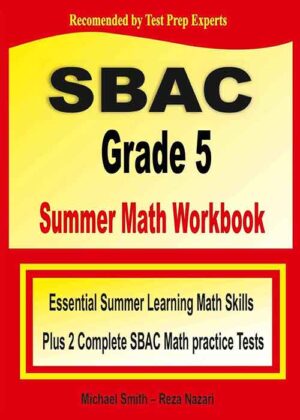 SBAC Grade 5 Summer Math Workbook: Essential Summer Learning Math Skills plus Two Complete SBAC Math Practice Tests Original price was: $18.99.$12.99Current price is: $12.99.Download
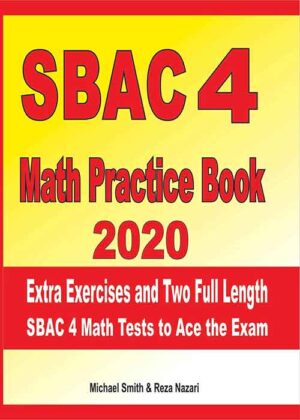 SBAC Grade 4 Math Practice Book 2020: Extra Exercises and Two Full Length SBAC Math Tests to Ace the Exam Original price was: $18.99.$12.99Current price is: $12.99.Download
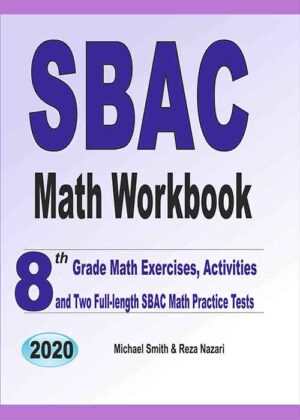 SBAC Math Workbook: 8th Grade Math Exercises, Activities, and Two Full-Length SBAC Math Practice Tests Original price was: $18.99.$12.99Current price is: $12.99.Download
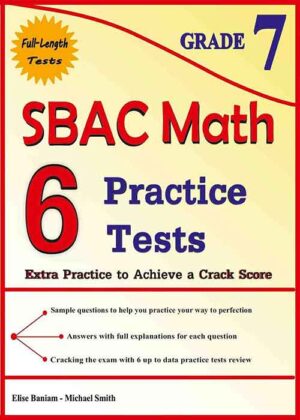 6 SBAC Math Practice Tests Grade 7: Extra Practice to Achieve a Crack Score Original price was: $18.99.$12.99Current price is: $12.99.Download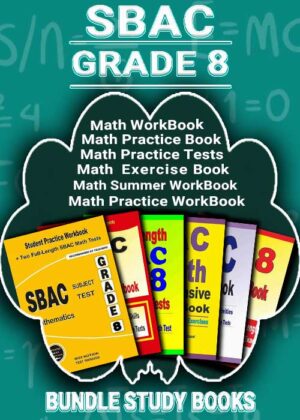
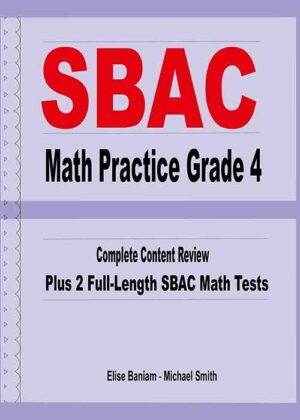 SBAC Math Practice Grade 4: Complete Content Review Plus 2 Full-length SBAC Math Tests Original price was: $18.99.$12.99Current price is: $12.99.Download
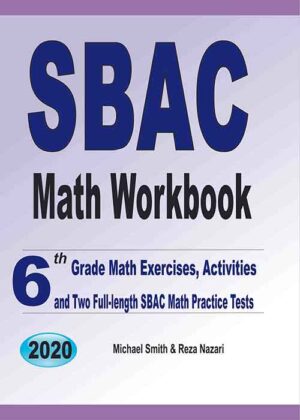 SBAC Math Workbook: 6th Grade Math Exercises, Activities, and Two Full-Length SBAC Math Practice Tests Original price was: $18.99.$12.99Current price is: $12.99.Download
 6 Full-Length SBAC Grade 8 Math Practice Tests: Extra Test Prep to Help Ace the SBAC Grade 8 Math Test Original price was: $18.99.$12.99Current price is: $12.99.Download
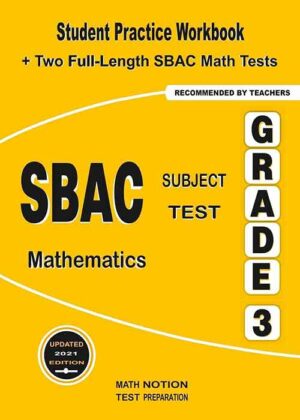 SBAC Subject Test Mathematics Grade 3: Student Practice Workbook + Two Full-Length SBAC Math Tests Paperback Original price was: $18.99.$12.99Current price is: $12.99.Download
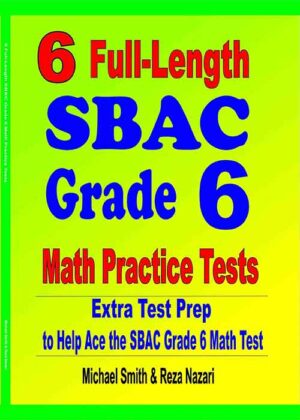 6 Full-length SBAC Grade 6 Math Practice Tests: Extra Test Prep to Help Ace the SBAC Grade 6 Math Test Original price was: $18.99.$12.99Current price is: $12.99.Download
 SBAC Congruence and Similarity Practice — California Guide
 7 SBAC Math Prep Habits for Nevada Students
 SBAC Scores Explained: Levels, Ranges, and the Highest Score
 CMAS Scatter Plots Practice — Colorado Guide
 OST Pre-Calculus Practice — Ohio Guide
Nevada SBAC Math Test Anxiety: A Step-by-Step Plan

📖 Reading time: 12 min
Quick answer: To overcome SBAC math test anxiety in Nevada, combine daily low-stakes math practice with targeted content review across all five Smarter Balanced math claim areas — starting at least six to eight weeks before test day — so familiarity replaces fear on exam morning.
Who this is for: Nevada students in grades 3–8 and grade 11 preparing for the SBAC math assessment, parents who want to support their child’s math confidence at home, and teachers looking for classroom strategies to reduce math test anxiety before state testing.
Math Test Anxiety Is Real — And It’s Holding Nevada Students Back
Math anxiety affects somewhere between 25% and 40% of students in the United States, according to research published through the U.S. Department of Education — and it doesn’t just hurt feelings. It actively interferes with working memory, the same cognitive resource students rely on to solve multi-step math problems under timed conditions. In other words, SBAC math test anxiety isn’t a personality quirk. It’s a measurable barrier to performance.
Nevada students face the Smarter Balanced Assessment Consortium (SBAC) math test each spring, and the stakes feel real. The results inform school placement decisions, teacher evaluations, and state accountability reports. That pressure is legitimate. But the students who score highest aren’t always the ones with the most raw math talent — they’re the ones who’ve learned to manage pressure alongside their math skills.
This guide gives you a complete, step-by-step approach to turning SBAC math test anxiety from an obstacle into an advantage. You’ll learn the science behind why anxiety strikes during math tests, how to build a weekly study schedule that reduces it, what specific SBAC math topics demand the most attention, and how parents and teachers can reinforce calm, confident math thinking every single day.
Why Nevada SBAC Math Test Anxiety Matters More Than Raw Math Ability
The Performance Gap Anxiety Creates
Math test anxiety directly lowers test scores — independent of a student’s actual math knowledge. Research consistently shows that students experiencing high math anxiety perform worse on timed assessments than their low-anxiety peers with identical math skills. On the Nevada SBAC math test, where students have a fixed testing window and face complex multi-step problems, that performance gap can mean the difference between a Level 2 and a Level 3 score.
The SBAC (Smarter Balanced Assessment Consortium) math assessment measures student proficiency against the Nevada Academic Content Standards (NVACS), which are aligned to Common Core State Standards. The test is adaptive — meaning it adjusts in difficulty based on how students respond — which can feel unsettling. A student who freezes on an early problem doesn’t just miss that one question. The adaptive algorithm may shift toward lower-level material, limiting the student’s ceiling score before the test even hits its stride.
That’s why addressing SBAC math test anxiety isn’t a soft, feel-good goal. It’s a core part of exam preparation. A student who knows how to stay calm and work through a problem they find difficult will always outperform an equally skilled student who panics and rushes. Math fluency matters — but so does the mental environment in which that fluency operates.
As confirmed by the Nevada – SBAC Math Assessment office, Nevada students in grades 3 through 8 and grade 11 participate in the Smarter Balanced summative assessment each spring. The results carry real weight — informing school accountability reports, Individualized Education Plan decisions, and high school graduation requirements for grade 11 students. Understanding what’s at stake is not meant to increase anxiety. It’s meant to justify the deliberate, structured approach this guide outlines.
Why “Just Study More” Isn’t the Answer
Many students respond to test anxiety by doubling down on content review — spending more hours on math worksheets, rereading notes, and doing more practice problems. That approach helps with knowledge gaps, but it doesn’t touch the anxiety itself. In fact, last-minute cramming often increases cortisol levels, which sharpens anxiety symptoms rather than dulling them.
The more effective approach combines content review with deliberate exposure to test-like conditions. Students need to practice math under mild pressure — timed exercises, unfamiliar problem formats, and adaptive-style questions — so that the real test doesn’t feel like a sudden shock. Familiarity is the antidote to anxiety, and familiarity is built through structured, consistent repetition over weeks, not hours.
- Practice timed math sessions daily. Set a timer for 15–20 minutes and work through 5–8 SBAC-style problems. The goal isn’t perfection — it’s building comfort with working under a clock. Over two weeks, most students report that the timer stops feeling threatening and starts feeling like a normal part of math work.
- Target adaptive test behavior. The SBAC adjusts to your responses. Practice with sets of mixed-difficulty problems so you experience both easy and hard questions in the same session. This mirrors what the actual test feels like and prevents panic when difficulty spikes.
- Track errors, not just scores. After every math practice session, note which problem types tripped you up — fractions, proportional reasoning, multi-step equations. This shifts your attention from “I’m bad at math” to “I need more practice with ratios,” which is an actionable, solvable observation.
- Celebrate incremental progress. Anxiety feeds on perceived hopelessness. When you notice improvement — even small gains like solving one more problem correctly than last week — acknowledge it. Mathematical reasoning builds in layers, and each layer of confidence reduces anxiety at the next level.
The Science Behind Math Test Anxiety — and How to Use It for Nevada SBAC Prep
What Happens in the Brain During Math Anxiety
Math test anxiety triggers the same neurological stress response as physical danger. When a student feels overwhelmed by a hard SBAC math problem, the brain’s amygdala fires, flooding the system with cortisol and adrenaline. This is the brain’s threat-response system — and it is not built for solving equations about proportional relationships or interpreting statistical graphs. It’s built for running from danger. As a result, the prefrontal cortex — the part of the brain responsible for logical reasoning, working memory, and multi-step problem solving — gets partially hijacked.
Working memory is particularly vulnerable. A typical SBAC math problem might require a student to hold several pieces of information simultaneously — a given ratio, a variable expression, and a conversion factor — while applying a sequence of steps. Under anxiety, working memory capacity shrinks. Students forget what they were solving, lose track of steps, or second-guess correct work they’ve already done. The math isn’t gone from their brain — the anxiety is simply blocking access to it.
Here’s the insight that changes everything: anxiety is a signal, not a verdict. Physiologically, the arousal state of anxiety looks almost identical to the arousal state of excitement. Research from Harvard psychologist Alison Wood Brooks, cited widely in educational psychology literature, shows that students who reframe pre-test nervousness as excitement — rather than trying to calm down — actually perform better on subsequent math tasks. The energy is the same. The label is different. And the label matters enormously for SBAC math test anxiety.
Using Nevada SBAC Study Tips to Retrain Your Stress Response
The practical implication is that you don’t need to eliminate stress before the SBAC math test — you need to change your relationship with it. Students who regularly practice math under mild pressure, review their errors without self-judgment, and use structured pre-test routines gradually retrain their nervous system. What once triggered panic becomes recognizable, manageable, and even energizing.
One of the most effective Nevada SBAC study tips for managing math anxiety is the “three-breath reset.” When a student hits a problem they don’t immediately recognize, they pause, take three slow breaths, and say (internally): “I’ve practiced problems like this. Let me identify what I know.” This micro-reset interrupts the amygdala’s threat signal and buys the prefrontal cortex enough time to re-engage. It sounds simple because it is — and the simplest techniques are the ones that work under real test pressure.
For students who want a structured framework that combines these anxiety-reduction techniques with comprehensive content review, 7 SBAC Math Prep Habits for Nevada Students walks through seven research-aligned habits — including daily practice routines, worked examples across every major SBAC math claim area, and expert tips specifically designed for Nevada grade-level students. It’s the kind of resource that transforms scattered studying into a coherent, confidence-building plan.
🎯 Recommended Math Book
7 SBAC Math Prep Habits for Nevada Students
Boost your Nevada SBAC math prep with 7 proven habits, worked examples, and expert tips to help grade-level students score higher on test day.
Your Step-by-Step Nevada SBAC Math Study Schedule Starting This Week
The most effective way to address math test anxiety for SBAC math is through a predictable, low-stress daily routine — not marathon study sessions. Here’s a structured routine you can begin today, even if the test is still weeks away.
- Day 1 — Diagnostic: Find Your Anxiety Triggers in SBAC Math.
Before you study anything, take a 20-minute untimed practice set covering all five SBAC math claim areas: concepts and procedures, problem solving, communicating reasoning, modeling and data analysis, and major content. Don’t worry about your score. Instead, notice which problem types make your stomach tighten — those are your anxiety triggers, and they’re also your highest-priority review topics. Write them down. This one honest inventory is the foundation of your entire math study schedule. - Day 2 — Targeted Content Review: Work the Hardest Topic First.
Take your top anxiety-trigger topic from Day 1 and spend 25 minutes on content-only review — no timer, no pressure. Work through 4–6 problems of that type step by step, checking each answer before moving on. The goal is to rebuild fluency in a low-stakes environment. For most Nevada middle school students, this tends to be proportional relationships, rational number operations, or expressions and equations. For grade 11 students, it’s frequently statistics, functions, or geometric measurement. - Day 3 — Timed Practice: Add the Clock in Small Doses.
Set a timer for 20 minutes and complete 8–10 SBAC-style problems from yesterday’s topic, plus 2–3 problems from a different category. This is deliberate exposure to the timed condition that triggers anxiety — but in a controlled setting where you’re already familiar with the material. When the timer goes off, review every problem you didn’t finish. The act of finishing under your own calm conditions builds a competing memory: “I can do this when I’m relaxed.” - Day 4 — Error Analysis: Turn Mistakes into Math Confidence.
Take 20 minutes to review only the problems you got wrong in Days 2 and 3. For each error, identify whether it was a conceptual mistake (you didn’t understand the math), a procedural mistake (you understood but made a calculation error), or an anxiety mistake (you knew the answer but second-guessed yourself and changed it). Categorizing errors this way is one of the most powerful Nevada SBAC study tips available — because it shows you that most “wrong” answers are fixable, not evidence that you’re bad at math. - Day 5 — Mixed Practice: Simulate Adaptive Test Conditions.
Work through a mixed set of 12–15 problems covering at least three different SBAC math domains. This simulates the adaptive nature of the real test, where problem types shift unpredictably. Practice your three-breath reset any time you hit a problem that feels unfamiliar. Time yourself for the full session (aim for about 1.5 minutes per problem), then review your results with curiosity rather than judgment. Focus on patterns: which domains are improving, and which still need targeted math review. - Day 6 — Active Recall: Explain the Math Out Loud.
Choose three math concepts from the week’s practice and explain them out loud as if you’re teaching a younger student. Walk through a full example for each one — say the steps, describe what you’re doing and why. This technique, called active recall, strengthens the neural pathways associated with each concept far more effectively than rereading notes. It also builds the kind of deep mathematical reasoning the SBAC explicitly assesses through its “communicating reasoning” claim. - Day 7 — Rest and Reflection: Let the Learning Consolidate.
Take a genuine rest day from active math study. Light activities are fine — glancing at a formula chart, playing a math game, or reviewing a few flashcards for 10 minutes. But don’t grind. Sleep and rest are when the brain consolidates what it practiced during the week. Students who rest on Day 7 regularly outperform students who study seven days straight, because memory consolidation happens during downtime, not during additional practice.
Repeat this weekly cycle for six to eight weeks before your Nevada SBAC math test date. Each cycle, rotate which topics you prioritize on Day 2 and Day 3. By week four, you’ll notice that problems which once triggered anxiety feel familiar — not necessarily easy, but manageable. That shift from unfamiliar to manageable is the definition of math confidence, and it’s built entirely through consistent, structured repetition.
Adjust the schedule honestly. If a week gets disrupted, don’t abandon the plan — pick up where you left off. Five days of quality math practice beats seven days of guilty, anxious review every single time. Progress in math is cumulative, and even 20 focused minutes a day adds up to over two hours of deliberate practice per week — more than enough to move the needle on both your content knowledge and your test-day composure.
Worked Examples: Applying Calm Focus to Hard SBAC Math Problems
One of the best ways to reduce SBAC math test anxiety is to watch yourself solve hard problems successfully — even in practice. The following examples cover problem types that frequently trigger anxiety for Nevada students. Work through each one using the three-breath reset before you start.
Example 1: Proportional Reasoning (Grade 7 SBAC Math)
Problem: A map of Nevada uses a scale of 1 inch = 45 miles. If the distance between two cities on the map measures 3.4 inches, what is the actual distance between the cities?
Step 1: Identify the relationship. The scale gives a ratio: 1 inch : 45 miles. You need to find what 3.4 inches represents in real miles.
Step 2: Set up a proportion. Write it as 1/45 = 3.4/x, where x is the actual distance.
Step 3: Cross-multiply. 1 × x = 45 × 3.4, so x = 153.
Answer: The actual distance between the two cities is 153 miles. Notice that this problem only requires identifying the ratio, setting up the proportion, and multiplying. Anxiety often makes it feel more complex than it is. The three-breath reset before Step 1 gives you time to see the structure clearly.
Example 2: Expressions and Equations (Grade 8 SBAC Math)
Problem: Solve for x: 3(2x − 4) = 5x + 2
Step 1: Distribute on the left side. 3 × 2x = 6x and 3 × (−4) = −12. The equation becomes 6x − 12 = 5x + 2.
Step 2: Move variable terms to one side. Subtract 5x from both sides: 6x − 5x − 12 = 2, which simplifies to x − 12 = 2.
Step 3: Isolate x. Add 12 to both sides: x = 14.
Step 4: Check. Substitute x = 14 back into the original: 3(2(14) − 4) = 3(28 − 4) = 3(24) = 72. Right side: 5(14) + 2 = 70 + 2 = 72. ✓
Answer: x = 14. The checking step is critical — and it’s something anxious students often skip because they’re rushing. Build the habit of checking every algebra answer, and you’ll catch careless errors before they cost you points.
Example 3: Data Analysis and Statistics (Grade 11 SBAC Math)
Problem: A class of 9 students scored the following on a math quiz: 72, 85, 91, 68, 79, 85, 94, 73, 85. Find the mean, median, and mode.
Step 1 — Mean: Add all scores: 72 + 85 + 91 + 68 + 79 + 85 + 94 + 73 + 85 = 732. Divide by 9: 732 ÷ 9 = 81.3̄ (approximately 81.3).
Step 2 — Median: Arrange in order: 68, 72, 73, 79, 85, 85, 85, 91, 94. With 9 values, the median is the 5th value: 85.
Step 3 — Mode: The value that appears most often is 85 (it appears three times).
Answer: Mean ≈ 81.3, Median = 85, Mode = 85. When mean, median, and mode appear in the same problem, many students freeze. Break it into three separate mini-problems — mean first, then median, then mode — and the anxiety dissolves.
Common Mistakes Students Make with Math Test Anxiety for SBAC Math
Mistaking Familiarity for Mastery
One of the most common — and costly — mistakes anxious students make is rereading their math notes and thinking they’ve studied. Passive review feels productive, but it doesn’t build the kind of retrieval fluency the SBAC demands. The test doesn’t ask you to recognize math. It asks you to apply it under pressure. There’s a significant difference between thinking “I’ve seen this before” and being able to solve it in under 90 seconds with a timer running.
The fix is simple: replace rereading with doing. Every hour you’d spend rereading a textbook section should become 30 minutes of active problem-solving and 30 minutes of error analysis. That shift alone often produces dramatic improvements in both content knowledge and test-day confidence.
Avoiding the Topics That Cause the Most Anxiety
Students with math test anxiety frequently avoid their hardest topics — they practice the problems they already know how to solve because those problems feel good. This is completely understandable, but it’s strategically backward. The topics that trigger the most anxiety are precisely the ones that need the most targeted practice. Avoiding them guarantees they’ll show up on the SBAC math test feeling exactly as threatening as they do now.
A better approach: schedule your hardest topic as the first item in every study session, when your mental energy is highest. Work on it for 20 minutes maximum, then shift to a topic you’re comfortable with. This structure ensures the hard material gets consistent attention while the easier material keeps your confidence high.
Neglecting the Physical Side of Math Performance
Sleep deprivation measurably impairs working memory — the same cognitive resource most critical for solving multi-step SBAC math problems. Students who stay up late the night before the test studying are not gaining an edge. They’re actively reducing their capacity to perform on the material they’ve spent weeks learning. The research is unambiguous: a well-rested brain outperforms a tired, over-studied brain on complex mathematical reasoning tasks every time.
In the final week before the Nevada SBAC math test, prioritize sleep over study. Do light math review — 20 minutes of familiar problems to stay warm — but do not introduce new material or push into exhaustion. Your brain will thank you on test morning, and your score will reflect it.
Ignoring the Test Format Until It’s Too Late
The SBAC math assessment includes both machine-scored items and technology-enhanced items — drag-and-drop, fill-in-the-blank, multi-select, and constructed response formats. Students who’ve only practiced multiple-choice problems often freeze when they encounter these formats on test day. Exam preparation must include familiarity with every item type the test uses, not just the most common one. Review SBAC sample items and practice tests available through the Nevada Department of Education so you’ve seen every format before test morning.
How Parents and Teachers Can Reinforce Math Confidence for the SBAC
What Parents Can Do at Home
Parents play a crucial role in shaping how children relate to math — and many don’t realize it. The most impactful thing a parent can do is model a growth mindset around math. Statements like “I was never good at math either” — however well-intentioned — communicate that math ability is fixed, which amplifies anxiety in students who are already struggling. Instead, try: “Math is hard for a lot of people at first. Let’s figure this out together.”
Create a calm, consistent study environment at home. A designated 20–30 minute math practice window every evening — at the same time, at the same table, free from screens — signals to a child’s nervous system that math time is safe and predictable. Over weeks, that consistency reduces the physiological stress response that precedes math work. The environment itself becomes a cue for calm focus.
Review your child’s math practice sheets together without focusing on the score. Ask questions like “Which problem was hardest? What did you try first?” These conversations build metacognitive awareness — the ability to think about one’s own thinking — which is one of the most powerful mathematical reasoning skills the SBAC assesses. They also communicate that the process of solving matters more than any single result.
What Teachers Can Do in the Classroom
Teachers have enormous influence over the classroom math environment — and small adjustments in how math practice is framed can dramatically reduce SBAC math test anxiety in students. First, separate low-stakes practice from high-stakes assessment wherever possible. When students know that every math worksheet is going to be graded and shared, anxiety stays elevated throughout practice — the exact time when they need to feel safe to make mistakes and learn from them.
Second, introduce brief pre-test routines for every math assessment — even minor quizzes. Two minutes of quiet focused breathing, reviewing what students already know about the topic, or writing one strategy they plan to use signals to the brain that this is a familiar, manageable situation. When this routine is consistent, students begin to associate the pre-test ritual with calm competence rather than threat.
Third, use math problems that reference Nevada-specific contexts — distances between Nevada cities, data about Nevada school populations, geometric measurements of familiar Nevada landmarks — to reduce the cognitive distance between abstract math and the student’s real world. Contextualized math practice reduces anxiety by making the content feel relevant and approachable rather than alien and arbitrary.
Tools, Apps, and Worksheets That Support SBAC Math Test Anxiety Prep
Free and Structured Resources for Nevada Students
The right tools don’t just teach math content — they build the kind of repeated, low-pressure exposure that gradually reduces test anxiety. Here’s what works best for Nevada SBAC math preparation specifically.
- Smarter Balanced Practice Tests (official). The official Smarter Balanced practice and training tests are available through the Nevada Department of Education portal. These are the most authentic preparation resource available because they use the exact item types, interface, and adaptive logic of the real test. Work through these tests multiple times across your study schedule — not just once the week before.
- Khan Academy SBAC math alignment. Khan Academy’s grade-level math courses align closely with the Common Core standards assessed on the SBAC. The mastery-based structure — where students must demonstrate consistent accuracy before advancing — is particularly effective for building the deep fluency that resists anxiety. Use it for targeted math review of specific domains where your diagnostic practice revealed gaps.
- Printed math worksheets by domain. Printable math worksheets organized by SBAC claim area allow students to do focused, low-distraction practice away from screens. For students whose anxiety spikes with digital testing, alternating between paper practice and screen-based practice helps desensitize the screen-based experience over time.
- Flashcards for procedural fluency. Physical or digital flashcards for key math procedures — integer rules, fraction operations, slope formula, area and volume formulas, properties of exponents — support automaticity. When foundational procedures are automatic, working memory is freed up for the higher-level reasoning the SBAC requires, which directly reduces cognitive overload and the anxiety that follows it.
- Breathing and focus apps. Apps like Calm, Headspace (student version), or even a simple box breathing timer can support the physiological regulation that precedes quality math practice. A five-minute breathing session before a timed math drill consistently improves performance in students with moderate to high math anxiety. This isn’t a distraction from math prep — it’s part of it.
Building a Personal SBAC Math Resource Toolkit
The most effective students don’t use every resource available — they use a small set of resources consistently and deeply. Build a personal toolkit: one official practice test platform (Smarter Balanced), one content review resource (Khan Academy or a structured workbook), and one set of domain-specific worksheets for your three hardest topics. Rotate through this toolkit on your weekly study schedule, and resist the urge to add new resources every time you feel uncertain. Consistency with a few good tools beats novelty with many mediocre ones.
Long-Term Habits That Compound Over a Nevada SBAC Math School Year
Why Small Daily Habits Beat Seasonal Cramming
Math confidence — and the reduction of SBAC math test anxiety — is a product of cumulative daily practice, not episodic test prep. Students who do 15–20 minutes of math review every school day build a fundamentally different relationship with math than students who study intensively for two weeks before each assessment. The daily students develop fluency, automaticity, and — critically — a stable identity as someone who does math regularly. That identity is deeply protective against test anxiety.
The key is designing habits so small they can’t be skipped. Not “study math for an hour after dinner” but “solve three SBAC-style problems right after breakfast.” The lower the friction, the more consistent the habit. And in mathematics, consistency over a school year is the single most reliable predictor of test-day performance — more reliable than any last-minute study tips or intensive exam preparation sprint.
Monthly Math Reviews That Keep Anxiety Low All Year
Once a month, schedule a 45-minute full review session where you work through problems from every major SBAC math domain — without looking up any formulas or notes. This spaced retrieval practice forces your brain to reconstruct knowledge from memory rather than recognition, which is exactly what the test requires. It also gives you a monthly snapshot of where you’ve grown and where gaps still exist, so your daily learning strategies can adapt accordingly.
At the start of each semester, review the SBAC math learning progressions for your grade level. Mathematics builds sequentially — the grade 7 proportional reasoning standards directly underpin the grade 8 expressions and equations standards, which in turn support the grade 11 algebra and functions standards. Understanding where this year’s content fits in the larger mathematical progression reduces the feeling that each test is a random, unpredictable ordeal. When you see the structure, the structure becomes manageable.
Building a “Math Wins” Journal
One of the most powerful long-term habits for combating SBAC math test anxiety is keeping a simple “math wins” journal — a running record of problems you solved correctly that you previously found difficult, strategies that worked for you on hard problems, and moments where you caught yourself managing anxiety successfully during practice. This journal serves two functions. First, it creates concrete evidence that you are improving, which counteracts the negative self-talk that fuels anxiety. Second, it builds a personalized archive of effective learning strategies that you can review in the days before the test as a confidence reinforcement tool.
Over a full school year, this journal becomes a remarkable document. Students who reach the spring SBAC math test date and can flip back through months of recorded progress experience a fundamentally different emotional state than students who arrive with no evidence of their own growth. The journal doesn’t change the math — it changes how the student sees themselves in relationship to the math. And that shift is at the heart of everything this guide has been working toward.
Frequently Asked Questions
What is SBAC math test anxiety, and how does it affect Nevada students?
SBAC math test anxiety is a stress response that specifically interferes with a student’s ability to perform on the Smarter Balanced Assessment Consortium math test. It affects Nevada students in grades 3–8 and grade 11 by reducing working memory capacity during the test — making it harder to complete multi-step problems, recall procedures, and manage time effectively. The good news is that targeted practice, consistent study routines, and simple cognitive techniques reliably reduce its impact over four to eight weeks of structured preparation.
How early should Nevada students start their SBAC math study schedule?
Nevada students should start a structured math study schedule at least six to eight weeks before their SBAC test date for meaningful anxiety reduction alongside content review. Starting earlier — ten to twelve weeks out — is better, especially for students with significant math anxiety or content gaps. A daily routine of 20–30 minutes produces better results than week-before cramming. The goal is building familiarity and fluency gradually so that test conditions feel predictable rather than threatening.
Can math test anxiety be completely eliminated before the SBAC?
Complete elimination of SBAC math test anxiety is neither realistic nor necessary. Some level of arousal before a high-stakes assessment is normal and can actually sharpen focus. The goal is to reduce anxiety to a manageable level — where it energizes rather than paralyzes. Students who reframe pre-test nervousness as excitement, maintain consistent daily math practice, and arrive with a proven set of problem-solving strategies typically perform well, even if they still feel some nerves on test morning.
📚 More from Math Notion
Key Takeaways
- SBAC math test anxiety directly reduces working memory performance — addressing it is as important as learning the math content itself.
- The most effective Nevada SBAC study tips combine daily low-stakes math practice with deliberate timed exposure, so test conditions become familiar rather than threatening.
- A seven-day repeating study schedule — diagnostic, targeted review, timed practice, error analysis, mixed practice, active recall, rest — builds both math fluency and anxiety resilience over six to eight weeks.
- Long-term habits like monthly spaced retrieval reviews and a “math wins” journal compound across a school year, producing the kind of deep math confidence that holds up on test day.
Managing SBAC math test anxiety in Nevada isn’t about lowering your standards or making excuses — it’s about clearing the mental runway so your real math ability can take off. Every strategy in this guide is designed to do exactly that: give you the familiarity, fluency, and composure to walk into the Smarter Balanced assessment and show what you actually know. Start your seven-day routine this week, and explore the full library of Nevada SBAC math preparation resources at mathnotion.com/math-practice/ to keep the momentum going all the way to test day.
SBAC math practice workbooks for Nevada
The fastest way to turn this guide into results is steady practice. Our Nevada math workbooks are built for SBAC test prep, with full-length Nevada SBAC math practice, worksheets, and step-by-step answer explanations — ideal for homeschool, classroom, or after-school SBAC test prep.
- 6th Grade Nevada Math Practice Workbook
- 7th Grade Nevada Math Practice Workbook
- 8th Grade Nevada Math Practice Workbook
Browse all Math Notion math practice books →
Official source: For the latest test details and dates, visit the Smarter Balanced assessment consortium.
Posted by Math Notion Team · Published on June 1, 2026