Math Articles, tips & study guides
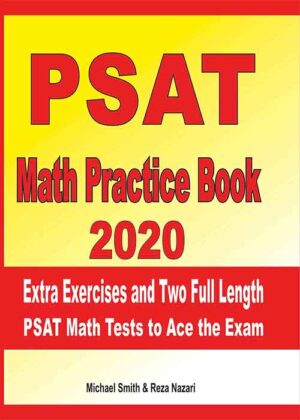 PSAT Math Practice Book 2020: Extra Exercises and Two Full Length PSAT Math Tests to Ace the Exam Original price was: $18.99.$12.99Current price is: $12.99.Download
 PSAT Math Workbook: Exercises, Activities, and Two Full-Length PSAT Math Practice Tests Original price was: $18.99.$12.99Current price is: $12.99.Download
 6 Full-Length PSAT / NMSQT Math Practice Tests: Extra Test Prep to Help Ace the PSAT Math Test Original price was: $18.99.$12.99Current price is: $12.99.Download
 PSAT Subject Test Mathematics: Student Practice Workbook + Two Full-Length PSAT Math Tests Original price was: $18.99.$12.99Current price is: $12.99.Download
 PSAT Math Comprehensive Exercise Book: Abundant Math Skill Building Exercises Original price was: $18.99.$12.99Current price is: $12.99.Download
 PSAT Summer Math Workbook: Essential Summer Learning Math Skills plus Two Complete PSAT Math Practice Tests Original price was: $18.99.$12.99Current price is: $12.99.Download
 SAT Subject Test Mathematics: Student Practice Workbook + Two Full-Length SAT Math Tests Original price was: $18.99.$12.99Current price is: $12.99.Download
 6 Full-Length SAT Math Practice Tests: Extra Test Prep to Help Ace the SAT Math Test Original price was: $18.99.$12.99Current price is: $12.99.Download
 SAT Summer Math Workbook: Essential Summer Learning Math Skills plus Two Complete SAT Math Practice Tests Original price was: $18.99.$12.99Current price is: $12.99.Download
 How to Prepare for the PSAT/NMSQT Math
 MECAS Mean Median Mode Practice — Maine Guide
 7 OST Math Study Habits for Ohio Students
 GED Math Prep: 7 Facts That Help You Pass First Try
 SDCA Math Prep: South Dakota Student Guide
Your PSAT Math Prep Roadmap: Tips That Work


📖 Reading time: 12 min
Quick answer: Effective PSAT math prep means understanding the two-module format, mastering the five core question types — algebra, advanced math, problem-solving, geometry, and data analysis — and practicing consistently for 4 to 8 weeks before test day.
Who this is for: High school students preparing for the PSAT 8/9 or PSAT 10/NMSQT, tutors building study plans for their students, and parents looking for a clear roadmap to help their teen succeed on test day.
Here’s a number that might surprise you: according to the National Center for Education Statistics (NCES), only about 4% of students who take the PSAT/NMSQT qualify as National Merit Scholarship semifinalists — and the math section plays a direct role in hitting that cutoff. Even if a scholarship isn’t your goal, strong PSAT math performance predicts SAT readiness and college placement outcomes, making this test far more important than many students realize.
Many students sit down to study and don’t know where to start. The PSAT math section covers a wide range of topics, from linear equations to data interpretation, and the new digital format adds another layer of unfamiliarity. That combination of broad content and a new testing environment can feel genuinely overwhelming.
This guide gives you a complete PSAT math prep plan. You’ll learn exactly what the math section tests and how it’s scored, how to pace yourself during the exam, the top five question types to master, common mistakes to avoid, a realistic study schedule, and the best resources available — including free math worksheets and structured practice books. By the end, you’ll have a clear action plan you can start using today.
What the PSAT Math Section Covers and How It’s Scored
The Structure of PSAT Math
The PSAT math section tests four core content domains: Algebra, Advanced Math, Problem-Solving and Data Analysis, and Geometry and Trigonometry. The exam — officially the PSAT/NMSQT (Preliminary SAT/National Merit Scholarship Qualifying Test) — moved to a digital, adaptive format in fall 2023, which changes how you should approach your PSAT math prep significantly.
The math portion is divided into two modules. Each module lasts 35 minutes and contains 22 questions, giving you 44 math questions total across 70 minutes. The first module presents a standard mix of difficulty levels. Based on your performance in module one, the second module adapts — you’ll receive either an easier or harder set of questions. Students who perform well on module one and receive the harder second module have access to a higher score ceiling, which is why starting strong matters enormously.
About 75% of PSAT math questions are multiple-choice with four answer options. The remaining 25% are student-produced response (SPR) questions, where you type in your own answer. There’s no penalty for wrong answers, so you should never leave a question blank. Guessing strategically on questions you’re unsure about is always worth doing.
The U.S. Department of Education has consistently emphasized that college readiness assessments like the PSAT provide students with measurable data about their academic trajectory — and the math score is one of the clearest signals of whether a student is on track for college-level coursework.
PSAT Math Scoring Explained
The PSAT math section is scored on a scale of 160 to 760. Your raw score — the number of questions you answer correctly — converts to a scaled score using a process called equating, which accounts for slight differences in difficulty across test forms. There’s no deduction for incorrect answers, so your strategy should always be to answer every question, even if you’re guessing on the hardest items.
The National Merit Scholarship cutoff — called the Selection Index — is determined by doubling your math score and adding your Evidence-Based Reading and Writing score. This means math carries extra weight in scholarship qualification. For context, the Selection Index cutoffs vary by state, but most semifinalist scores require total scaled scores well above 1400 combined.
Here’s a breakdown of what each content domain covers and its approximate weight on the exam:
- Algebra (35%): Linear equations in one variable, systems of equations, linear inequalities, and interpreting linear functions in context. This is the single largest content area on the test — mastering it gives you the biggest score gains.
- Advanced Math (35%): Quadratic equations, polynomial expressions, rational and radical equations, and nonlinear functions. Expect to factor, expand, and solve equations that go beyond simple one-variable problems.
- Problem-Solving and Data Analysis (15%): Ratios, proportions, percentages, unit conversion, interpreting tables, scatter plots, and statistical concepts like mean, median, and standard deviation.
- Geometry and Trigonometry (15%): Area, perimeter, volume, the Pythagorean theorem, similarity, congruence, circle equations, and basic right-triangle trigonometry (sine, cosine, tangent).
Understanding this breakdown is the first step in smart PSAT math prep. Since Algebra and Advanced Math together account for roughly 70% of your score, spending the majority of your study time on those two domains is the most efficient use of your preparation hours.
Time Management and the Top 5 Question Types
How to Pace Yourself Through PSAT Math
The most effective pacing strategy for PSAT math is to spend no more than 90 seconds on any single question during your first pass — and to flag hard questions immediately and return to them after completing the easier ones. With 22 questions in 35 minutes, you have just under 96 seconds per question on average, which feels tight if you’re not prepared.
Many students make a costly mistake: they get stuck on a hard problem early in the module and burn four or five minutes before moving on. Every minute you spend frozen on one question is a minute you can’t spend answering three easier questions correctly. Disciplined time management isn’t optional — it’s a core PSAT math strategy.
Here’s a practical pacing approach that works for most students:
- Questions 1-10 (first pass): Aim for 60 seconds or less per question. These tend to be easier. Lock in correct answers quickly and build your confidence early in the module.
- Questions 11-18 (medium difficulty): Budget 90 seconds each. Read carefully, eliminate wrong answers, and use scratch work. If a question takes longer than 2 minutes, flag it and move on.
- Questions 19-22 (hardest): Use your remaining time here. Don’t rush — but also don’t abandon the rest of the test for one hard problem. Make your best educated guess if time is short, then review if minutes remain.
- Final 5 minutes: Return to flagged questions. Check any SPR answers for calculation errors. Confirm every question has a response — blank answers earn zero points, so even a random guess gives you a chance.
Practicing this pacing strategy with timed PSAT math practice is essential. When you practice with math worksheets or full-length practice tests, always use a timer. Untimed practice builds knowledge — timed practice builds test-taking skill. You need both.
The Top 5 Question Types You’ll See on PSAT Math
PSAT math questions fall into predictable patterns. Students who recognize these patterns — and know the approach for each — gain a real advantage over those who treat every question as unfamiliar territory.
1. Linear Equation and Inequality Problems. These questions ask you to solve for a variable, interpret what a solution means in a real-world context, or set up an equation from a word problem. They’re the most common question type on the test. The key skill is translating word problems into algebraic expressions quickly and accurately.
2. Systems of Equations. These problems give you two equations with two variables and ask you to find the values that satisfy both. You’ll use substitution or elimination. A common PSAT twist is asking how many solutions a system has (one, none, or infinitely many) — which requires understanding the relationship between the equations rather than just solving them.
3. Quadratic Equations and Polynomial Functions. Expect to factor quadratics, use the quadratic formula, identify the vertex of a parabola, and interpret graphs of nonlinear functions. These appear heavily in the Advanced Math domain and are often the questions students find hardest.
4. Ratios, Proportions, and Percent Problems. These questions embed math in real-world scenarios — things like calculating a percent change in sales, finding unit rates, or interpreting data from a table. They test whether you can apply mathematical reasoning to everyday situations, not just solve abstract equations.
5. Geometry and Measurement. Area, perimeter, volume formulas, coordinate geometry, and basic trigonometry all appear here. A reference sheet is provided on the digital PSAT, so you don’t need to memorize every formula — but you do need to know how to apply them accurately under time pressure.
For students who want a structured approach to building mastery across all five of these question types, working through step-by-step lessons with built-in practice is one of the most reliable methods. Resources like the 5th Grade Alabama Math for Beginners book from Math Notion demonstrate the kind of clear, scaffolded instruction model that works — complete lessons, worked examples, and realistic practice problems in one organized package — which is exactly the format that transfers well to structured test prep at any level.
📚 More from Math Notion
PSAT Math Tips: Common Mistakes and How to Fix Them
Knowing what not to do is just as valuable as knowing the right strategies. These are the most common errors students make on PSAT math — and exactly how to correct each one before test day.
- Skipping the word problem setup and jumping straight to arithmetic. Word problems on the PSAT math section require careful reading before any calculation. Students who rush past the setup often solve the wrong equation — or solve the right equation for the wrong variable. Fix this by underlining what the question is actually asking before writing a single number. Make it a habit during every PSAT math practice session.
- Ignoring units in Problem-Solving and Data Analysis questions. Many students arrive at a correct numerical answer but choose the wrong option because they missed a unit conversion — for example, answering in feet when the question asks for inches. Always re-read the question after you solve it to verify your answer matches the requested unit or form.
- Forgetting to check for extraneous solutions in radical and rational equations. When you solve a radical equation by squaring both sides, you can introduce solutions that don’t actually satisfy the original equation. After solving, plug your answer back into the original equation to verify it works. This single habit eliminates an entire category of avoidable errors.
- Misreading graphs and tables in data analysis questions. PSAT math data questions often include deliberately misleading scales or non-zero y-axis starting points. Students who glance at a graph and estimate lose points they should have earned. Take five seconds to read axis labels, units, and the title of every graph before interpreting it.
- Not using the built-in calculator effectively. The digital PSAT provides a built-in Desmos graphing calculator. Many students either don’t use it at all or don’t know how to use it efficiently. Before test day, practice with the free online Desmos calculator so you can graph functions, check solutions, and verify quadratic roots quickly during the exam.
- Running out of time on student-produced response questions. SPR questions — where you type in your own answer — often appear near the end of the module. Students who use too much time on earlier questions arrive at SPRs exhausted and rushed. Structured math prep that includes timed SPR practice helps you build the efficiency needed to finish strong.
- Studying without reviewing wrong answers. Doing practice test questions without analyzing your errors is one of the least effective uses of study time. After every PSAT math practice session, spend equal time reviewing what you got wrong and understanding why. That review phase is where genuine improvement happens — not during the initial attempt.
Most of these mistakes share a common root: rushing. The PSAT math section rewards careful, methodical thinking more than raw speed. Students who slow down slightly, read every question fully, and check their work consistently outscore students who race through the test trying to bank extra time.
Building these habits during practice is critical. Every time you work through a PSAT math study guide or a set of math worksheets, practice the habits above — not just the math content. Test-day behavior is a direct reflection of practice habits. If you rush during practice, you’ll rush on test day. If you check your work during practice, you’ll check it on test day too.
Worked Examples: PSAT Math Practice Questions
Example 1: Linear Equation in Context
Problem: A school store sells pens for $1.50 each and notebooks for $3.00 each. A student spends exactly $18.00 and buys a total of 8 items. How many notebooks did the student buy?
Step 1: Set up a system of equations. Let p = number of pens and n = number of notebooks.
Equation 1 (total items): p + n = 8
Equation 2 (total cost): 1.50p + 3.00n = 18
Step 2: Solve Equation 1 for p: p = 8 − n
Step 3: Substitute into Equation 2: 1.50(8 − n) + 3.00n = 18
Expand: 12 − 1.50n + 3.00n = 18
Combine like terms: 12 + 1.50n = 18
Subtract 12: 1.50n = 6
Divide: n = 4
Answer: The student bought 4 notebooks. Check: 4 notebooks + 4 pens = 8 items. Cost: 4(3.00) + 4(1.50) = 12 + 6 = $18. ✓
Example 2: Quadratic Equation
Problem: What are the solutions to x² − 5x + 6 = 0?
Step 1: Factor the quadratic. Find two numbers that multiply to +6 and add to −5. Those numbers are −2 and −3.
Step 2: Write the factored form: (x − 2)(x − 3) = 0
Step 3: Apply the zero-product property. Either x − 2 = 0 or x − 3 = 0.
So x = 2 or x = 3.
Answer: The solutions are x = 2 and x = 3. On a graph, these are the x-intercepts of the parabola y = x² − 5x + 6, which opens upward and crosses the x-axis at those two points.
Example 3: Percent Change in a Data Table
Problem: A store sold 240 math workbooks in January and 300 math workbooks in February. What is the percent increase in sales from January to February?
Step 1: Find the change in sales: 300 − 240 = 60
Step 2: Divide the change by the original value: 60 ÷ 240 = 0.25
Step 3: Convert to a percent: 0.25 × 100 = 25%
Answer: Sales increased by 25% from January to February. This type of percent change calculation appears frequently in PSAT math’s Problem-Solving and Data Analysis domain — know this formula cold: Percent Change = (New − Old) ÷ Old × 100.
Study Schedule and Best Practice Resources
4-Week PSAT Math Study Plan
A 4-week PSAT math study schedule works well for students who have solid foundational math skills and need focused review and practice rather than from-scratch learning. Plan on studying 45 to 60 minutes per day, five days per week.
Week 1 — Algebra Foundation: Spend the full week on linear equations, inequalities, and systems of equations. Complete 20-30 algebra practice problems each day. Use free math worksheets targeting one-variable equations on days 1-2, systems of equations on days 3-4, and linear inequalities on day 5. Take a 10-question timed quiz on Friday to measure your starting baseline in this domain.
Week 2 — Advanced Math: Focus on quadratic equations, factoring, polynomial expressions, and nonlinear functions. Practice factoring every day until it feels automatic. Spend one day on the quadratic formula and one day on interpreting parabola graphs using Desmos. Use the College Board’s official PSAT math practice problems available on their website as your primary resource this week.
Week 3 — Data Analysis and Geometry: Alternate between data interpretation (ratios, percentages, scatter plots, tables) and geometry (area, volume, coordinate geometry, basic trig). This is also the week to review the reference sheet provided on the digital test so you know exactly what’s given and what you need to apply from memory.
Week 4 — Full Practice Tests and Review: Take two full-length timed PSAT math practice modules. After each, spend equal time reviewing every wrong answer. Identify your two weakest question types and do targeted math prep on those topics for the remaining days. The day before the test: light review only, no new material.
8-Week PSAT Math Study Plan
Students who want a more thorough preparation timeline — or who are starting from a weaker math foundation — will benefit from an 8-week plan. Study 30 to 45 minutes daily, five days per week.
Weeks 1-2 — Arithmetic and Pre-Algebra Review: Before diving into PSAT-specific content, solidify your number sense, fraction operations, decimal and percent conversions, and ratio and proportion skills. These concepts underlie the Problem-Solving and Data Analysis domain and also appear embedded in algebra problems.
Weeks 3-4 — Algebra: Follow the same algebra plan as the 4-week schedule, but move more slowly. Spend extra time on word-problem setup and on translating between verbal descriptions and algebraic equations. Use math worksheets with worked examples so you can see the solution process step by step before attempting problems independently.
Weeks 5-6 — Advanced Math and Data Analysis: Work through quadratic equations, polynomial functions, statistical concepts (mean, median, mode, range, standard deviation), and data interpretation. Practice reading and analyzing tables, bar graphs, line graphs, and scatter plots. This is also when you should start incorporating timed practice — 10 questions in 15 minutes, working up to full modules.
Weeks 7-8 — Geometry, Full Tests, and Final Review: Cover geometry and trigonometry in week 7. In week 8, take two complete timed practice exams, review all errors thoroughly, and target your weakest areas. Enter test day having already experienced the pressure of a timed exam — it makes the real thing feel far less intimidating.
Best PSAT Math Practice Resources
The best free resource for official PSAT math practice is the College Board’s own test prep platform, which offers full-length practice tests modeled after the real digital exam. Khan Academy’s official SAT prep (which closely parallels PSAT content) also offers free, personalized practice based on your College Board diagnostic results.
For printed math worksheets and structured workbooks, Math Notion’s library of math prep books at mathnotion.com/tests/ offers organized, grade-aligned practice materials that help students build fluency before tackling full-length digital practice tests. A free study guide approach — combining official College Board practice with supplemental worksheet practice — gives you the broadest preparation foundation.
🎯 Recommended Math Book
5th Grade Alabama Math for Beginners — $14.99
Category: Alabama, General, Grade 5
.mnshort{margin:0 0 8px}.mnshort p{font-size:17px;font-weight:700;line-height:1.55;color:#12305b;margin:0 0 8px}.mnshort .cta{color:#c0392b}.mnshort .mn-amz{margin:12px 0 0}
Master every topic and walk into test day with real confidence. Clear step-…
Test-Day Strategies: What to Bring and How to Stay Calm
What to Bring on PSAT Test Day
Walking into the PSAT fully prepared means knowing what’s allowed, what’s required, and what to leave at home. The digital PSAT is taken on a school-provided or personal device using the Bluebook testing app — so your primary concern is arriving ready to focus, not carrying the right pencils.
Here’s what you need on test day:
- Your device, fully charged: If your school allows personal devices, make sure it’s charged to 100% the night before. Bring a charger as a backup even if power outlets aren’t promised — some testing rooms have them.
- Acceptable photo ID: A school ID, driver’s license, or passport. Check your school’s specific requirements in advance.
- Your College Board admission ticket: Print it or have it accessible on your phone. Don’t assume your name is on a list.
- Scratch paper and a pencil: Scratch paper will be provided at the testing center, but bring a few pencils anyway. Physical scratch work for math problems is faster for most students than typing notes.
- A snack for the break: The PSAT includes a short break between sections. A small snack — something with protein or complex carbohydrates — helps maintain mental focus for the second half of the test.
What to leave home: notes, unauthorized calculators (the Desmos calculator is built into the Bluebook app), and any external devices beyond what your testing center permits. Review your test center’s rules the week before to avoid surprises.
Managing Math Anxiety on Test Day
Math anxiety is real — and it’s common. Research consistently shows that test anxiety temporarily reduces working memory capacity, which is the exact cognitive resource you need for solving multi-step math problems. The students who manage anxiety best on test day are those who have practiced under realistic conditions enough times that the testing environment feels familiar rather than threatening.
Before the test: get a full night’s sleep. Sleep deprivation measurably impairs mathematical reasoning, problem-solving speed, and the ability to recall procedures learned during PSAT math prep. Going into the test tired costs points you studied hard to earn.
During the math section: if you feel your heart rate climbing on a hard question, use a simple technique — skip it immediately, flag it, and move to the next question. The act of making forward progress resets your mindset and prevents the spiral of anxiety that comes from staring at a problem you can’t solve. Remind yourself that the test is adaptive — you don’t need to get every question right to earn a strong score.
Finally, trust your preparation. Students who work through consistent PSAT math study — building skills across all four content domains, practicing under timed conditions, and reviewing their errors — walk into test day with a genuine advantage. Math confidence doesn’t come from hoping you’ll remember everything. It comes from proving to yourself, through practice, that you already know how to handle these problems.
Frequently Asked Questions
What math topics should I focus on most for PSAT math prep?
Focus first on Algebra and Advanced Math, which together make up roughly 70% of your PSAT math score. Linear equations, systems of equations, and quadratic equations appear most frequently. After solidifying those areas, move to Problem-Solving and Data Analysis (percentages, ratios, data interpretation) and then Geometry. This prioritization gives you the highest score return for the time you invest in PSAT math practice.
How many questions are on the PSAT math section?
The PSAT math section has 44 questions total, split across two adaptive modules of 22 questions each. Each module is 35 minutes long, giving you 70 minutes of math testing time. Approximately 75% of questions are multiple-choice and 25% are student-produced response (SPR) questions where you enter your own answer. There is no penalty for incorrect answers, so always answer every question.
What is considered a good PSAT math score?
The PSAT math section is scored on a scale of 160 to 760. A score at or above the 75th percentile — roughly 570 or higher — is generally considered strong. For National Merit Scholarship consideration, students typically need combined scores (math plus reading and writing) well above 1400, with the exact state-specific cutoff varying by year. Your PSAT math score also serves as a benchmark for SAT readiness, making consistent PSAT math prep valuable regardless of scholarship goals.
Key Takeaways
- The PSAT math section tests four domains — Algebra, Advanced Math, Problem-Solving and Data Analysis, and Geometry — with Algebra and Advanced Math making up 70% of your score. Prioritize these areas first.
- Pace yourself using a first-pass, flag, and return strategy: 60-90 seconds per question, flag hard ones immediately, and never leave a question blank since there’s no penalty for wrong answers.
- The seven most costly PSAT math mistakes all share one root: rushing. Slow down, read every question fully, and build careful work habits during every practice session — not just on test day.
- A structured 4-week or 8-week PSAT math study schedule, combined with timed practice modules and thorough error review, produces measurably better outcomes than scattered, untimed studying.
Your PSAT math prep doesn’t have to be overwhelming. With a clear understanding of what the test covers, a realistic study schedule, and consistent practice across all four content domains, you can walk into test day prepared and confident. The students who perform best aren’t necessarily the ones who are naturally “good at math” — they’re the ones who prepared deliberately and practiced under realistic conditions. Start with the study plan that fits your timeline, work through the question types outlined in this guide, and use the resources available at mathnotion.com/tests/ to find math prep books and practice materials organized by topic and level.
Posted by Math Notion Team · Published on September 4, 2026