Math Articles, tips & study guides
 GED Math Workbook: Activities, Exercises, and Two Complete GED Mathematics Practice Tests Original price was: $18.99.$12.99Current price is: $12.99.Download
 GED Math Comprehensive Exercise Book: Abundant Math Skill Building Exercises Original price was: $18.99.$12.99Current price is: $12.99.Download
 GED Subject Test Mathematics: Student Practice Workbook + Two Realistic GED Math Tests Original price was: $18.99.$12.99Current price is: $12.99.Download
 6 GED Math Practice Tests: Extra Practice to Achieve a Crack Score Original price was: $18.99.$12.99Current price is: $12.99.Download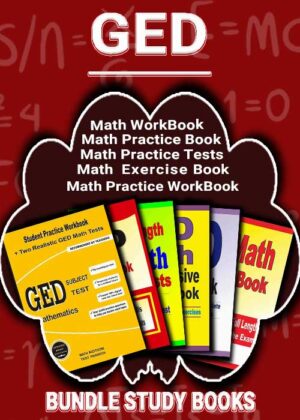
 GED Math Exercise Book: Review of Essential Skills and Concepts with 2 GED Math Practice Tests Original price was: $18.99.$12.99Current price is: $12.99.Download
 GED Math Practice Book: Complete Content Review Plus 2 Full-length GED Math Tests Original price was: $18.99.$12.99Current price is: $12.99.Download
 GED Math Workbook: Essential Learning Math Skills Plus Two Complete GED Math Practice Tests Original price was: $18.99.$12.99Current price is: $12.99.Download
 GED Math Practice Book 2020: Extra Exercises and Two Full Length GED Math Tests to Ace the Exam Original price was: $18.99.$12.99Current price is: $12.99.Download
 GED Math Prep: The Ultimate Step by Step Guide Plus Two Full-Length GED Practice Tests Original price was: $18.99.$12.99Current price is: $12.99.Download
 GED Math Prep: 7 Facts That Help You Pass First Try
 GED Math for Beginners: A Step-by-Step Starter Guide
 GED & HiSET Math Formula Cheat Sheet (Essential Formulas)
 How Long Is the GED Math Test? Timing and Pacing Explained
 The GED Math Test: A Complete Overview
Math Topics on the GED: A Complete Breakdown


If you’re preparing for the GED, knowing exactly which math topics the test covers lets you focus your studying where it counts. The GED math topics fall into a defined, finite set of skills, so understanding what’s on the test, and what isn’t, helps you prepare efficiently rather than studying blindly. This guide breaks down the math topics on the GED, explains what each involves, and shows how to practice them, so you can build exactly the skills the test rewards.
The GED math test covers two broad areas, quantitative problem-solving and algebraic problem-solving, each made up of specific topics. Below we’ll walk through them, so you know precisely what to study, and show how steady GED math practice on these exact topics prepares you to pass the GED math test.
The two main areas of GED math
GED math content divides into two broad categories. Quantitative problem-solving covers number sense and operations, fractions, decimals, percentages, ratios, proportions, and basic measurement and data. Algebraic problem-solving covers expressions, equations, inequalities, exponents, polynomials, functions, and graphing. Together these two areas make up the whole test, roughly evenly split.
Knowing this split helps you balance your studying across both areas. Many test-takers are stronger in one than the other, so identifying which needs more work lets you focus efficiently. A complete workbook covers both, building from the quantitative fundamentals into the algebra, in the logical order that makes learning easiest.
Number sense and operations
A foundational topic is number sense and operations: working with whole numbers, understanding place value, and performing the four operations accurately. While this may seem basic, it underpins everything else, and the test assumes fluency with it. Strong number sense also helps you estimate and check whether answers are reasonable.
This topic includes working with positive and negative numbers (integers), which appear throughout the test. Comfort with the number line and integer operations is essential, since sign errors are a common source of mistakes. Solidifying number sense and operations is the first step in mastering the GED math topics.
Fractions, decimals, and percentages
Fractions, decimals, and percentages are among the most important and frequently tested GED math topics. You’ll need to add, subtract, multiply, and divide fractions, work with decimals, calculate percentages, and convert among these forms. These appear in both pure-computation questions and applied word problems.
Because these topics are so common, and so often a stumbling block, they deserve focused attention. Many test-takers find fractions especially challenging, so practicing them until they’re comfortable pays off enormously. Mastering fractions, decimals, and percentages is one of the highest-value things you can do for the GED math test.
Ratios, proportions, and rates
Ratios, proportions, and rates are key GED math topics that appear in many word problems. You’ll need to understand ratios, solve proportions (often by cross-multiplying), and work with rates like speed or cost per unit. These skills are essential for the applied, real-world problems the GED favors.
Proportional reasoning shows up constantly, from comparing prices to scaling quantities, so it’s worth practicing thoroughly. Once you recognize the structure of a proportion problem and can solve it confidently, a whole category of GED questions becomes manageable. This topic bridges arithmetic and the algebra that follows.
Measurement and geometry
The GED includes measurement and geometry topics: calculating area, perimeter, and volume; working with the Pythagorean theorem; understanding properties of shapes; and using units and conversions. A formula sheet is provided, but you need to know which formula to use and how to apply it.
These topics appear in applied problems about real-world spaces and objects, so they’re practical as well as tested. Knowing the key formulas, and practicing applying them, ensures you can handle the geometry and measurement questions efficiently. They’re a finite, learnable set that rewards focused practice.
Data analysis and statistics
Data analysis, statistics, and probability are GED math topics that involve interpreting graphs, tables, and charts; calculating measures like mean, median, mode, and range; and understanding basic probability. In a data-rich world, these skills are both widely useful and meaningfully represented on the test.
You’ll need to read and interpret different data displays and summarize data with the right measures. These topics aren’t difficult once you know the definitions and practice applying them, and they offer reliable points. Including data and statistics in your studying ensures you’re ready for this important part of the test.
Expressions and equations
Moving into algebra, expressions and equations are central GED math topics. You’ll write and evaluate algebraic expressions, simplify them, and solve linear equations and inequalities. Solving equations, finding the unknown by keeping both sides balanced, is a core skill that underlies much of the algebra on the test.
These topics represent the heart of algebraic problem-solving and appear throughout the test. Building fluency with expressions and equations, from simple one-step problems to multi-step ones, is essential. For many adult learners, this is the area most in need of rebuilding, and focused practice here makes a big difference.
Exponents and polynomials
The GED covers exponents and polynomials: applying the rules of exponents, and adding, subtracting, and multiplying polynomial expressions. Factoring may also appear. These topics extend your algebraic toolkit and prepare you for the more advanced questions on the test.
While these can feel mechanical, they follow consistent patterns that become automatic with practice. Knowing the exponent rules and being comfortable manipulating polynomials lets you handle this portion of the test efficiently. Including these topics in your studying rounds out your algebra preparation.
Functions and graphing
The GED includes functions and graphing topics: understanding the coordinate plane, graphing linear equations, finding slope, and interpreting functions and graphs. Linear relationships in particular appear frequently, so understanding slope and how to graph and read lines is important.
These topics connect algebra to visual representation and to real-world relationships. Being able to interpret a graph and understand what a function represents prepares you for the many GED questions involving lines and relationships. Practicing graphing and function problems ensures you’re ready for this content.
What’s not on the GED math test
It’s also useful to know what the GED doesn’t test, so you don’t waste time. The GED math test doesn’t include advanced topics like calculus, trigonometry, or higher-level math. It focuses on the foundational and intermediate skills described above, which is reassuring, the content is finite and entirely learnable.
Knowing the boundaries lets you concentrate your studying on the topics that actually appear, rather than worrying about advanced material. This focused approach makes preparation efficient: master the listed topics, and you’ve covered what the GED math test will ask, with no need to study beyond them.
How to study the GED math topics
The most effective approach is to work through the topics systematically, starting with the quantitative fundamentals, number sense, fractions, percentages, ratios, then moving into algebra, geometry, and data. Master each topic before moving on, since later ones build on earlier ones, and practice actively by working problems.
Identifying your weak topics and giving them extra attention makes studying efficient. Review your mistakes to understand them, and take a practice test to see which topics still need work. This topic-by-topic, foundation-first approach ensures you cover everything the GED math test includes.
Practice the topics with GED worksheets
Targeted practice on each topic is the key to mastery. Math Notion offers free, printable GED math worksheets covering the arithmetic, fractions, algebra, geometry, and data topics the test includes, so you can drill exactly the areas you need.
Browse the full library on our math worksheets page for more practice, including grade-level worksheets to shore up any rusty foundations. Working topic by topic, reviewing every mistake, builds the skills the GED rewards. This focused practice on the exact GED math topics is the most efficient path to a passing score.
The workbook that covers every topic
For complete coverage of all the GED math topics, a structured workbook is ideal. The GED Subject Test Math workbook covers exactly the number sense, fractions, ratios, algebra, geometry, and data the test measures, organized topic by topic, with clear lessons and step-by-step answer explanations you can follow on your own.
Paired with the free GED worksheets for targeted practice, a workbook ensures you master every topic the test includes. It’s an instant download, so you can start working through the GED math topics tonight. Browse all our GED math resources → to find the right fit.
How the topics are weighted
It helps to know that the GED math topics aren’t all weighted equally. The test draws roughly half its questions from quantitative problem-solving and half from algebraic problem-solving, and within those, certain topics, like fractions and percentages, ratios and proportions, and linear equations, appear more often than others. Knowing this lets you prioritize: the highest-value studying targets the topics that show up most.
This doesn’t mean ignoring the less-frequent topics, but it does mean ensuring your strongest preparation goes to the heavily tested areas. A test-taker fluent in fractions, proportions, and basic algebra has covered a large share of the test before even reaching the less common topics. Studying with this weighting in mind makes your preparation as efficient as possible.
Connecting the topics together
While it’s useful to study the GED math topics one at a time, it’s worth remembering how they connect. Fractions and number sense underpin ratios and percentages; those feed into algebra; algebra connects to functions and graphing. Seeing these connections helps the topics reinforce one another rather than feeling like a disconnected list to memorize.
This is why a foundation-first approach works so well: mastering the earlier topics makes the later ones far easier, because they build on the same skills. As you work through the topics, look for how each relates to the others, and you’ll find your understanding deepening across the whole test. Steady GED math practice that builds these connected topics in order is the surest path to covering everything the GED asks and walking in fully prepared.
Frequently asked questions
What math topics are on the GED?
Number sense and operations, fractions, decimals, percentages, ratios and proportions, measurement and geometry, data and statistics, expressions and equations, exponents and polynomials, and functions and graphing.
Is calculus or trigonometry on the GED math test?
No. The GED math test focuses on foundational and intermediate skills and does not include calculus, trigonometry, or higher-level math, so the content is finite and learnable.
Which topics should I focus on most?
Fractions, decimals, and percentages, along with expressions and equations, are heavily tested and often the most challenging, so they deserve focused practice, along with whatever areas you find weakest.
How should I study the topics?
Work through them systematically, starting with the quantitative fundamentals and building into algebra, geometry, and data. Master each before moving on, practice actively, and review your mistakes.
Math Notion makes standards-aligned math workbooks and test prep for learners at every level and across all 50 states. See the full collection.
Posted by Math Notion Team · Published on June 18, 2024