Math Articles, tips & study guides
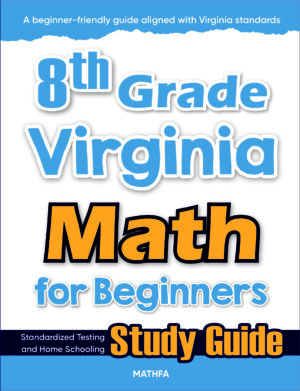 8th Grade Virginia Math for Beginners Original price was: $21.99.$14.99Current price is: $14.99.Download
 6th Grade Virginia Math for Beginners Original price was: $21.99.$14.99Current price is: $14.99.Download
 7th Grade Virginia Math for Beginners Original price was: $21.99.$14.99Current price is: $14.99.Download
 8th Grade West Virginia Math for Beginners Original price was: $21.99.$14.99Current price is: $14.99.Download
 8th Grade Alabama Math for Beginners Original price was: $21.99.$14.99Current price is: $14.99.Download
 6th Grade West Virginia Math for Beginners Original price was: $21.99.$14.99Current price is: $14.99.Download
 7th Grade Alabama Math for Beginners Original price was: $21.99.$14.99Current price is: $14.99.Download
 7th Grade West Virginia Math for Beginners Original price was: $21.99.$14.99Current price is: $14.99.Download
 WVGSA Math Prep: West Virginia Student Guide
 WVGSA Math Prep: West Virginia Student Guide
 7 SOL Math Prep Strategies for Virginia Students
 6th Grade West Virginia Math: WVGSA Guide (2026)
 IAR Quadratic Equations Practice — Illinois Guide
WVGSA Math Prep: West Virginia Student Guide


📖 Reading time: 11 min
Quick answer: To pass the WVGSA math section, West Virginia students should focus on number sense, algebraic reasoning, geometry, and data analysis — the four core domains tested — and complete targeted math practice problems at least four days per week in the weeks leading up to the assessment.
Who this is for: West Virginia students in grades 3–8 preparing for the WVGSA math assessment, parents supporting their child’s math readiness at home, and homeschool families looking for a structured West Virginia math test preparation plan.
Nearly one in three students across the country scores below proficient in math on state assessments — and West Virginia students face the same challenge every spring when the WVGSA arrives. If that statistic makes you feel uneasy, you’re not alone. The good news is that math proficiency on a state test is not a matter of talent. It’s a matter of preparation, practice, and knowing exactly what the test asks you to do.
WVGSA math prep doesn’t have to be overwhelming. This guide breaks down everything you need to know — what the test covers, which skills matter most, how to build a realistic study plan, and how to practice the right way so that math confidence grows alongside your score. Whether you’re a student working on your own or a parent guiding a child through review, this roadmap gives you a clear path forward.
By the end of this post, you’ll understand the structure of the WVGSA math section, know which topics to prioritize, have a set of proven study strategies you can start today, and see worked examples of the types of problems you’ll actually face on test day.
Understanding the West Virginia WVGSA Math Assessment
What the WVGSA Tests and Why It Matters
The WVGSA (West Virginia General Summative Assessment) is the annual state test that measures how well West Virginia students in grades 3 through 8 have mastered math and English language arts standards. On the math side, the assessment is directly aligned to West Virginia’s College and Career Readiness Standards (WVCCRS), which are built on a foundation of progressive mathematical reasoning — meaning each grade’s content builds on the one before it.
Understanding the test format is the first step in any smart WVGSA math prep plan. The math section is not a random sampling of problems. Every question maps to a specific standard, and those standards fall into predictable domains that repeat across grade levels with increasing complexity. According to the West Virginia – WVGSA Math Assessment page maintained by the West Virginia Department of Education, the assessment is designed to measure student achievement and growth against these rigorous academic standards — making it one of the most important benchmarks of math mastery in the state.
For most grade levels, the WVGSA math section covers four broad content domains: Operations and Algebraic Thinking (or Expressions and Equations at higher grades), Number and Operations, Measurement and Data (or Statistics and Probability), and Geometry. The weight of each domain shifts as students move from grade 3 toward grade 8, with algebraic reasoning taking on a much larger share by middle school. Knowing which domain carries the most weight at your specific grade level lets you spend your study time where it counts most.
The test includes both multiple-choice questions and technology-enhanced items — meaning students may need to drag and drop answers, fill in a number grid, or interact with a graph or table. This makes it important to practice not just the math itself but also the style of questions you’ll encounter. Students who’ve only drilled multiple-choice problems can feel caught off guard by open-ended items that ask them to show reasoning or select multiple correct answers.
The Four Core Math Domains on the WVGSA
Breaking down the four domains helps you build a study checklist that’s specific to what the test actually measures. Here’s what each domain focuses on and why each one matters for your overall score:
- Operations and Algebraic Thinking / Expressions and Equations: This domain covers the relationship between numbers and operations — writing and evaluating expressions, solving one- and two-step equations, identifying patterns, and working with variables. For grades 6–8, this becomes the heaviest-weighted domain and includes work with inequalities, proportional relationships, and linear equations. Students who feel shaky on algebraic reasoning often lose the most points here, so targeted algebra practice pays off significantly. Spend extra time writing and solving equations from word problems, since contextual algebraic thinking is a consistent feature of WVGSA items.
- Number and Operations: This domain tests math fluency with whole numbers, fractions, decimals, and integers. At lower grade levels, the focus is on place value, addition, subtraction, multiplication, and division. At higher grade levels, it expands to include rational numbers, percentages, ratios, and proportions. Students who struggle with fraction operations — adding fractions with unlike denominators, multiplying mixed numbers, dividing fractions — tend to find this domain the most time-consuming. Regular number sense drills, even five minutes a day, create the automaticity that saves time on test day.
- Measurement and Data / Statistics and Probability: This domain includes reading and interpreting graphs, calculating mean, median, mode, and range, working with units of measurement, and understanding basic probability. At the middle school level, it expands to include scatter plots, two-way tables, and data distributions. Many students underestimate this domain because it feels more applied than abstract algebra — but it consistently appears across all grade levels and rewards students who practice reading and interpreting real-world data carefully.
- Geometry: The geometry domain covers angles, triangles, area and perimeter of polygons, surface area and volume of three-dimensional figures, and coordinate geometry. For grades 6–8, it includes working with the Pythagorean theorem and understanding geometric transformations. Students often find geometry more approachable once they memorize key formulas — area of a triangle, volume of a rectangular prism — and practice applying them to word problems rather than just abstract diagrams.
How Scores Are Reported and What Proficiency Means
West Virginia reports WVGSA math scores across four performance levels: Distinguished, Above Mastery, Mastery, and Partial Mastery. The goal for every student is to reach Mastery or above, which signals that a student has demonstrated solid command of the grade-level math standards. Reaching Mastery doesn’t mean getting every question right — it means demonstrating consistent understanding across the domains the test covers. That’s an important distinction, because it means strategic preparation — knowing where to focus effort — can meaningfully move a score from Partial Mastery to Mastery even without perfecting every single topic.
Growth scores also matter on the WVGSA. Even students who don’t reach Mastery in a single year can demonstrate significant academic growth, which is tracked and reported separately. This is encouraging for students who are working hard but still building foundational skills — the test recognizes improvement, not just absolute performance.
West Virginia Math Test Preparation: Building Your Study Plan
How to Structure Effective WVGSA Math Practice
The most effective West Virginia math test preparation follows a simple structure: assess, target, practice, and review. Students who skip the assessment step and go straight to random practice often spend time reinforcing concepts they already know while leaving real gaps untouched. A focused plan starts by identifying exactly which domains and skills need the most work.
Start by taking a WVGSA math practice test — ideally one aligned to your specific grade level and the West Virginia College and Career Readiness Standards. Score yourself honestly. Which domain lost you the most points? Which question types took the longest to answer or left you guessing? Those answers become your study priorities. According to the National Center for Education Statistics (NCES), consistent, targeted math practice is one of the most reliable predictors of improved math achievement — and that finding holds across grade levels and demographic groups.
Once you’ve identified your weak areas, build a weekly schedule that dedicates more time to those domains without abandoning the ones you’ve already mastered. A reasonable structure for a six-week WVGSA math prep plan looks like this: spend weeks one and two reviewing Number and Operations, weeks three and four covering Algebraic Thinking and Expressions, and weeks five and six focusing on Geometry and Data/Statistics — with a full practice test at the end of each two-week block to measure progress. Review every wrong answer carefully. Understanding why an answer is wrong builds more math confidence than simply drilling more problems.
Daily consistency matters more than marathon weekend study sessions. Research consistently shows that spaced practice — shorter sessions spread across multiple days — produces better long-term retention than cramming. Even 30 minutes of math practice problems four to five days a week will outperform a single three-hour session on Saturday. Set a specific time each day, keep it short enough to stay focused, and end every session by reviewing at least three problems you got wrong or found difficult.
Targeting Algebra for the WVGSA
Algebra is where many students’ scores drop most sharply — particularly from grade 6 onward, when the WVGSA math section demands fluency with variables, equations, and proportional reasoning. For students in middle school preparing for the WVGSA, algebraic thinking deserves its own dedicated study block each week.
The key to building algebra skills quickly is to move from concrete to abstract. Start with numerical patterns — if a sequence follows a rule, identify it. Then move to expressions: translate a word phrase like “seven less than twice a number” into an algebraic expression (2n − 7). Next, practice solving one-step and two-step equations, always checking your answer by substituting it back into the original equation. Finally, tackle word problems that require setting up and solving an equation — this is the format the WVGSA uses most frequently for algebra items.
For students who want structured, step-by-step practice covering all of these algebraic concepts in the context of West Virginia standards, West Virginia Algebra 1 for Beginners provides comprehensive coverage of Algebra 1 topics aligned to the state’s College and Career Readiness Standards. It’s designed for both classroom use and at-home practice, making it equally useful for students working independently and for parents or homeschool families guiding a child through pre-algebra and algebra readiness. The workbook format means students aren’t just reading explanations — they’re applying concepts through practice immediately after learning them, which is exactly the kind of active engagement that builds real math mastery.
🎯 Recommended Math Book
West Virginia Algebra 1 for Beginners — $16.99
Category: Algebra 1, General, Test, West Virginia
Comprehensive Algebra 1 Study Guide & Workbook
Perfect for classroom learning, homeschooling,
or extra practice at home.
Using Practice Tests the Right Way
A WVGSA math practice test is one of the most powerful tools in your prep plan — but only if you use it correctly. Most students take a practice test, check their score, feel good or bad about it, and move on. That approach wastes the most valuable part of the practice test: the wrong answers. Every incorrect response is a window into a specific gap in understanding. When you get a problem wrong, don’t just look up the answer. Work backward: what concept did the question test? Which step did you miss or misapply? Could you solve a similar problem correctly now?
Take at least two full practice tests under realistic conditions — seated at a desk, with a timer, no distractions, using only the tools the actual test allows. The second practice test should show measurable improvement from the first. If it doesn’t, the study plan needs adjustment — either the wrong topics are being reviewed, the practice sessions aren’t frequent enough, or the practice materials don’t closely match the actual WVGSA format.
Proven WVGSA Math Prep Strategies You Can Use Today
These strategies are specifically designed for WVGSA math prep — not generic study advice, but concrete, math-specific actions you can put to work today. Each one targets a different aspect of test preparation, so they work best when used together as part of a regular routine.
- Start every study session with a warm-up of mental math and number sense. Before diving into practice problems, spend five minutes on mental math — estimating sums, identifying whether a fraction is closer to 0, ½, or 1, or quickly converting a percent to a decimal. This activates mathematical reasoning and primes your brain for more complex problem-solving. Students who build strong number sense make fewer careless errors on the WVGSA because they recognize when an answer is unreasonable before they even check their work. Number sense exercises don’t have to be fancy — a quick set of 10 mental math questions from a worksheet is enough to warm up effectively.
- Practice word problems every single session — without exception. The WVGSA math section is heavy on contextual, real-world problems. These aren’t abstract computations; they’re scenarios involving rates, distances, quantities, and relationships that require you to read carefully, identify the math operation needed, and then execute it correctly. Many students who can solve a naked equation struggle when the same concept is embedded in a word problem. The fix is simple: practice word problems every day. Highlight the key numbers, underline what the question asks, and identify the operation before you write a single digit.
- Memorize essential math formulas and practice applying them — not just recalling them. The WVGSA math section tests your ability to use formulas, not just list them. Memorize the area formulas for rectangles, triangles, circles, and trapezoids. Know the formulas for volume of rectangular prisms and cylinders. Understand how the Pythagorean theorem (
a² + b² = c²) works and when to apply it. For each formula you memorize, practice at least three problems where you apply it to a realistic scenario — a room with specific dimensions, a circular garden with a given radius, a ramp with a known height and base. Application practice is what turns memorized formulas into reliable test-day tools. - Review fraction operations until they feel automatic. Fractions appear across every grade level on the WVGSA, and fraction errors are among the most common reasons students lose points they could easily earn. Practice adding and subtracting fractions with unlike denominators by finding the least common denominator. Practice multiplying fractions by multiplying numerators together and denominators together. Practice dividing fractions by flipping the second fraction and multiplying. Most importantly, practice converting between improper fractions and mixed numbers — both forms appear on the test and students who can move between them fluidly save significant time. Set aside one practice session per week specifically for fraction drills until these operations feel second nature.
- Interpret graphs, tables, and data displays with focused practice. The WVGSA regularly includes questions that require reading a bar graph, a line plot, a circle graph, or a data table and answering questions about the information shown. Students who’ve practiced only computation problems often slow down dramatically on data items because they haven’t developed the habit of reading data displays carefully before answering. In your study sessions, include at least two or three data interpretation problems per week. Practice identifying what each axis represents, what scale is used, what the highest and lowest values are, and what conclusions the data supports.
- Use a consistent system for checking your work. Time pressure is real on any standardized math test. But students who rush through the WVGSA without checking their work leave easy points behind. Develop a quick checking habit: after solving a problem, re-read the question to confirm you answered what was actually asked (not what you assumed was asked), verify your arithmetic by working backward when possible, and check that your answer has the right units if the problem involves measurement. This three-step check takes about 20 seconds per problem and consistently catches the kind of careless errors that cost students a full performance level on the WVGSA.
- Build math confidence through small daily wins. Math confidence isn’t built in a single study marathon — it accumulates through consistent small victories. Each day, set a specific, achievable goal: “I will solve 10 fraction problems and get at least 8 correct.” When you hit that goal, it registers as a genuine success and motivates the next session. Students who set vague goals (“I’ll study math today”) feel less accomplished and are more likely to lose motivation. Specific, measurable daily goals tied to WVGSA math topics create momentum that carries through the entire prep period.
Beyond these individual strategies, the way you organize your study materials matters. Keep a dedicated math notebook where you record formulas, worked examples, and mistakes. When you get a problem wrong, write down the correct method in your own words — explaining a solution out loud or in writing is one of the most powerful ways to move a concept from short-term memory to long-term retention. Students who keep error logs and review them before each practice test consistently improve faster than those who don’t.
Finally, pay attention to how you manage time during practice. On the actual WVGSA, you have a set amount of time to complete the math section, and students who’ve never practiced under a timer often find themselves rushing at the end. During at-home practice, use a timer for every session. If you’re spending more than two or three minutes on a single problem, mark it and move on — then return to it if time allows. Practicing this triage mindset prevents one hard problem from derailing your entire test.
Worked Examples: WVGSA-Style Math Problems
The best way to prepare for the WVGSA is to practice solving the types of problems you’ll actually see. The following worked examples cover three common WVGSA math question types — one from the algebra domain, one from number and operations, and one from geometry. Work through each one before reading the solution.
Example 1: Writing and Solving a Two-Step Equation (Algebraic Thinking)
Problem: A student earns $8 per hour babysitting. After working several hours, she spends $5 on a snack and has $43 left. Write and solve an equation to find how many hours she worked.
Step 1: Define the variable. Let h = the number of hours worked. Her total earnings equal 8h dollars.
Step 2: Write the equation. She earned 8h dollars, then spent $5, leaving $43. The equation is: 8h − 5 = 43
Step 3: Solve. Add 5 to both sides: 8h = 48. Then divide both sides by 8: h = 6.
Step 4: Check. Does 8(6) − 5 = 43? That’s 48 − 5 = 43. ✓
Answer: She worked 6 hours. This type of two-step equation — involving earnings, spending, and a remaining total — appears frequently in WVGSA math items at the middle school level.
Example 2: Adding Fractions with Unlike Denominators (Number and Operations)
Problem: A recipe calls for 2/3 cup of flour and 3/4 cup of oats. How much dry ingredient is needed in total?
Step 1: Find the least common denominator (LCD) of 3 and 4. The LCD is 12.
Step 2: Convert each fraction. 2/3 = 8/12 (multiply numerator and denominator by 4). 3/4 = 9/12 (multiply numerator and denominator by 3).
Step 3: Add the fractions. 8/12 + 9/12 = 17/12.
Step 4: Convert to a mixed number. 17/12 = 1 5/12.
Answer: The recipe requires 1 and 5/12 cups of dry ingredients. When the WVGSA presents fraction problems in a real-world context like this, always check whether the answer should remain as an improper fraction or be written as a mixed number — the question will usually specify.
Example 3: Finding the Area of a Composite Figure (Geometry)
Problem: A garden is shaped like an L. The full outer rectangle is 10 feet wide and 8 feet tall. A rectangular corner has been removed from the top right — the removed corner is 4 feet wide and 3 feet tall. What is the area of the remaining garden?
Step 1: Find the area of the full outer rectangle. Area = length × width = 10 × 8 = 80 square feet.
Step 2: Find the area of the removed corner. Area = 4 × 3 = 12 square feet.
Step 3: Subtract the removed area from the full area. 80 − 12 = 68 square feet.
Answer: The garden’s area is 68 square feet. Composite figure problems are a consistent feature of WVGSA geometry items. The key strategy is always to either break the shape into simpler rectangles and add their areas, or calculate the full bounding rectangle and subtract what’s been removed — both approaches give the same result.
Frequently Asked Questions
What math topics should I focus on most for the WVGSA?
For WVGSA math prep, the highest-priority topics are algebraic thinking and expressions, fraction and decimal operations, geometry formulas, and data interpretation. The WVGSA math section tests all four of these domains every year across grades 3–8, with algebraic reasoning carrying increasing weight in the middle grade levels. Students who concentrate their study time on these four areas — and practice applying them in word problem contexts — see the most improvement in their WVGSA math scores.
How long should I prepare for the WVGSA math section?
A six-week WVGSA math preparation plan is realistic for most students, provided they practice consistently four to five days per week for 30 to 45 minutes per session. Students with significant gaps in foundational math skills — particularly with fractions, integers, or algebraic reasoning — may benefit from starting eight to ten weeks before the test. West Virginia math test preparation is most effective when it’s structured around identified weak areas rather than reviewing everything equally. Take a diagnostic practice test first, then build your schedule around the results.
Is there a West Virginia WVGSA study guide specifically for algebra?
Yes — students preparing for the algebra-heavy portions of the WVGSA math section can use a West Virginia–aligned algebra workbook to get structured, standard-by-standard practice. A targeted study guide covers topics like writing expressions, solving equations, understanding ratios and proportional relationships, and applying algebraic thinking to real-world problems — all of which appear consistently on the WVGSA. The workbook format is especially valuable because it requires students to actively work through problems rather than passively review notes, which produces stronger long-term math mastery.
📚 More from Math Notion
Key Takeaways
- The WVGSA math section covers four core domains — algebraic thinking, number and operations, geometry, and data analysis — and each domain requires specific, targeted practice to improve your score.
- The most effective WVGSA math prep combines a diagnostic practice test, a six-to-eight-week structured study plan, and daily 30-minute sessions focused on your weakest domains rather than reviewing everything equally.
- For students who need structured algebra practice aligned to West Virginia standards, West Virginia Algebra 1 for Beginners provides a comprehensive, step-by-step workbook that covers the algebra content that drives the most points on the WVGSA.
- Math confidence on the WVGSA comes from consistent daily practice, careful word problem work, formula application, and a reliable system for checking answers before moving on.
Smart WVGSA math prep is about working strategically — knowing which domains the test weights most heavily at your grade level, identifying your personal gaps, and building daily math fluency through focused practice rather than random review. Every concept covered in this guide maps directly to what appears on the WVGSA math section each year, so the time you invest here translates directly into test-day performance. Explore the full collection of West Virginia math test preparation resources at mathnotion.com/tests/ to find the right tools for every grade level and skill area.
Posted by Math Notion Team · Published on August 14, 2026