Math Articles, tips & study guides
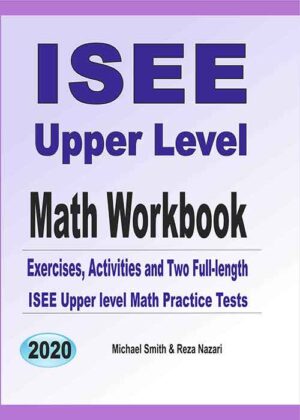 ISEE Upper Level Math Workbook: Exercises, Activities, and Two Full-Length ISEE Upper Level Math Practice Tests Original price was: $18.99.$12.99Current price is: $12.99.Download
 ISEE Lower-Level Subject Test Mathematics: Student Practice Workbook + Two Full-Length ISEE Middle-Level Math Tests Original price was: $18.99.$12.99Current price is: $12.99.Download
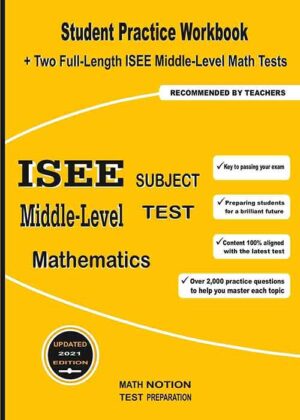 ISEE Middle-Level Subject Test Mathematics: Student Practice Workbook + Two Full-Length ISEE Middle-Level Math Tests Original price was: $18.99.$12.99Current price is: $12.99.Download
 ISEE Upper Level Summer Math Workbook: Essential Summer Learning Math Skills plus Two Complete ISEE Upper Level Math Practice Tests Original price was: $18.99.$12.99Current price is: $12.99.Download
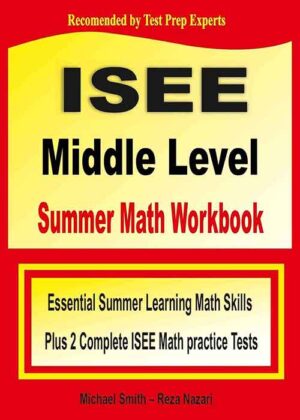 ISEE Middle Level Summer Math Workbook: Essential Summer Learning Math Skills plus Two Complete ISEE Middle Level Math Practice Tests Original price was: $18.99.$12.99Current price is: $12.99.Download
 6 Full-Length ISEE Middle Level Math Practice Tests: Extra Test Prep to Help Ace the ISEE Middle-Level Math Test Original price was: $18.99.$12.99Current price is: $12.99.Download
 ISEE Lower Level Math Practice Book 2020: Extra Exercises and Two Full Length ISEE Lower Level Math Tests to Ace the Exam Original price was: $18.99.$12.99Current price is: $12.99.Download
 ISEE Middle Level Math Practice book 2020: Extra Exercises and Two Full Length ISEE Middle Level Math Tests to Ace the Exam Original price was: $18.99.$12.99Current price is: $12.99.Download
 ISEE Lower Level Math: How to Prepare Your Child
 ISEE Middle Level Math: What to Know and How to Prepare
 How to Prepare for the ISEE Math Test
 ACAP Geometry Basics Practice: Alabama Student Guide
 Math Exams Explained: A Guide to the Major Standardized Tests
ISEE Math Questions: Topics, Samples, and How to Practice


One of the best ways to prepare your child for the ISEE is to know exactly what kind of math questions to expect. This guide focuses on the ISEE math questions themselves, the two math sections, the topics they cover, the question styles, and worked examples, so your child can practice the right material and walk in feeling familiar with the test. The Independent School Entrance Exam is used by many private and independent schools, and its math sections reward familiarity as much as ability. Seeing the questions ahead of time is one of the most effective forms of preparation.
Consistent ISEE math practice with the exact question types the test uses is the most reliable path to a strong score. Below we’ll break down the two math sections, the topics they test, sample questions with explanations, common mistakes, and how to practice for the ISEE math test.
The two ISEE math sections
The ISEE has two math sections. Quantitative Reasoning focuses on problem-solving and reasoning rather than pure computation, and at the upper levels includes quantitative-comparison questions where you compare two quantities. Mathematics Achievement tests grade-level math knowledge directly, with questions tied to the math concepts students learn in school.
Both sections are multiple choice, and calculators are not permitted, so your child needs to work problems by hand. Because the two sections emphasize different skills, reasoning versus content knowledge, preparing for both is important. Understanding this structure helps your child know what to expect and study comprehensively for everything the test asks.
What topics the math questions cover
ISEE math questions cover grade-appropriate content: number sense and operations, fractions, decimals, and percentages, ratios and proportions, and algebra through expressions and equations. They also include geometry, area, perimeter, and properties of shapes, along with data interpretation from charts and graphs and introductory probability and statistics.
The difficulty matches your child’s ISEE level, Lower, Middle, or Upper, with the upper levels including more demanding algebra and geometry. Because the questions draw on both school math and the ISEE’s distinctive reasoning style, practicing the specific question types, not just general math, is what truly prepares a student for the test.
Sample question: fractions and percentages
Here’s a typical Mathematics Achievement problem: “A shirt costs 40 dollars and is marked down by 30 percent. What is the sale price?” Find 30 percent of 40, which is 12, then subtract from 40 to get a sale price of 28 dollars. Notice the two-step structure, find the discount, then subtract, that many ISEE questions use.
Problems like this reward reading carefully and working step by step. A common error is finding the discount but forgetting to subtract it, landing on the wrong answer. Practicing percentage and fraction problems until the steps are automatic prepares your child for one of the most common ISEE math question types.
Sample question: ratios and proportions
Consider: “If 4 notebooks cost 6 dollars, how much do 10 notebooks cost?” Set up the proportion or find the unit cost: 6 divided by 4 is 1.50 per notebook, then multiply by 10 to get 15 dollars. Ratio and proportion questions are extremely common on the ISEE and reward recognizing the relationship and solving systematically.
The key skill is translating the words into a proportional relationship and solving it. Once your child recognizes the proportion structure, these become quick, reliable points. Practicing a variety of ratio and rate problems builds exactly the recognition that makes these ISEE questions feel routine rather than confusing.
Sample question: quantitative comparison
At the Middle and Upper levels, the Quantitative Reasoning section includes comparison questions, where you compare two quantities (Column A and Column B) and determine which is greater, or if they’re equal or it can’t be determined. For example, comparing the value of one expression to another tests careful reasoning rather than heavy computation.
The strategy is to evaluate each quantity fully before comparing, and to watch for cases where the answer depends on unknown values. These questions are unfamiliar to many students, so practicing them specifically pays off, since they follow predictable patterns once you’ve seen enough of them.
Sample question: basic algebra
An algebra example: “If 3x plus 5 equals 20, what is x?” Subtract 5 from both sides to get 3x equals 15, then divide by 3 to get x equals 5. Solving simple equations like this is a core ISEE skill, especially at the Middle and Upper levels, and rewards knowing the balanced-equation method.
Algebra questions test whether your child can work with variables and solve for unknowns, foundational skills that grow more prominent at higher levels. Practicing solving equations until the steps feel automatic ensures your child can confidently handle the algebra the ISEE includes.
The no-calculator factor
Because the ISEE prohibits calculators, every math question must be done by hand, which makes arithmetic fluency essential. A student slow or error-prone with multiplication, fractions, or percentages will struggle even on problems they understand. Building this by-hand fluency is one of the most important parts of ISEE math preparation.
Practicing mental and paper-and-pencil computation until it’s automatic frees up time and reduces errors on the timed test. Because every question depends on it, strong no-calculator skills underpin success across both math sections, so they deserve dedicated, regular practice as your child prepares.
Common mistakes on ISEE math questions
Students tend to lose points in predictable ways. Rushing leads to misreading questions and careless errors, especially on the reasoning questions. Weak by-hand arithmetic undermines harder problems. And unfamiliarity with the quantitative-comparison format costs points that practice would secure. Leaving questions blank also wastes the no-penalty scoring.
By practicing the exact question styles and reviewing every mistake, your child trains out of these habits. Teaching them to read carefully, work by hand fluently, and recognize the comparison format prepares them for the situations that trip up unprepared test-takers. Most ISEE errors are preventable with the right practice.
A note on ISEE scoring
It helps to know that the ISEE does not penalize wrong answers, so your child should never leave a question blank. If unsure or short on time, an educated guess can only help. Teaching this simple strategy ensures your child attempts every question, capturing points they’d otherwise leave on the table.
Scores are reported as percentiles and stanines comparing your child to other applicants, so there’s no fixed passing score, and aiming high matters for competitive admissions. Knowing how scoring works helps you set realistic goals and reminds your child that answering everything, even with a guess, is always the right move.
How to practice ISEE math questions
The most effective preparation is working plenty of practice questions of each type, then reviewing every problem, especially the misses, to understand the method. Focus extra time on the question styles that feel hardest, whether word problems, comparisons, or algebra, since targeted practice yields the biggest gains.
Keep practice sessions short and regular, and include full, timed sections as the test approaches to build pacing. Practicing on paper without a calculator, the way the test is administered, builds the right habits. Steady practice in exactly the formats the ISEE uses is what turns unfamiliar questions into routine ones.
The workbook that builds these skills
The most reliable way to master ISEE math questions is structured practice matched to your child’s level. The ISEE math workbook covers exactly the number sense, fractions, algebra, and geometry the ISEE tests, with clear lessons and step-by-step answer explanations you and your child can follow together, no calculator required.
Paired with free grade-level math worksheets for building fundamentals, a workbook gives your child both targeted instruction and practice in the exact question types the ISEE uses. It’s an instant download, so you can start practicing tonight. Browse our ISEE math collection → to find the right level.
Sample question: a multi-step word problem
Many of the more challenging ISEE math questions combine several skills, so practicing multi-step problems matters. Try this: “A class has 24 students, and 5/8 of them are girls. How many boys are in the class?” First find the number of girls, 5/8 of 24 is 15, then subtract from 24 to get 9 boys. The difficulty isn’t any single calculation but stringing them together correctly.
Word problems reward a calm, organized approach: read carefully, identify what’s being asked, and work step by step rather than rushing to an answer. Students who practice translating words into operations build the confidence to handle these reliably. Because multi-step problems appear across both math sections, getting comfortable with them is one of the most valuable parts of ISEE preparation.
Sample question: geometry
A geometry example: “What is the area of a triangle with a base of 8 and a height of 5?” Use the formula, one-half base times height, to get one-half times 8 times 5, which is 20. ISEE geometry questions test whether your child knows the basic formulas and can apply them, so memorizing area, perimeter, and volume formulas is worthwhile.
Geometry questions also include properties of shapes, angles, and the coordinate plane at higher levels. Practicing with the key formulas and shape properties ensures your child can handle these confidently. Because geometry rewards knowing a finite set of formulas, it’s an area where focused study produces reliable points on the ISEE.
Build a simple practice routine
A practical way to prepare is three short sessions a week, each focused on one question type, fractions and percentages one day, ratios and word problems another, algebra and geometry or comparisons a third, so you cover the full range over time. Work a set, review every problem, and keep a running list of the question types that still trip your child up so they get extra attention.
As the test approaches, add a few full, timed practice sections to build pacing and stamina, since the ISEE’s time limits are real. This steady, varied routine, practiced on paper without a calculator, mirrors the real test and builds the familiarity that turns even the unusual quantitative-comparison questions into points your child can count on. Consistency over several weeks beats any amount of last-minute cramming.
Frequently asked questions
What kind of math questions are on the ISEE?
Two sections: Quantitative Reasoning (problem-solving and, at upper levels, quantitative comparisons) and Mathematics Achievement (grade-level content). Topics include number sense, fractions, percentages, ratios, algebra, and geometry.
Can my child use a calculator on the ISEE?
No, calculators aren’t permitted, so building by-hand fluency with operations, fractions, and percentages is essential for answering ISEE math questions accurately and quickly.
Does the ISEE penalize wrong answers?
No. There’s no deduction for guessing, so your child should answer every question, even when unsure, rather than leaving any blank.
How should my child practice ISEE math?
Work plenty of practice questions of each type, review every mistake, drill the by-hand fundamentals and the comparison format, and use a level-matched workbook and worksheets.
Math Notion makes standards-aligned math workbooks and test prep for learners at every level and across all 50 states. See the full collection.
Posted by Math Notion Team · Published on July 3, 2024