Math Articles, tips & study guides
 SAT Math Comprehensive Exercise Book: Abundant Math Skill Building Exercises Original price was: $18.99.$12.99Current price is: $12.99.Download
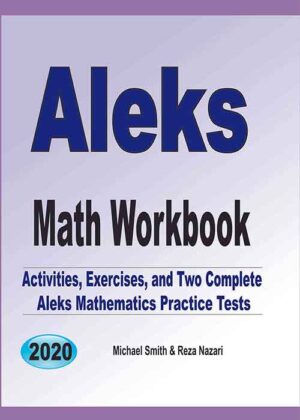 ALEKS Math Workbook: Exercises, Activities, and Two Full-Length ALEKS Math Practice Tests Original price was: $18.99.$12.99Current price is: $12.99.Download
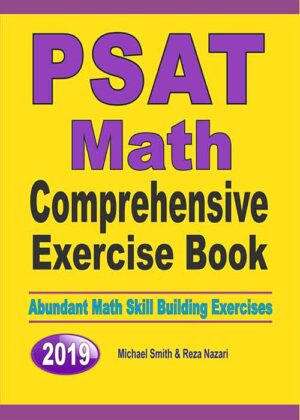 PSAT Math Comprehensive Exercise Book: Abundant Math Skill Building Exercises Original price was: $18.99.$12.99Current price is: $12.99.Download
 PERT Math Workbook: Practice Questions for the Florida Postsecondary Education Readiness Test With 2 Full-Length PERT Math Exams Original price was: $18.99.$12.99Current price is: $12.99.Download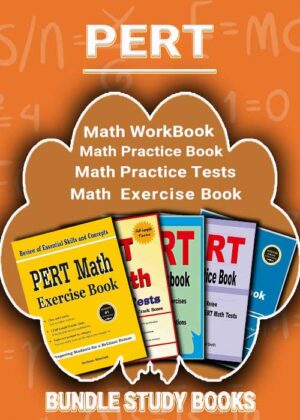
 ALEKS Math Comprehensive Exercise Book: Abundant Math Skill Building Exercises Original price was: $18.99.$12.99Current price is: $12.99.Download
 6 Full-Length PSAT / NMSQT Math Practice Tests: Extra Test Prep to Help Ace the PSAT Math Test Original price was: $18.99.$12.99Current price is: $12.99.Download
 TSI Math Workbook: Exercises, Activities, and Two Full-Length TSI Math Practice Tests Original price was: $18.99.$12.99Current price is: $12.99.Download
 Texas College Math Placement: From the THEA to the TSIA2
 WVGSA Math Prep: West Virginia Student Guide
 IAR Quadratic Equations Practice — Illinois Guide
 WVGSA Math Prep: West Virginia Student Guide
 CMAS Scatter Plots Practice — Colorado Guide
Learning College Math: How to Succeed in Your Courses


The jump to college math catches many students off guard. Courses move faster, expect more independence, and demand stronger study habits than high school did. But learning college math successfully is entirely doable with the right approach, and doing well in it opens doors across majors and careers. Whether you’re heading into College Algebra, statistics, calculus, or a math course required for your major, this guide shares practical strategies for succeeding in college math, from preparing for the pace to studying effectively to getting help when you need it.
The students who thrive in college math aren’t necessarily the most naturally gifted; they’re the ones who adapt their habits to the demands of the course. Below we’ll cover how college math differs from high school, how to study it effectively, and how steady practice and the right support set you up to succeed.
How college math differs from high school
The first thing to understand is that college math is different from high school math in pace and expectations. Courses cover material much faster, often a chapter a week or more, and assume you’ll learn a great deal independently outside class. A single lecture may cover what took several days in high school, so falling behind happens quickly if you’re not keeping up.
College also expects more self-direction: there’s less hand-holding, fewer reminders, and more responsibility on you to practice, seek help, and stay on track. Recognizing this shift early is crucial, because students who approach college math with high-school habits often struggle, while those who adapt their approach to the faster, more independent format succeed.
Start with the right placement
Success in college math often begins before the course does, with proper placement. Most colleges use a placement test to determine which math course you should start in, and starting at the right level matters enormously. Being placed too low wastes time and money; being placed too high sets you up to struggle.
If you have a placement test coming up, prepare for it, since a stronger result can place you directly into credit-bearing college math rather than a developmental course. And if you’re unsure which course is right, talk with an advisor. Starting in the course that matches your actual skill level is the foundation for success.
Keep up with the fast pace
Because college math moves quickly, keeping up day to day is essential. Falling even a few classes behind can be hard to recover from, since each topic builds on the last. The most successful students review material soon after each class, do the assigned practice promptly, and never let confusion accumulate unaddressed.
This means treating college math as something you work on regularly, not just before exams. A little work after each class, reviewing notes, doing problems, clearing up anything unclear, keeps you current and prevents the snowball of confusion that derails so many students. Consistency is far more effective than cramming in a fast-paced course.
Practice problems, not just notes
College math is learned by doing, even more than by listening or reading. Attending lectures and reading the textbook are necessary but not sufficient; you genuinely learn the material by working problems yourself. Many students mistake understanding a worked example for being able to do it, only to struggle on exams when they must produce solutions independently.
So make working problems the core of your study. Do the assigned homework thoroughly, then do extra problems if a concept isn’t solid. Working problems reveals exactly what you do and don’t understand, and it builds the genuine skill college exams test. This active practice is the single most important study strategy in college math.
Use your resources and get help early
Colleges offer abundant math help, office hours, tutoring centers, study groups, online resources, and the students who succeed use them, especially early. The biggest mistake is waiting until you’re badly behind to seek help. Getting clarification the moment you’re confused, rather than weeks later, prevents small gaps from becoming insurmountable.
Professors’ office hours are an underused resource; professors generally want to help, and a few minutes there can clear up what an hour of frustration couldn’t. Tutoring centers and study groups offer additional support. Reaching out early and often isn’t a sign of weakness; it’s exactly what strong college math students do.
Build strong study habits
College math rewards disciplined math study skills: regular study sessions, active problem-solving, reviewing mistakes, and managing time well. Because no one is checking your daily work, you must build the self-discipline to study consistently. Setting a regular study schedule and treating it as non-negotiable is one of the keys to success.
Effective study also means studying actively, not passively. Work problems, explain concepts to yourself, and test your understanding rather than just rereading. Reviewing and learning from mistakes, rather than ignoring them, accelerates improvement. These habits, more than raw ability, separate students who thrive in college math from those who struggle.
Master the prerequisites
College math builds on prior math, so gaps in prerequisite skills cause ongoing trouble. A student weak in algebra will struggle in College Algebra, statistics, or calculus, not because the new material is too hard, but because the foundation isn’t solid. Identifying and shoring up weak prerequisites is often the key to success.
If you find yourself struggling, the issue is frequently a prerequisite gap rather than the current topic. Reviewing the underlying skills, often algebra, fixes the root cause. Strengthening your foundation, whether before the course or alongside it, makes the new material far more approachable and is one of the most effective things you can do.
Manage math anxiety and confidence
Many college students carry math anxiety from earlier years, and it can undermine performance independent of ability. Anxiety occupies the mental capacity you need to solve problems, so managing it matters. Thorough preparation, which builds genuine confidence, is the best antidote, along with reframing negative beliefs about your math ability.
It also helps to adopt a growth mindset: college math ability grows with effort and practice, like any skill. Students who believe they can improve persist through difficulty, while those who think they’re “not math people” give up. Approaching college math with confidence built on preparation, and a willingness to work, makes a real difference.
Use practice resources effectively
Beyond your course materials, additional practice resources help you master college math, especially for shoring up prerequisites or getting extra reps on tough topics. Working through plenty of problems, with worked solutions to check your reasoning, builds the fluency college exams demand.
Math Notion’s resources, including materials for college placement tests like the ACCUPLACER, ALEKS, and others, plus algebra practice, help you build and reinforce the skills college math requires. Browse the full Math Notion collection and the free math worksheets to find practice that targets exactly what you need.
Prepare for exams strategically
College math exams often count for a large share of your grade, so strategic preparation matters. Start studying well before the exam, not the night before, since the volume of material makes cramming ineffective. Work through practice problems and past exams if available, focusing on the types of problems the exam will include.
Review your homework and any quizzes to identify weak areas, and practice those specifically. Simulating exam conditions, timed practice without notes, builds readiness. This strategic, spaced approach to exam preparation, rather than last-minute cramming, is how successful students perform their best on high-stakes college math exams.
Don’t fall behind, and recover fast if you do
Because college math is cumulative and fast, falling behind is the most common path to failure, and recovering quickly is essential if it happens. If you realize you’re behind, act immediately: get help, review the missed material, and put in extra work to catch up before the next topic compounds the problem.
Don’t wait and hope it resolves itself; in a fast-paced course, gaps only grow. Reaching out to your professor or a tutor, dedicating extra time, and systematically filling the gaps can get you back on track. The students who recover are the ones who address falling behind promptly rather than letting it spiral.
The workbook that builds your foundation
For shoring up prerequisites or building confidence before and during a college math course, a structured workbook is invaluable. Math Notion’s algebra and test-prep workbooks rebuild the foundational skills college math depends on, with clear lessons and step-by-step solutions you can work through independently to fill gaps and strengthen weak areas.
Used alongside your course materials and free worksheets, a workbook gives you the targeted practice that makes college math manageable. The workbooks are instant downloads, so you can start strengthening your math foundation today. Browse the full Math Notion collection → to find the right resource for your needs.
Why college math is worth the effort
It helps to remember why succeeding in college math matters. Many majors and careers, in business, science, healthcare, technology, and beyond, require college math, and a strong grasp keeps your options open. Even beyond degree requirements, the quantitative reasoning college math builds is increasingly valued across the working world, where data and analysis appear everywhere.
Viewing your college math course as a gateway rather than a hurdle can be motivating on the hard days. The effort you put into mastering college algebra, statistics, or calculus pays off not just in a grade but in the doors it keeps open and the durable reasoning skills you carry forward. That bigger purpose makes the steady, sometimes demanding work genuinely worthwhile, and it’s well within reach for any student who applies the strategies in this guide.
With the right habits, steady practice, and a willingness to seek help early, learning college math becomes far more manageable than its reputation suggests, and succeeding in it sets you up for everything that follows in your education and career.
Frequently asked questions
Why is college math harder than high school math?
College math moves much faster, expects more independent learning, and demands stronger study habits. A single lecture may cover several days of high-school material, so keeping up requires consistent, self-directed work.
How do I succeed in college math?
Start with the right placement, keep up with the pace, practice problems actively, get help early, build strong study habits, master prerequisites, and prepare for exams strategically rather than cramming.
What should I do if I fall behind?
Act immediately, get help, review the missed material, and put in extra work to catch up before the next topic compounds the problem. In a cumulative course, gaps only grow if ignored.
How can I prepare before a college math course?
Shore up your prerequisites, especially algebra, prepare for any placement test, and build confidence through practice. A structured workbook and worksheets help you strengthen the foundation college math requires.
Math Notion makes standards-aligned math workbooks and test prep for learners at every level and across all 50 states. See the full collection.
Posted by Math Notion Team · Published on February 26, 2025