
Math Articles, tips & study guides
 8th Grade Illinois Math for Beginners Original price was: $21.99.$14.99Current price is: $14.99.Download
 6th Grade Illinois Math for Beginners Original price was: $21.99.$14.99Current price is: $14.99.Download7th Grade Illinois Math for Beginners Original price was: $21.99.$14.99Current price is: $14.99.Download
 ALEKS Math Workbook: Essential Learning Math Skills Plus Two Complete ALEKS Math Practice Tests Original price was: $18.99.$12.99Current price is: $12.99.Download
 SAT Summer Math Workbook: Essential Summer Learning Math Skills plus Two Complete SAT Math Practice Tests Original price was: $18.99.$12.99Current price is: $12.99.Download
 ASVAB Math Prep: The Ultimate Step by Step Guide Plus Two Full-Length ASVAB Practice Tests Original price was: $18.99.$12.99Current price is: $12.99.Download
 GED Math Workbook: Activities, Exercises, and Two Complete GED Mathematics Practice Tests Original price was: $18.99.$12.99Current price is: $12.99.Download
 Accuplacer Math Comprehensive Exercise Book (Next Generation): Abundant Math Skill Building Exercises Original price was: $18.99.$12.99Current price is: $12.99.Download
 PARCC Scores Explained: Levels and What Replaced the Test
 What Happened to the PARCC Math Test? (And What Replaced It)
 CMAS Scatter Plots Practice — Colorado Guide
 NSCAS Sequences & Series Practice — Nebraska Guide
 How to Pass the RISE Math Test in Utah
IAR Quadratic Equations Practice — Illinois Guide


📖 Reading time: 11 min
Quick answer: To master IAR quadratic equations practice, Illinois students should focus on three solving methods — factoring, completing the square, and the quadratic formula — while drilling common error patterns and working through timed practice problems modeled after the actual IAR test format.
Who this is for: Illinois students in grades 7–12 preparing for the IAR math test, parents supporting their child’s algebra review at home, and teachers building structured quadratic equations units for classroom or homeschool use.
Roughly one in three Illinois students does not meet or exceed expectations on the state math assessment — and quadratic equations are one of the biggest reasons why. These multi-step problems appear consistently on the IAR (Illinois Assessment of Readiness) and demand a level of algebraic reasoning that trips up even confident math students. If you or your student has ever stared at a quadratic and felt that familiar wave of math anxiety, you’re not alone — and the good news is that this is one of the most teachable skills in all of high school algebra.
This guide walks you through everything you need for effective IAR quadratic equations practice. You’ll learn why quadratic equations matter so much on the IAR, what mistakes students make most often, how to solve every type of quadratic step by step, and which memory tricks actually stick. Whether you’re a student retaking the math test or a teacher building a targeted review unit, every section gives you something actionable you can use today.
According to the National Center for Education Statistics (NCES), algebra proficiency is one of the strongest predictors of long-term academic success — making quadratic equations not just a test topic, but a foundational skill worth mastering fully.
Why Quadratic Equations Are Foundational for Illinois IAR Math Success
What the IAR Actually Tests — and Why Quadratics Are Central
Quadratic equations are foundational to IAR math success because they represent the bridge between basic algebra and the higher-level mathematical reasoning the test demands. The IAR (Illinois Assessment of Readiness) is the state’s primary math benchmark for grades 3–8, and at the secondary level, Illinois algebra courses directly feed into IAR-aligned assessments that measure readiness for college and career math. Understanding quadratics isn’t optional — it’s the gateway to functions, graphing, and data analysis across multiple test domains.
The Illinois – IAR Math Assessment is built on the Illinois Learning Standards (ILS), which are closely aligned with the Common Core State Standards. Within those standards, quadratic expressions and equations fall under the Functions and Algebra domains — two of the most heavily tested areas. When students understand quadratic equations deeply, they also unlock their ability to interpret graphs of parabolas, solve real-world projectile problems, and factor polynomials — all skills that appear in multiple forms throughout the assessment.
Think of quadratic equations as a hub in the algebra wheel. Mastering them means you’ve also strengthened your understanding of factoring, the distributive property, square roots, and coordinate graphing. These aren’t isolated skills — they’re all connected through the quadratic. Students who skip over quadratics and hope they won’t appear often find themselves unable to complete multi-step problems that require combining those concepts.
Beyond the test itself, quadratic equations matter because they model real situations — from calculating the trajectory of a ball to optimizing areas in geometry problems. Teachers and parents who frame quadratics as “just a test topic” miss an opportunity to show students how directly this math connects to physics, engineering, business, and everyday spatial reasoning. That connection makes the math stick.
- Quadratics appear on the IAR in multiple formats: Students may see them as algebraic expressions to factor, graphs of parabolas to interpret, word problems involving area or projectile motion, or equations to solve for unknown variables. Preparing for all four formats is essential, not just one.
- Algebra fluency builds number sense: Students who can manipulate quadratic expressions comfortably also develop stronger overall number sense — they’re faster at recognizing patterns, checking reasonableness, and working with integers and fractions under timed test conditions.
- Functions are impossible without quadratics: The standard form
f(x) = ax² + bx + cis a quadratic function. Understanding it means understanding domain, range, vertex, and axis of symmetry — concepts woven throughout Illinois math standards from grade 8 onward. - Confidence compounds: Research on math anxiety consistently shows that students who achieve mastery in one algebraic concept — like factoring quadratics — carry that confidence into every subsequent topic. Quadratics are a natural confidence-builder because the progress is visible and measurable.
Where Quadratic Equations Fit in the Illinois Learning Standards
Illinois Learning Standards for Mathematics require students to understand the structure of expressions, create and solve equations, and interpret functions. Quadratic equations sit at the center of these requirements. By the end of Algebra 1, students are expected to factor quadratics, solve them using multiple methods, and understand the relationship between the solutions of an equation and the zeros of its related function — all of which are testable on IAR-aligned assessments.
For grade 8 students, the IAR begins to assess their ability to work with simple quadratic relationships and interpret non-linear graphs. This is the first formal exposure for many students, and how well they’re prepared in that year often determines how smoothly they move through Algebra 1 and Algebra 2. A strong foundation in quadratic thinking at grade 8 pays dividends for years of math ahead.
Common Mistakes Illinois Students Make with Quadratic Equations
The Errors That Cost the Most Points on IAR Math
Most IAR math errors on quadratic equations come from a handful of predictable mistakes — and identifying them early is the fastest way to gain back lost points. Students who recognize these patterns before test day can eliminate them through targeted practice, turning near-misses into correct answers on multi-step problems worth significant credit.
The single most common mistake is sign errors. When factoring a quadratic like x² - 5x + 6, students must find two numbers that multiply to +6 and add to -5. Many students rush and write (x + 2)(x + 3), ignoring the negative signs entirely. The correct factoring is (x – 2)(x – 3). This one-character error flips both solutions from negative to positive and costs full credit on multi-part questions. The fix? Always check your factors by multiplying them back out before writing the final answer.
The second major error pattern involves forgetting to set the equation equal to zero before factoring or applying the quadratic formula. If a student sees x² + 3x = 10 and immediately tries to factor the left side, they’ll get nowhere. The equation must first be rearranged to x² + 3x - 10 = 0. Illinois math standards explicitly require students to understand why this step is necessary — the zero product property only works when one side of the equation is zero.
Third, many students apply the quadratic formula but mishandle the discriminant. The discriminant is b² - 4ac — the expression under the square root. Students who compute it incorrectly (often by confusing subtraction with addition or by forgetting that a negative number squared becomes positive) end up with the wrong number of solutions entirely. On the IAR, some questions specifically ask about the discriminant to determine how many real solutions exist, so this error is especially costly.
A fourth common mistake is dropping one of the two solutions. Quadratic equations have two solutions (sometimes equal, sometimes imaginary — but on IAR math, almost always two distinct real solutions). Students who stop after finding x = 3 in a factored equation forget to find the second solution from the other factor. Both solutions are required for full credit.
- Not checking answers by substitution: After solving a quadratic, plugging each solution back into the original equation takes about 30 seconds and catches almost every arithmetic mistake. Students who skip this step on the IAR often lose points they actually earned conceptually — the understanding was there, but the arithmetic slipped.
- Mixing up the quadratic formula components: The formula is
x = (-b ± √(b² - 4ac)) / 2a. A frequent error is substituting values with wrong signs — especially when b is negative (e.g., b = -5, so -b = 5). Writing the formula slowly and labeling a, b, and c before substituting prevents this error completely. - Graphing parabolas incorrectly: On IAR problems involving parabola graphs, students often confuse the vertex location or forget that the axis of symmetry is at
x = -b/2a. Misidentifying the vertex shifts the entire graph and leads to wrong answers on multiple related questions. - Skipping the GCF step: When the quadratic has a greatest common factor (like
2x² + 6x + 4), factoring out the GCF first (giving2(x² + 3x + 2)) simplifies everything that follows. Students who skip this step end up working with larger numbers unnecessarily and make more errors.
Why These Mistakes Persist — and How to Address Them
These errors persist largely because quadratic equations require students to hold several rules in mind simultaneously — sign conventions, the zero product property, the structure of the quadratic formula — while also performing arithmetic under time pressure. That’s a heavy cognitive load, especially for students who haven’t automated the basics yet.
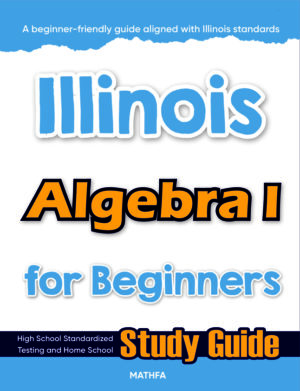
The most effective remedy is slow, deliberate practice with immediate feedback. Rather than solving 20 problems quickly, students benefit far more from solving 5 problems slowly, writing out every step, and checking each one before moving to the next. This is exactly the kind of structured, step-by-step math practice that builds the habits that carry into high-stakes test environments. For students who want comprehensive structured practice with all of these concepts, Illinois Algebra 1 for Beginners provides a step-by-step workbook approach that walks through every quadratic concept aligned to Illinois math standards — making it a genuinely useful resource to work through alongside any IAR review plan.
🎯 Recommended Math Book
Illinois Algebra 1 for Beginners — $16.99
Category: Algebra 1, General, Illinois, Test
Comprehensive Algebra 1 Study Guide & Workbook
Perfect for classroom learning, homeschooling,
or extra practice at home.
Step-by-Step Strategies for IAR Quadratic Equations Practice
Effective IAR quadratic equations practice follows a clear sequence: understand the structure, choose the right solving method, execute carefully, and verify. Here are seven specific strategies Illinois students can use right now to sharpen their quadratic skills before the IAR math test.
-
Identify the form before choosing a method. Before touching pencil to paper, look at the quadratic and decide: Can it be factored easily? Does it have a leading coefficient other than 1? Is the discriminant likely to be a perfect square? Taking five seconds to assess the problem form prevents the common mistake of applying the wrong method. Standard form is
ax² + bx + c = 0. If a = 1 and you can spot factor pairs quickly, factor first. If not, the quadratic formula works for every case. Students who develop this “method selection” habit solve problems faster and with fewer errors. -
Always rearrange to standard form first. No matter how a quadratic appears on the IAR, rewrite it in the form
ax² + bx + c = 0before doing anything else. This single habit eliminates the “forgot to set equal to zero” error entirely. Write the rearrangement as a separate step on your scratch paper — don’t try to do it mentally. Illinois math standards expect students to fluently manipulate equations, and showing this step demonstrates mathematical reasoning even on partial-credit problems. -
Label a, b, and c explicitly before applying the quadratic formula. When you use the formula
x = (-b ± √(b² - 4ac)) / 2a, write out “a = ___, b = ___, c = ___” on your scratch paper first. Then substitute. This slows you down by about 20 seconds and saves you from sign errors that cost full-answer credit. Students who plug values in directly from memory — without labeling — make sign mistakes far more often, especially when b or c is negative. - Check every answer by substituting back into the original equation. Found solutions of x = 4 and x = -1? Plug each one back into the original equation and verify that both sides equal zero. This takes under a minute and catches arithmetic errors reliably. On step-by-step math problems worth multiple points on the IAR, a wrong final answer from a small arithmetic slip costs disproportionately — verification prevents that completely.
- Practice with timed math practice problems modeled after IAR format. The IAR includes both multiple-choice and constructed-response questions on quadratic equations. Practice both types under realistic time conditions — roughly 2–3 minutes per question. Free math worksheets aligned to Illinois Learning Standards are widely available and let students drill specific quadratic types (factoring, formula, completing the square) in focused 15-minute sessions that build fluency faster than longer unfocused sessions.
-
Master factoring by drilling factor pairs systematically. For a quadratic
x² + bx + c, you need two numbers that multiply to c and add to b. Practice this as a fast mental math drill: given the product and sum, find the pair. Start with small integers and work up to negatives and fractions. When factoring becomes automatic, the entire quadratic solving process accelerates — and you’ll spend less time on these problems during the test, leaving more time for harder items. -
Understand the discriminant as a decision-making tool. Before solving a quadratic fully, compute
b² - 4ac. If it’s positive, expect two real solutions. If it equals zero, there’s exactly one solution (a repeated root). If it’s negative, there are no real solutions. On the IAR, some questions ask you to determine the number of solutions without actually solving the equation — if you know the discriminant, you answer these in seconds. Practice computing discriminants for 10 different quadratics as a focused drill to make this automatic.
Beyond these individual strategies, the most important overall practice approach is consistency over intensity. Fifteen minutes of IAR quadratic equations practice every day for three weeks builds stronger skills than a single three-hour marathon session the night before the test. Spaced repetition — returning to previously learned concepts at increasing intervals — is the mechanism behind long-term retention, and it applies directly to math skill building.
Parents and teachers can support this by building a simple weekly practice schedule: Monday for factoring, Wednesday for the quadratic formula, Friday for word problems and graphing. This structured rotation keeps each method fresh while preventing the overload that comes from trying to cover everything at once. Math homework help is most effective when it follows a clear focus area each session rather than attempting to review everything simultaneously.
Worked Examples: Quadratic Equations on the IAR
Example 1: Solving by Factoring
Problem: Solve x² - 7x + 12 = 0.
Step 1: Confirm standard form. The equation is already in the form ax² + bx + c = 0, with a = 1, b = -7, c = 12. Good — no rearrangement needed.
Step 2: Find two numbers that multiply to +12 and add to -7. Think through the factor pairs of 12: (1, 12), (2, 6), (3, 4). Now consider signs — since the product is positive and the sum is negative, both numbers must be negative. Try (-3) and (-4): (-3) × (-4) = 12 ✓ and (-3) + (-4) = -7 ✓.
Step 3: Write the factored form: (x - 3)(x - 4) = 0.
Step 4: Apply the zero product property. Either x - 3 = 0 or x - 4 = 0. This gives x = 3 or x = 4.
Step 5 (Check): Substitute x = 3: (3)² - 7(3) + 12 = 9 - 21 + 12 = 0 ✓. Substitute x = 4: (4)² - 7(4) + 12 = 16 - 28 + 12 = 0 ✓.
Answer: x = 3 and x = 4. Both solutions are valid and should be reported.
Example 2: Solving with the Quadratic Formula
Problem: Solve 2x² + 3x - 5 = 0.
Step 1: Label the coefficients. a = 2, b = 3, c = -5. Note that c is negative — be careful with signs throughout.
Step 2: Compute the discriminant. b² - 4ac = (3)² - 4(2)(-5) = 9 + 40 = 49. Since the discriminant is positive and a perfect square (49 = 7²), expect two rational solutions — a good sign that the problem will work out cleanly.
Step 3: Apply the quadratic formula. x = (-3 ± √49) / (2 × 2) = (-3 ± 7) / 4.
Step 4: Solve both cases. x = (-3 + 7) / 4 = 4/4 = 1. And x = (-3 - 7) / 4 = -10/4 = -5/2.
Step 5 (Check): For x = 1: 2(1)² + 3(1) - 5 = 2 + 3 - 5 = 0 ✓. For x = -5/2: 2(25/4) + 3(-5/2) - 5 = 25/2 - 15/2 - 10/2 = 0 ✓.
Answer: x = 1 and x = -5/2. Report both solutions for full credit.
Example 3: IAR-Style Word Problem
Problem: A rectangular garden has a length that is 3 meters more than its width. The area of the garden is 40 square meters. Find the dimensions of the garden.
Step 1: Define variables. Let width = x meters. Then length = x + 3 meters.
Step 2: Write the equation. Area = length × width, so x(x + 3) = 40.
Step 3: Expand and rearrange to standard form. x² + 3x = 40 → x² + 3x - 40 = 0.
Step 4: Factor. Find two numbers that multiply to -40 and add to 3: try (+8) and (-5): 8 × (-5) = -40 ✓ and 8 + (-5) = 3 ✓. Factored form: (x + 8)(x - 5) = 0.
Step 5: Solve. x = -8 or x = 5. Since width cannot be negative, reject x = -8.
Answer: Width = 5 meters, Length = 5 + 3 = 8 meters. Check: 5 × 8 = 40 ✓. Always interpret solutions in context — on IAR word problems, a negative dimension is always rejected.
Memory Tricks and Shortcuts for Quadratic Equations
Memory tricks accelerate recall during the IAR math test, when time pressure makes it harder to reconstruct formulas from scratch. These techniques are used by students who consistently score well on Illinois math assessments — they don’t replace understanding, but they make retrieval faster and more reliable.
The Quadratic Formula Song
The most widely used memory trick for the quadratic formula is singing it to the tune of “Pop Goes the Weasel”: “x equals negative b, plus or minus square root, of b squared minus four ac, all over two a.” It sounds simple, but students who use this mnemonic report that the formula comes back to them automatically even under test stress. Pair the song with writing the formula out five times from memory each study session to reinforce it in both auditory and kinesthetic memory.
The “ac Method” for Factoring
When the leading coefficient is not 1 (e.g., 3x² + 10x + 8), use the ac method: multiply a and c (here, 3 × 8 = 24), find two numbers that multiply to 24 and add to b (10): those are 6 and 4. Rewrite the middle term as 3x² + 6x + 4x + 8, then factor by grouping: 3x(x + 2) + 4(x + 2) = (3x + 4)(x + 2). The ac method works every time and removes the guesswork from factoring trinomials with larger coefficients.
The Discriminant Decision Tree
Create a simple mental flowchart: Compute b² - 4ac. If the result is positive → two real solutions. If zero → one repeated solution. If negative → no real solutions (imaginary). Drawing this tree on scratch paper at the start of a quadratic-heavy test section takes 15 seconds and gives you a reference point for every discriminant question that follows.
Vertex Formula Shortcut
The x-coordinate of the vertex of any parabola y = ax² + bx + c is x = -b / (2a). Notice that this is exactly the part of the quadratic formula before the ± square root term. Students who recognize this connection don’t need to memorize a separate formula — the vertex x-coordinate is simply the “midpoint” of the two solutions. Once you have the x-coordinate, substitute it back into the equation to find the y-coordinate of the vertex.
How Quadratic Equations Appear Across Standardized Tests
Illinois students benefit from understanding that quadratic equations show up across virtually every major standardized math test — not just the IAR. This context helps students see their quadratic practice as an investment that pays off across multiple assessments throughout their academic career.
On the SAT Math section, quadratic equations are among the most frequently tested algebra topics. The College Board reports that algebra (including quadratics) makes up about 35% of all SAT Math questions. Students who master IAR quadratic equations practice are directly building skills they’ll need on the SAT two to four years later.
The ACT Math section tests quadratic equations within its Pre-Algebra, Elementary Algebra, and Intermediate Algebra question pools, which together account for roughly 40% of the 60-question test. ACT quadratic problems often appear in both factoring and graphing formats, requiring students to move fluidly between algebraic and graphical representations of the same equation.
The GED Mathematical Reasoning section tests quadratic equations as part of its algebraic problem solving domain. Adult learners who are working through GED math skills find that quadratics are among the most challenging topics — and also among the most heavily tested. The GED math test includes 46 questions total, and quadratic-related items routinely appear in both the calculator and non-calculator portions.
College placement tests like the Accuplacer and ALEKS also assess quadratic proficiency to determine whether students are ready for college-level math or need remediation. Students who arrive at community college or university placement testing with strong IAR quadratic foundations frequently place directly into credit-bearing courses, bypassing costly and time-consuming remedial math sequences.
Even professional and career-focused tests like the ASVAB (Armed Services Vocational Aptitude Battery) and TEAS (Test of Essential Academic Skills for nursing programs) include algebraic reasoning questions that draw on quadratic understanding. The investment Illinois students make in mastering quadratic equations during their IAR preparation genuinely compounds across every future math assessment they encounter.
Strategies for Parents and Teachers Supporting IAR Quadratic Equations Practice
How Adults Can Help Without Doing the Math for Students
Parents and teachers play a crucial supporting role in IAR quadratic equations practice — but the most effective support looks different from what many adults expect. The goal is not to re-teach the math (unless you’re a math educator) but to create the conditions in which consistent, focused practice can happen. Structure, accountability, and encouragement do more to improve test scores than last-minute tutoring sessions.
For parents, the most impactful things you can do are establishing a regular practice schedule and asking the right questions. Instead of “Did you do your math homework?” try “Walk me through how you solved this one — what method did you use?” This kind of process-focused conversation helps students articulate their thinking, which deepens retention and catches misunderstandings early. You don’t need to know quadratic equations yourself to ask “How do you know that’s right?” or “What happens if you check your answer by plugging it back in?”
For teachers, the most effective classroom strategy for building IAR quadratic fluency is deliberate practice with immediate corrective feedback. Warm-up exercises that take 5–8 minutes at the start of each algebra class — specifically targeting the error patterns described in Section 2 of this guide — build automaticity faster than any end-of-unit review session. Consider dedicating one class period per week to an “error analysis” activity: show students worked examples with deliberate mistakes and ask them to identify and fix each error. This metacognitive practice is one of the highest-leverage teaching strategies in math education.
- Create a weekly practice calendar together: Sit down with your student and map out 15-minute daily practice sessions, rotating through factoring, the quadratic formula, word problems, and graphing. Students who co-create their own practice schedules show significantly higher follow-through than those who receive schedules passively.
- Use worked example review as math homework help: Rather than assigning 20 problems for homework, consider assigning 5 problems with the requirement to show every step and verify every answer. Reviewing those 5 deeply done problems together is more valuable than quickly correcting 20 rushed ones.
- Celebrate process milestones, not just correct answers: When a student correctly identifies that a quadratic can’t be factored and switches to the formula — that’s a strategy win, even if the arithmetic slips. Acknowledging process steps builds the mathematical reasoning habits that produce lasting improvement.
- Connect quadratics to real-world contexts students care about: Sports physics (projectile motion), game design (parabolic trajectories), and area optimization for a student’s real-life room layout all use quadratic equations. Contextualizing the math reduces resistance and builds intrinsic motivation that no practice schedule alone can create.
Building a School-to-Home Connection Around Illinois Math Standards
Teachers who communicate clearly with parents about exactly which quadratic concepts are being tested — and at what level of depth — empower parents to provide targeted support at home. A simple one-page guide listing the three solving methods (factoring, completing the square, quadratic formula), the key vocabulary (vertex, discriminant, parabola, zeros), and two or three practice problems parents can work through alongside their student can transform homework time from a struggle session into a genuine learning partnership.
Illinois math standards quadratic equations content is publicly available through the Illinois State Board of Education. Parents who review the relevant standards for their child’s grade level gain a clearer picture of what “meeting expectations” actually requires — and can focus their support accordingly rather than trying to cover everything at once.
When to Seek a Tutor or Extra Help for Quadratic Equations
Recognizing the Signs That Independent Practice Isn’t Enough
Most students can make meaningful progress on quadratic equations through structured independent practice and parent or teacher support. However, there are specific situations where seeking a tutor or additional math help is the right call — and recognizing those situations early prevents weeks of frustration and falling further behind.
The clearest signal is persistent confusion about the foundational concepts that underlie quadratics. If a student consistently struggles with factoring simple trinomials, cannot reliably evaluate expressions with exponents, or makes sign errors even on basic integer arithmetic, these are gaps that need to be addressed before quadratic practice can be effective. A tutor who works backward to identify and fill those foundational gaps will produce more improvement than any amount of quadratic formula drilling on an unstable foundation.
A second signal is math anxiety so significant that it interferes with practice itself. Math anxiety affects millions of students and is not a reflection of ability — it’s a learned response that can be systematically reduced through structured exposure to manageable challenges. Tutors who specialize in anxiety-sensitive math instruction can help students build the emotional regulation skills that allow them to access the mathematical knowledge they already have, even under test-day pressure.
A third signal is the student who is working hard, practicing daily, and still not making progress. This often indicates a specific conceptual misunderstanding — sometimes just one flipped rule or sign convention — that no amount of additional practice will fix without targeted diagnosis. A skilled math tutor can identify that specific misunderstanding in one or two sessions and provide the targeted correction that unlocks rapid subsequent progress.
For students who want to retake the math test or have already taken the IAR and fallen short of expectations, tutoring combined with a structured workbook-based review plan is the fastest path to improvement. Working through step-by-step math materials that align to Illinois standards, alongside a tutor who can answer questions in real time, produces the kind of accelerated growth that the IAR timeline often requires.
Parents should also consider group tutoring options, which are often more affordable than one-on-one sessions and provide the additional benefit of peer learning. Many Illinois schools offer after-school math support programs specifically aligned to the IAR — ask your student’s teacher or school counselor about available options before the test window opens.
Frequently Asked Questions
What types of quadratic equation problems appear on the IAR math test?
The IAR includes quadratic equations in factored form, standard form, and word problem contexts — primarily in the Algebra and Functions domains. Students should prepare for multiple-choice questions asking for solutions, constructed-response questions requiring step-by-step work, and graphing problems involving parabolas. Illinois math standards quadratic equations requirements expect students to demonstrate fluency with factoring, the quadratic formula, and interpreting graphs of quadratic functions. Practicing all three formats is essential for full IAR readiness.
How long should I spend on IAR quadratic equations practice before the test?
Most students benefit from four to six weeks of focused IAR quadratic equations practice, working 15–20 minutes per day on targeted problems. Start with factoring simple trinomials, then progress to the quadratic formula, completing the square, and word problems. During the final week, mix all problem types in timed practice sessions to simulate the actual test environment. Students who start earlier and maintain consistency consistently outperform those who cram intensively in the final days before the assessment.
Can I use a calculator on the IAR math test for quadratic equations?
The IAR math test includes both a calculator-allowed section and a non-calculator section. Quadratic equations can appear in either section, so students must be able to solve them both with and without a calculator. For the non-calculator section, factoring and mental math skills are especially important. For the calculator section, knowing how to use the quadratic formula correctly and interpret calculator outputs accurately is the priority. Practice both scenarios during your review to avoid surprises on test day.
📚 More from Math Notion
Key Takeaways
- Quadratic equations are central to the IAR math assessment and directly aligned to Illinois Learning Standards — mastering them builds fluency across functions, graphing, and algebraic reasoning domains.
- The most common IAR quadratic mistakes — sign errors, forgetting to set equations to zero, and dropping one solution — are all preventable with deliberate step-by-step math practice and consistent answer verification.
- Three solving methods (factoring, the quadratic formula, and the ac method for leading coefficients) cover every quadratic type on the IAR — knowing when to use each one is as important as knowing how.
- Parents and teachers who build structured, consistent practice schedules — rather than last-minute marathon sessions — see the greatest improvement in students’ IAR quadratic performance and overall math confidence.
IAR quadratic equations practice doesn’t have to feel overwhelming. Students who work through each solving method systematically, learn from their specific error patterns, and practice in short daily sessions consistently outperform those who study harder but less strategically. Every worked example you complete today is one less surprise on test day. Start with the examples in this guide, build your method selection instincts, and let the practice compound over the weeks ahead.
Ready to put these strategies to work with a resource designed specifically for Illinois students? Explore Math Notion’s full collection of math test prep books — including materials aligned directly to Illinois algebra and IAR math standards — and take the next step toward the score your student is capable of.
Posted by Math Notion Team · Published on August 5, 2026