Math Articles, tips & study guides
 8th Grade Tennessee Math for Beginners Original price was: $21.99.$14.99Current price is: $14.99.Download
 6th Grade Tennessee Math for Beginners Original price was: $21.99.$14.99Current price is: $14.99.Download
 7th Grade Tennessee Math for Beginners Original price was: $21.99.$14.99Current price is: $14.99.Download
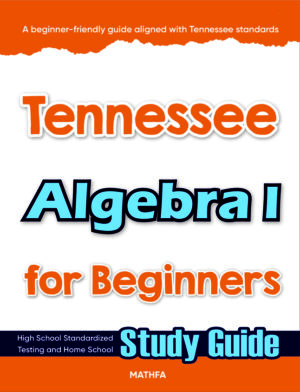 Tennessee Algebra 1 for Beginners Original price was: $22.99.$16.99Current price is: $16.99.Download
 6th Grade Vermont Math for Beginners Original price was: $21.99.$14.99Current price is: $14.99.Download
 6 Full-Length DAT Math Practice Tests: Extra Test Prep to Help Ace the DAT Math Test Original price was: $18.99.$12.99Current price is: $12.99.Download
 DAT Math Workbook: Essential Learning Math Skills Plus Two Complete DAT Math Practice Tests Original price was: $18.99.$12.99Current price is: $12.99.Download
 DAT Math Comprehensive Exercise Book Original price was: $18.99.$12.99Current price is: $12.99.Download
 6th Grade Tennessee Math: TNReady Guide (2026)
 WVGSA Math Prep: West Virginia Student Guide
 ILEARN Geometry Basics Practice — Indiana Guide
 7 Things Nobody Tells You About GRE Math Prep
 KSA 4th Grade Prep: Kentucky Math Guide
TCAP Math Prep Tips for Tennessee Students


📖 Reading time: 11 min
Quick answer: Effective TCAP math prep means spending at least 30 minutes daily on Tennessee-aligned practice problems, focusing on number sense, algebraic reasoning, and geometry — the three domains that carry the most weight on the Tennessee Comprehensive Assessment Program math test.
Who this is for: Tennessee students in grades 3 through 8 preparing for the TCAP math test, parents supporting their child’s math review at home, and teachers looking for targeted practice strategies aligned to Tennessee Academic Standards.
Did you know that Tennessee has made some of the most dramatic academic gains of any state in the nation over the past decade — yet math scores remain one of the biggest areas where students still struggle to reach proficiency? The TCAP (Tennessee Comprehensive Assessment Program) math test is taken by hundreds of thousands of Tennessee students every year, and for many of them, test day feels overwhelming. If your child stares at a math practice test and freezes, or if you’ve been searching for a solid Tennessee math test preparation plan, you’re in the right place.
TCAP math prep doesn’t have to be stressful or complicated. The students who score well on this test aren’t necessarily the ones with the highest natural math ability — they’re the ones who practiced the right material in the right way. That distinction matters enormously when you’re building a math study schedule.
In this post, you’ll learn what the TCAP math test actually covers, how to build a realistic and effective study plan, which strategies work best for different types of math problems, and how to tackle the most challenging question types with confidence. Every tip here is rooted in what the Tennessee Academic Standards actually require — not generic advice, but math help designed specifically for Tennessee students.
What the TCAP Math Test Covers (And Why It Matters)
Understanding the Tennessee Comprehensive Assessment Program
The TCAP math test measures how well Tennessee students have mastered the math standards set by the state’s academic curriculum — and knowing exactly what’s on the test is the single most important first step in any TCAP math prep plan. The TCAP (Tennessee Comprehensive Assessment Program) is administered each spring to students in grades 3 through 8, with end-of-course assessments for high school subjects including Algebra 1, Geometry, and Algebra 2.
Each grade-level test is designed around the Tennessee Academic Standards (TAS), which define what students should know and be able to do by the end of each grade. These standards aren’t arbitrary — they build on each other year after year, which means gaps from one grade will show up as trouble in the next. That’s why consistent math practice throughout the school year matters just as much as last-minute cramming before the test.
The TCAP math test is scored on a scale from 100 to 500, with results falling into one of four performance levels: Below Basic, Basic, On Track, and Mastered. The goal for most students is to reach “On Track” or “Mastered,” which signals grade-level math proficiency and readiness for the next year’s content. Tennessee’s state Department of Education publishes detailed score reports every year that break down student performance by domain, so families can see exactly where their student excels and where extra math help is needed.
Research from the U.S. Department of Education consistently shows that students who engage in regular, structured practice — rather than passive review — demonstrate significantly higher math assessment scores. That’s an important distinction. Simply reading your notes the night before is not the same as working through actual math problems under conditions similar to the real test.
Key Math Domains Tested on the TCAP
While the specific standards shift slightly from grade to grade, several core domains appear across all TCAP math tests. Understanding these domains helps you direct your study time toward what matters most.
- Number and Operations / Number Sense: This domain covers place value, whole numbers, fractions, decimals, and integers. Students in grades 3–5 spend the most time here, but number sense questions appear at every grade level. Strong number sense means students can estimate, compare, and calculate efficiently — without always needing a calculator. Practice mental math and estimation regularly to build this skill.
- Algebraic Reasoning: Starting in grade 3, students work with patterns, equations, and expressions. By grades 6–8, this domain expands into linear equations, inequalities, slope, functions, and proportional relationships. Algebraic thinking is the bridge between arithmetic and higher-level math, and it appears heavily on every middle school TCAP math practice test.
- Geometry and Measurement: This domain tests understanding of shapes, angles, area, perimeter, volume, surface area, and coordinate geometry. Many students lose points here simply because they confuse formulas — especially for area vs. perimeter, or for 3D shapes like cylinders and rectangular prisms. Keeping a formula reference sheet while studying helps lock these in.
- Data Analysis, Statistics, and Probability: Students analyze graphs, tables, and data sets. They calculate mean, median, mode, and range, interpret scatter plots, and reason about probability. These questions reward students who slow down and read carefully — the math itself is usually straightforward once you understand what the graph or table is asking.
- Ratios, Proportions, and Percentages (Grades 6–8): This domain includes unit rates, scale factors, percentage increase and decrease, and proportional reasoning. Real-world word problems in this category are among the most common on TCAP math practice tests for middle school. Students who practice translating word problems into equations score significantly better in this domain.
Knowing which domain gives you the most trouble lets you build a targeted math study schedule instead of reviewing everything equally. That kind of focused preparation is exactly what separates students who improve their scores from those who don’t.
Building a Tennessee TCAP Study Guide That Actually Works
How to Structure Your Math Study Schedule
The most effective Tennessee TCAP study guide isn’t a single book you read cover to cover — it’s a structured, week-by-week plan that combines content review with consistent practice problems. Students who build a math study schedule at least six weeks before the test outperform those who cram in the final days, and the research supports this strongly. The Institute of Education Sciences has published extensive findings showing that spaced practice — reviewing material multiple times over several days rather than in one long session — is one of the most evidence-backed strategies for long-term math skill retention.
A practical TCAP math study schedule for grades 6–8 looks like this: spend the first two weeks reviewing your weakest domain (usually algebraic reasoning or fractions), the next two weeks working through practice problems by domain, the fifth week completing at least two full TCAP math practice tests under timed conditions, and the final week reviewing missed questions and strengthening weak spots. For grades 3–5, adjust the content focus toward number operations and geometry, but keep the same weekly structure.
Daily practice sessions don’t need to be long to be effective. Twenty to thirty minutes of focused math problems is more productive than two hours of passive reading. Set a timer, put away distractions, and work through 10–15 problems per session. When you miss a problem, don’t just check the answer — write out why you got it wrong and what strategy you should have used. That reflection step is where real math learning happens.
Targeting Algebra 1 Skills for the TCAP End-of-Course Test
For high school students taking the TCAP Algebra 1 End-of-Course (EOC) test, the content expectations jump significantly. The Algebra 1 EOC covers linear equations and inequalities, systems of equations, functions, quadratic equations, exponential expressions, and statistical reasoning with data. Many students find that working through a structured, step-by-step workbook alongside their classroom notes helps them connect the abstract concepts they learn in class to the types of questions that actually appear on the test.
For students preparing for the Algebra 1 EOC, Tennessee Algebra 1 for Beginners offers a comprehensive, standards-aligned workbook that walks through every major Algebra 1 concept with clear explanations and practice problems at each step. It’s built for students who want to understand the material — not just memorize procedures — and it covers the exact content tested on Tennessee’s Algebra 1 assessment. Whether you’re using it in a classroom, at home with a parent, or on your own as a self-study resource, the structured format gives you a clear path from confusion to confidence.
According to Tennessee’s Department of Education, Algebra 1 is a gateway course — students who master these concepts are significantly more likely to succeed in higher-level math courses and score proficiently on future assessments. That makes strong Algebra 1 preparation one of the highest-return investments a Tennessee student can make.
🎯 Recommended Math Book
Tennessee Algebra 1 for Beginners — $16.99
Category: Algebra 1, General, Tennessee, Test
Comprehensive Algebra 1 Study Guide & Workbook
Perfect for classroom learning, homeschooling,
or extra practice at home.
7 Proven TCAP Math Prep Strategies You Can Use Today
Strong TCAP math prep comes down to working smarter — not just harder. These seven strategies are grounded in how math learning actually works, and every one of them can be applied starting today, whether the test is six weeks away or six days away.
- Take a diagnostic TCAP math practice test first.
Before you study anything, sit down and complete a full-length TCAP math practice test under real test conditions — timed, no distractions, no looking up answers. This gives you a clear baseline of where you stand right now. Once you score it, sort your wrong answers by domain: number sense, algebra, geometry, data analysis. Your longest list of mistakes tells you exactly where to spend the most study time. Starting without a diagnostic is like driving to a new city without a map — you might get there eventually, but you’ll waste a lot of time going in the wrong direction. - Focus on understanding concepts, not just memorizing steps.
Many students can memorize the steps to solve a linear equation — but freeze when the same concept appears wrapped in a word problem or a different format. On the TCAP, questions are designed to test mathematical reasoning, not just procedure. For every formula you memorize, ask yourself: “What does this actually mean?” For example, understanding that slope represents a rate of change — not just “rise over run” — helps you answer application problems you’ve never seen before. Math fluency grows when you understand why the steps work. - Practice math problems in sets of 10, then review immediately.
Instead of working 50 problems in one sitting without checking answers, work in sets of 10 — then stop and review each mistake before moving on. This technique, known as interleaved practice, is one of the most effective math learning strategies supported by education research. When you catch a misunderstanding immediately, you prevent it from hardening into a bad habit. For TCAP prep, this means you’re constantly correcting your mathematical reasoning rather than reinforcing errors. - Use the math test’s reference sheet strategically.
Tennessee’s TCAP math test provides a reference sheet with formulas for area, perimeter, surface area, volume, and other key measurements. Many students either ignore this sheet or spend too long looking at it during the test. The right approach is to study it thoroughly during your TCAP math prep so you already know what’s on it — then use it only to double-check your setup, not to learn formulas from scratch on test day. Practice with your reference sheet during every timed session so using it becomes automatic. - Build number sense with daily mental math exercises.
Number sense — the ability to understand, estimate, and work flexibly with numbers — underlies every domain on the TCAP math test. Students with strong number sense are faster, make fewer arithmetic errors, and can more easily check whether their answers are reasonable. Practice mental math every day: estimate products before multiplying, round decimals before adding, identify whether a fraction is closer to 0, ½, or 1. These small daily exercises build the mathematical reasoning skills the TCAP directly tests. - Write out every problem-solving step — even the “obvious” ones.
One of the most common reasons students lose points on the TCAP isn’t that they don’t know the math — it’s that they make careless errors because they skip steps in their head. Writing out every step forces you to slow down, check your logic, and catch arithmetic mistakes before they become wrong answers. This is especially important for multi-step word problems involving ratios, percentages, or algebraic equations. Develop this habit during practice and it will carry over automatically to test day. - Simulate test conditions with a consistent math study schedule.
Your brain performs better under familiar conditions. If you’ve never practiced math problems with a timer running, the time pressure on test day will feel foreign and anxiety-inducing. During the last two weeks before your TCAP, complete at least two full timed practice sessions per week — same time of day, same environment, same rules as the real test. This kind of structured preparation helps you ace the math test not just because you know the content, but because you’ve practiced performing under pressure. That confidence is earned, and it shows up in your score.
These strategies work best when they’re combined. A student who takes a diagnostic, builds a math study schedule around their weak domains, and practices under timed conditions will almost always outscore a student who simply re-reads their textbook. The difference isn’t talent — it’s method.
Beyond strategy, consistency matters more than intensity. Short, regular math practice sessions — five days a week for four to six weeks — will do more for your TCAP score than two marathon study sessions the weekend before the test. The goal is to make math problem-solving feel automatic, and that only happens through repeated, spaced practice over time.
Finally, don’t neglect the math topics you feel comfortable with. One of the biggest mistakes students make in Tennessee math test preparation is only reviewing the material they find hard, while assuming they’ll automatically get full credit on familiar topics. Reviewing areas of strength — even briefly — keeps those skills sharp and prevents the kind of silly mistakes that cost easy points on test day.
Worked Examples: TCAP-Style Math Problems
The best way to prepare for the TCAP math test is to practice on problems that look and feel like the real thing. Here are three worked examples modeled after the types of questions that appear on the TCAP, with step-by-step solutions showing the reasoning at each stage.
Example 1: Proportional Reasoning (Grade 7 Level)
Problem: A car travels 156 miles in 3 hours at a constant speed. At this rate, how many miles will the car travel in 5 hours?
Step 1: Find the unit rate (miles per hour).
156 miles ÷ 3 hours = 52 miles per hour
Step 2: Multiply the unit rate by the new number of hours.
52 miles/hour × 5 hours = 260 miles
Answer: The car will travel 260 miles in 5 hours. This problem tests proportional reasoning — a core skill in the Grade 7 TCAP math domain. The key is always finding the unit rate first, then scaling up.
Example 2: Linear Equations (Algebra 1 / Grade 8 Level)
Problem: Solve for x: 3x − 7 = 2x + 5
Step 1: Move all terms with x to one side by subtracting 2x from both sides.
3x − 2x − 7 = 5
x − 7 = 5
Step 2: Isolate x by adding 7 to both sides.
x − 7 + 7 = 5 + 7
x = 12
Step 3: Check your answer by substituting x = 12 back into the original equation.
3(12) − 7 = 2(12) + 5
36 − 7 = 24 + 5
29 = 29 ✓
Answer: x = 12. Always verify your solution by plugging it back in — this takes ten seconds and catches arithmetic errors before they cost you a point on the actual TCAP test.
Example 3: Area and Perimeter (Grade 5–6 Level)
Problem: A rectangular garden has a length of 14 feet and a width of 9 feet. What is the area of the garden, and what is the total length of fencing needed to surround it?
Step 1: Calculate the area using the formula A = length × width.
A = 14 × 9 = 126 square feet
Step 2: Calculate the perimeter (total fencing needed) using P = 2(length + width).
P = 2(14 + 9) = 2(23) = 46 feet
Answer: The garden’s area is 126 square feet, and it requires 46 feet of fencing. Note that area is measured in square units and perimeter is measured in linear units — confusing these two is one of the most frequent mistakes on TCAP geometry questions. Keeping that distinction clear in your mind saves points.
Frequently Asked Questions
What topics should I focus on most for TCAP math prep?
Focus on the domains where you scored lowest on a diagnostic practice test — typically algebraic reasoning, fractions and ratios, and geometry. For TCAP math prep in grades 3–5, prioritize number sense, fractions, and measurement. For grades 6–8, shift your Tennessee math test preparation toward proportional reasoning, expressions and equations, and data analysis, since these domains represent a larger share of the test’s total questions.
How long should I study for the Tennessee TCAP math test?
Most students see meaningful score improvement with four to six weeks of consistent preparation — roughly 20 to 30 minutes of focused TCAP math practice problems per day, five days a week. A well-structured Tennessee TCAP study guide helps you cover all tested domains systematically rather than studying randomly. Starting earlier is always better, but even two weeks of targeted daily math practice can produce measurable gains if you stay focused on your weakest areas.
Is a TCAP math practice test worth doing before the real exam?
Yes — completing at least one full TCAP math practice test under timed conditions before the actual test is one of the highest-value steps you can take. A practice test reveals your weakest domains, builds familiarity with the question format, and reduces test-day anxiety by making the experience feel familiar. Students who complete multiple timed practice tests typically feel more confident and make fewer careless errors on test day because the format is no longer unfamiliar.
📚 More from Math Notion
Key Takeaways
- TCAP math prep is most effective when you start with a diagnostic practice test to identify your weakest domains — then build your entire study schedule around closing those specific gaps.
- Daily math practice sessions of 20–30 minutes, spread across four to six weeks, produce better results than last-minute cramming — because spaced repetition is how math fluency is actually built.
- For Algebra 1 EOC preparation, a structured, Tennessee-aligned workbook like Tennessee Algebra 1 for Beginners gives students a clear, step-by-step path through every concept tested on the assessment.
- Strong number sense, careful step-by-step written work, and timed practice under real test conditions are three habits that consistently separate high scorers from struggling students on the Tennessee TCAP math test.
Every Tennessee student who puts in consistent, well-directed effort on TCAP math prep improves — not because the test gets easier, but because the content becomes familiar and the problem-solving process becomes second nature. Use the strategies in this post, work through practice problems every day, and approach test day as a chance to show what you’ve already learned. Visit mathnotion.com/tests to explore the full collection of Tennessee math test prep books and find the right resource for your grade level and goals.
Posted by Math Notion Team · Published on June 14, 2026