Math Articles, tips & study guides
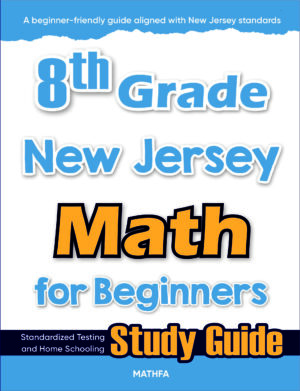 8th Grade New Jersey Math for Beginners Original price was: $21.99.$14.99Current price is: $14.99.Download
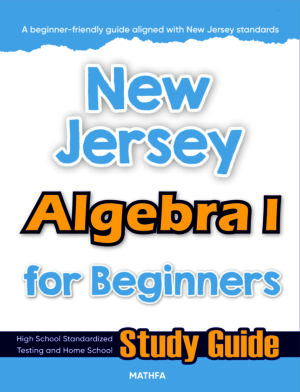 New Jersey Algebra 1 for Beginners Original price was: $22.99.$16.99Current price is: $16.99.Download
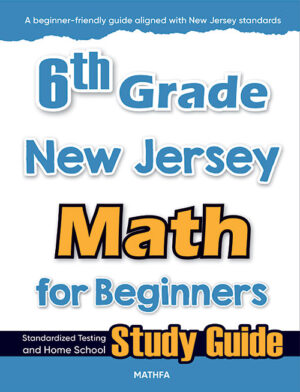 6th Grade New Jersey Math for Beginners Original price was: $21.99.$14.99Current price is: $14.99.Download
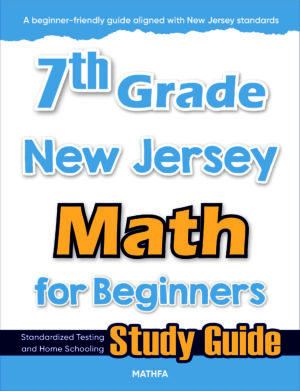 7th Grade New Jersey Math for Beginners Original price was: $21.99.$14.99Current price is: $14.99.Download
 ACT Math Practice Book 2020: Extra Exercises and Two Full Length ACT Math Tests to Ace the Exam Original price was: $18.99.$12.99Current price is: $12.99.Download
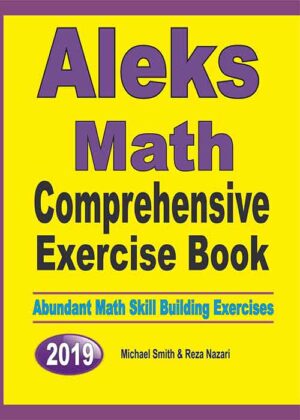 ALEKS Math Comprehensive Exercise Book: Abundant Math Skill Building Exercises Original price was: $18.99.$12.99Current price is: $12.99.Download
 SAT Math Practice Book 2020: Extra Exercises and Two Full Length SAT Math Tests to Ace the Exam Original price was: $18.99.$12.99Current price is: $12.99.Download
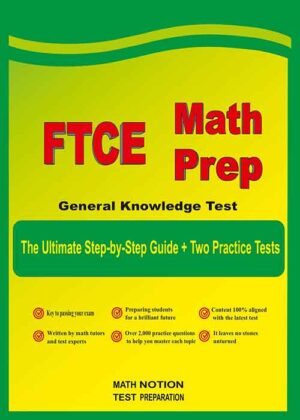 FTCE Math Prep (General Knowledge Test): The Ultimate Step by Step Guide Plus Two Full-Length FTCE Practice Tests Original price was: $18.99.$12.99Current price is: $12.99.Download
 PARCC Scores Explained: Levels and What Replaced the Test
 What Happened to the PARCC Math Test? (And What Replaced It)
 IAR Quadratic Equations Practice — Illinois Guide
 CMAS Scatter Plots Practice — Colorado Guide
 NSCAS Sequences & Series Practice — Nebraska Guide
NJSLA Geometric Proofs: New Jersey Practice Guide


📖 Reading time: 13 min
Geometric proofs are the single biggest source of lost points on the New Jersey NJSLA geometry assessment — and most students lose those points before they even finish reading the question. If that surprises you, you’re in good company. According to the New Jersey Department of Education, only about 35% of New Jersey high school students met grade-level expectations on the most recent NJSLA geometry assessment, and proof-based items consistently rank among the lowest-scoring question types across every district from Newark to Cherry Hill.
This guide walks you through targeted NJSLA geometric proofs practice — what trips students up, how to fix it, and exactly what a clean two-column proof looks like on test day. You’ll see the most common mistakes (with real examples), a step-by-step approach you can use immediately, worked practice problems, memory tricks for theorems, and advice for parents and teachers helping students at home throughout New Jersey.
Geometry proofs aren’t about being “good at math” — they’re about being organized. Once you learn the structure, the rest is pattern recognition. Let’s break it down so the next proof you see on a New Jersey NJSLA geometric proofs question feels like familiar territory, not a surprise. Whether you’re a sophomore preparing for the spring test, a parent supporting a struggling student, or a teacher refining your classroom approach, the strategies below are field-tested and ready to use.
Why Geometric Proofs Matter for New Jersey NJSLA Success
Proofs Are the Backbone of Geometry — and the NJSLA Knows It
Geometric proofs matter because they test the one skill every other math topic depends on: logical reasoning. The NJSLA (New Jersey Student Learning Assessment) treats proof writing as the gateway to higher-level math, which is why proof-based items appear across multiple-choice, drag-and-drop, and constructed-response questions on the geometry exam. New Jersey’s testing framework is designed around the Common Core-aligned NJSLS standards, and proofs sit at the heart of high school geometry expectations.
The New Jersey math standards for geometric proofs ask students to do more than memorize. They expect you to justify each step using a definition, postulate, or theorem. That’s a real shift from middle school, where “showing work” usually meant writing down arithmetic. In high school geometry, “showing work” means proving that what you wrote is logically true — and the NJSLA rewards that precision generously while penalizing vague reasoning harshly.
Students who master proofs also tend to do better on algebra, trigonometry, and even data analysis questions. Why? Because proofs train the same habit every standardized test rewards — careful reading, clear structure, and step-by-step justification. As the official guidance from the New Jersey – NJSLA Math Assessment confirms, students who practice structured reasoning consistently outperform peers who rely on guessing or pattern-matching. This is true at every grade level and in every subject area, not just geometry.
Here’s why building this skill early pays off across every math test you’ll take:
- Proofs build math fluency. When you write 8–10 proofs a week, your brain starts spotting congruent triangles, parallel lines, and angle relationships automatically. That speed translates directly to faster, more accurate answers under time pressure on the NJSLA.
- Proofs strengthen number sense and reasoning. Each step forces you to ask “why is this true?” — which is exactly the habit the NJSLA rewards in every multi-step word problem, not just geometry. The reasoning skills carry over into algebra and statistics questions too.
- Proofs prepare you for the SAT, ACT, and college math. The same logical structure shows up in SAT geometry, ACT plane geometry, and any college-level proof-based course. Mastering it now saves you years of catch-up later when you’re applying to Rutgers, Princeton, NJIT, or any out-of-state university.
- Proofs raise your math confidence. There’s a moment when proof writing clicks — and after that, geometry stops feeling random. That confidence carries over to test day, where calm thinking beats panic every time.
- Proofs develop transferable career skills. Engineering, computer science, law, and medicine all reward the same structured reasoning that proofs teach. New Jersey’s strong STEM economy values these skills enormously.
What “Mastery” Actually Looks Like
Mastery isn’t writing perfect proofs from memory. It’s recognizing the proof type within the first 30 seconds, identifying the given information, and knowing which two or three theorems are likely to apply. Students who reach this level can attempt almost any NJSLA proof — even unfamiliar ones — because they’ve internalized the framework. They don’t need to remember every theorem perfectly; they just need to know where to look in their mental toolbox.
Beyond that, mastery means being comfortable with multiple proof formats: two-column, paragraph, and flowchart. The NJSLA can ask you to complete partial proofs, drag justifications into the correct order, or even fill in missing reasons. If you’ve only practiced one format, you’re going to lose points on the others. Strong students rotate between all three formats during practice so nothing on test day feels foreign or surprising.
True mastery also means being able to explain your proof out loud to someone else. If you can teach the proof to a younger sibling or classmate, you understand it deeply. If you can only copy it from a textbook, you don’t yet. This is why study groups and peer tutoring work so well for geometry — verbalizing reasoning cements it permanently.
Common Mistakes on New Jersey NJSLA Geometric Proofs
The Errors That Cost Students the Most Points
The most common geometric proof mistakes on the NJSLA fall into five predictable categories — and almost every one of them is fixable in under a week of focused practice. Knowing what they are is half the battle, because once you can name a mistake, you can stop making it.
First, students confuse given information with what they need to prove. They start using the conclusion as a step, which creates circular reasoning. Always underline the “Given” and circle the “Prove” before writing anything else. This 10-second habit prevents the most embarrassing proof errors and immediately clarifies the structure of the problem.
Second, students skip the justification column. A statement without a reason isn’t a proof — it’s a guess. The NJSLA scoring rubric awards partial credit only when each step has a valid reason: a definition, postulate, or theorem. According to the New Jersey Department of Education, geometry constructed-response items typically have between 4 and 8 scoring points, and missing justifications are the single biggest cause of lost partial credit. Even a half-finished proof with full justifications scores higher than a complete proof with missing reasons.
Third, students misuse theorems they haven’t fully memorized. A common example: writing “SSA” as a triangle congruence reason. SSA is not a valid congruence theorem. Only SSS, SAS, ASA, AAS, and HL prove triangles congruent. Mixing these up turns a correct-looking proof into a zero. Another classic error is calling AAA a congruence theorem — it proves similarity, not congruence, and the NJSLA scorers are trained to spot this exact mistake.
Fourth, students rely on the diagram instead of the given facts. Just because two segments look equal doesn’t mean they are. Unless the problem states it or you can prove it, you can’t use it. This is one of the most common NJSLA math geometric proofs tips experienced teachers repeat: trust the givens, not the picture. NJSLA diagrams are sometimes drawn slightly inaccurately on purpose to catch students who guess from appearance.
Fifth, students stop too early. They prove triangles congruent but forget to add the final step using CPCTC (Corresponding Parts of Congruent Triangles are Congruent). That last line is often what the question actually asked for. Always reread the “Prove” statement after writing your final line — if your final statement doesn’t match it word-for-word, you’re not done yet.
For students who want structured practice with all of these reasoning skills, 6th Grade New Jersey Math for Beginners builds the foundation early — covering the geometric thinking, vocabulary, and step-by-step problem solving that students need before tackling high school proof work. It’s a great companion for younger students or anyone strengthening the basics that NJSLA proofs build on.
🎯 Recommended Math Book
6th Grade New Jersey Math for Beginners — $14.99
Category: Others
New Jersey Math
NJSLA Success
Perfect for classroom learning, homeschooling, or extra practice at home.
STEM thinking — the kind of careful reasoning federal programs like CDC – NIOSH STEM Education highlights as essential — starts with exactly this kind of disciplined, step-by-step proof work. When you fix these five mistakes, your score climbs fast. Most students see a 15–25 point improvement on NJSLA practice tests within three weeks of correcting these specific errors.
Why These Mistakes Persist
These errors aren’t random — they happen because most geometry curriculum spends only a few weeks on formal proofs, then moves on. Students never get the volume of practice needed to internalize the structure. Add test anxiety on NJSLA day, and even strong students default to bad habits. The fix is simple: deliberate practice with immediate feedback. Five proofs a day for a month builds the muscle memory that overrides panic.
NJSLA Geometric Proofs Practice: A Step-by-Step Approach for New Jersey Students
Here’s the seven-step framework that turns proof writing from a guessing game into a repeatable process. Practice this every time you see a proof, and within two weeks the steps will feel automatic. New Jersey teachers who use this method report dramatic improvement in student NJSLA scores.
- Read the entire problem twice before writing anything. The first read gives you the picture; the second read makes sure you understand what’s given and what you need to prove. Most NJSLA proof errors happen because students start writing during their first read. Slow down — those 20 seconds save you from rebuilding the whole proof later. Treat the first read as orientation and the second as analysis.
- Mark up the diagram immediately. Tick congruent segments, arc congruent angles, and label parallel lines. This visual coding turns abstract givens into concrete clues. Use a different mark for each pair so your eye can find matching parts instantly when you’re choosing a triangle congruence theorem. On the digital NJSLA, use the highlighter and annotation tools provided — they exist for exactly this purpose.
- List the givens in a column on scratch paper. Then list the “Prove” statement underneath. Now ask: “What’s the gap between what I know and what I need?” That gap tells you which theorems are likely candidates — vertical angles, alternate interior angles, reflexive property, or a triangle congruence postulate. This bridge-building approach is how experienced mathematicians actually think.
- Choose your proof strategy before writing line 1. Most NJSLA proofs follow one of three paths: prove triangles congruent then use CPCTC, use parallel-line angle theorems, or apply properties of special quadrilaterals. Identifying the path first prevents you from wandering through unrelated theorems and wasting precious test time.
- Write each statement with its reason side by side. Never write three statements in a row and come back for reasons. You’ll forget your logic. The two-column format exists for a reason — use it. Each line should answer “What’s true?” and “Why is it true?” If you can’t immediately name a reason, that statement probably doesn’t belong yet.
- Use the reflexive property when a side or angle is shared. This is the single most forgotten step on the NJSLA. If two triangles share a side, that side is congruent to itself by the reflexive property. Forgetting this line breaks an otherwise perfect proof. Train yourself to scan for shared parts every single time.
- End with the exact statement the problem asked you to prove. Your last line must match the “Prove” word-for-word. If the problem asks you to prove segments congruent and you stop at “triangles congruent,” you’ve left points on the table. Add the CPCTC line. Always.
This sequence is what separates students who get 60% on proof items from students who get 95%. The math doesn’t get harder — the process gets cleaner. Practice this checklist on five proofs a day for two weeks and watch what happens to your test day math tips routine. New Jersey students who follow this protocol consistently report feeling calmer and more confident on test day.
One more thing: time yourself. NJSLA proof items typically allow 4–6 minutes each. If you’re spending 12 minutes on practice proofs at home, you need more reps, not more time. Speed comes from familiarity, and familiarity comes from volume. A good math cheat sheet of theorems taped to your desk during practice (not on test day, of course) accelerates this dramatically. Pacing is one of the most underrated skills in NJSLA preparation.
Finally, build a personal “theorems bank.” Write each theorem on an index card with a tiny diagram. Quiz yourself daily. Within a month you’ll recall any theorem in under three seconds — which is exactly the speed the NJSLA rewards. Add a card for every new theorem you encounter, and review the deck every Sunday for 10 minutes.
Building a Weekly Practice Routine
Structure beats willpower every time. A solid weekly routine for New Jersey students preparing for the NJSLA might look like this: Monday and Wednesday, three triangle congruence proofs each; Tuesday and Thursday, two parallel-line proofs and one quadrilateral proof; Friday, a timed mixed quiz of five proofs; Saturday, review every mistake from the week; Sunday, rest or light theorem review. Stick with this for six weeks before the NJSLA and your scores will reflect the work.
Worked Examples: NJSLA-Style Geometric Proofs for New Jersey Students
Example 1: Triangle Congruence Using SAS
Problem: In triangle ABC and triangle DEF, you are given that AB ≅ DE, ∠A ≅ ∠D, and AC ≅ DF. Prove that △ABC ≅ △DEF.
Step 1: Identify what’s given. You have two pairs of congruent sides and the included angle between them. The word “included” matters — it means the angle sits between the two named sides.
Step 2: Match the configuration to a triangle congruence theorem. Two sides and the included angle = SAS (Side-Angle-Side). This is one of the five valid congruence theorems on the NJSLA.
Step 3: Write the proof in two columns. Statement: AB ≅ DE; Reason: Given. Statement: ∠A ≅ ∠D; Reason: Given. Statement: AC ≅ DF; Reason: Given.
Step 4: Conclude. Statement: △ABC ≅ △DEF; Reason: SAS Postulate.
Answer: The triangles are congruent by SAS. Notice how every line has a justification — that’s what earns full credit on the NJSLA. This proof is short, but completeness matters more than length.
Example 2: Using CPCTC After Proving Triangles Congruent
Problem: Given that M is the midpoint of AB and CM ⊥ AB, prove that CA ≅ CB.
Step 1: Mark the diagram. AM ≅ MB (definition of midpoint), and the perpendicular creates two right angles.
Step 2: Identify the shared side. CM ≅ CM by the reflexive property. This is the line students forget most often.
Step 3: Apply SAS to triangles CMA and CMB. You have AM ≅ MB, ∠AMC ≅ ∠BMC (both right angles), and CM ≅ CM.
Step 4: Conclude triangles congruent: △CMA ≅ △CMB by SAS.
Step 5: Apply CPCTC. Since the triangles are congruent, CA ≅ CB.
Answer: CA ≅ CB by CPCTC. This is a classic NJSLA-style proof — and forgetting that final CPCTC line is the most common reason students lose the last point. Always check that your final line matches the “Prove” statement.
Example 3: Parallel Lines and Alternate Interior Angles
Problem: Given line ℓ ∥ line m with transversal t, prove that ∠1 ≅ ∠2, where ∠1 and ∠2 are alternate interior angles.
Step 1: State the given. ℓ ∥ m; Reason: Given.
Step 2: Apply the Alternate Interior Angles Theorem. When two parallel lines are cut by a transversal, alternate interior angles are congruent.
Step 3: Conclude. ∠1 ≅ ∠2; Reason: Alternate Interior Angles Theorem.
Answer: The angles are congruent. This short proof shows up frequently on the NJSLA — and students lose points only when they cite the wrong theorem name. Memorize the exact wording: “Alternate Interior Angles Theorem,” not “alternate angles” or “Z-angles.”
Memory Tricks That Make Theorems Stick
Memorizing theorems doesn’t have to be miserable. Try these proven shortcuts that New Jersey teachers and tutors swear by:
- “SAS, ASA, AAS, SSS, HL” — these are the only triangle congruence theorems. Sing them to a rhythm. SSA and AAA are NOT congruence theorems. Repeating this aloud daily keeps you from making the SSA mistake on the NJSLA.
- CPCTC = “Cats Pounce Carefully Then Calmly” — silly mnemonics work. Use whatever sticks. The point is to reach for CPCTC automatically after proving triangles congruent.
- Parallel-line angles: “Co-interior add to 180, alternate are equal, corresponding are equal.” Say it out loud while pointing at a diagram. After 20 reps you’ll never forget.
- Reflexive property: “Shared = Same.” If two triangles share a side or angle, that part is congruent to itself. This three-word reminder catches a lot of forgotten lines.
- HL Theorem: “Hypotenuse-Leg, right triangles only.” HL works exclusively for right triangles. Saying the restriction every time you use it prevents misapplication.
How Geometric Proofs Appear on Other Standardized Tests
Proof skills travel well. The SAT Math section includes geometry questions that don’t require a full proof but test the same reasoning — angle chasing, triangle congruence, and parallel-line relationships. The ACT plane geometry section asks similar questions. The GED math test includes simpler geometry items focused on area, perimeter, and the Pythagorean theorem, but the logical reasoning practiced through proofs makes those questions feel easy. Even college placement tests like Accuplacer and ALEKS reward students who think in structured steps. New Jersey students who plan to attend Rutgers, TCNJ, Montclair State, or any other in-state university will see these skills tested again on placement exams.
Practice Strategies for New Jersey Parents and Teachers
Parents and teachers can support proof learning without being geometry experts themselves. The trick is asking the right questions: “Which theorem did you use?” “What’s the reason for this line?” “Can you find a different way to prove this?” These questions force the student to verbalize reasoning, which is the fastest way to internalize it. Set aside 15 minutes daily for proof practice using printable math worksheets and free math worksheets from reputable sources. Consistency beats intensity every time, and many New Jersey libraries offer free access to test prep materials and tutoring resources.
When to Seek a Tutor or Extra Help
If a student has practiced proofs daily for three weeks and still scores below 50% on practice items, it’s time for a tutor. Proofs require precise feedback that self-study often can’t provide — a tutor can spot exactly which theorem the student is misapplying and correct it in minutes. Many New Jersey districts offer free after-school math help, and online tutoring platforms provide step-by-step math support at affordable rates. Don’t wait until the week before the test. The earlier you address proof weaknesses, the more time you have to build genuine confidence before NJSLA day.
📚 More from Math Notion
Frequently Asked Questions
How much time should I spend on NJSLA geometric proofs practice each week?
Aim for 30–45 minutes of focused proof practice five days a week. Daily repetition beats long weekend sessions because proof writing builds pattern recognition, and patterns fade fast without consistent reinforcement. Mix easy and hard proofs each session, and always review your mistakes the next day. After four to six weeks of this routine, most New Jersey students see major score improvements on NJSLA geometric proofs practice items, often jumping a full performance level.
What’s the most common NJSLA geometric proofs mistake students make?
Forgetting to write a reason next to each statement is the most common mistake. The NJSLA scoring rubric awards partial credit only when each step is justified by a definition, postulate, or theorem. Students who write correct statements without reasons often score zero on the proof, even when their logic is sound. Always pair every statement with its justification — no exceptions, no shortcuts. This single habit can raise a New Jersey student’s geometry score by 10 to 20 points overnight.
Why do parallel-line theorems show up so often in NJSLA proofs?
Parallel-line theorems appear frequently because they connect to triangle congruence, quadrilateral properties, and coordinate geometry — three of the largest NJSLA content areas. Mastering alternate interior angles, corresponding angles, and co-interior angles unlocks roughly 40% of the proof questions you’ll see. Memorize the three theorems exactly, practice identifying them in diagrams quickly, and your overall geometry score will climb noticeably. New Jersey teachers consistently report this as the highest-leverage content area for proof preparation.
Key Takeaways for New Jersey NJSLA Students
- Geometric proofs are the highest-leverage skill on the NJSLA — mastering them improves every other geometry score for New Jersey students.
- Avoid the five common mistakes: skipping reasons, misusing SSA, trusting the diagram, forgetting CPCTC, and stopping too early.
- Use the seven-step proof framework daily; structure beats raw talent on test day.
- Build foundational skills early with structured resources like 6th Grade New Jersey Math for Beginners to make high school geometry feel natural.
- Practice consistently — 30–45 minutes a day for six weeks before the NJSLA — and the results will follow.
Strong NJSLA geometric proofs practice comes down to three habits: read carefully, justify every step, and finish with the exact statement the problem asked you to prove. Master those, and proof items go from your weakest section to your strongest. Ready to build the foundation? Explore the full math book collection at mathnotion.com and pick the resource that matches your grade level. Every New Jersey student deserves the tools to succeed on the NJSLA — and proof mastery is one of the most important tools in the kit.
NJSLA math practice workbooks for New Jersey
The fastest way to turn this guide into results is steady practice. Our New Jersey math workbooks are built for NJSLA test prep, with full-length New Jersey NJSLA math practice, worksheets, and step-by-step answer explanations — ideal for homeschool, classroom, or after-school NJSLA math test prep.
- 6th Grade New Jersey Math Practice Workbook
- 7th Grade New Jersey Math Practice Workbook
- 8th Grade New Jersey Math Practice Workbook
Browse all Math Notion math practice books →
Official source: For the latest test details and dates, visit the New Jersey Department of Education assessment page.
Posted by Math Notion Team · Published on May 7, 2026