Math Articles, tips & study guides
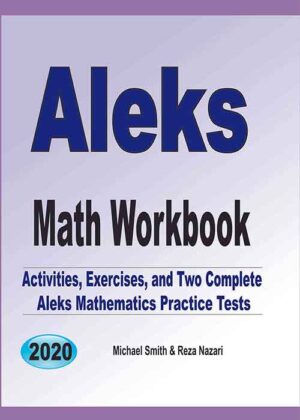 ALEKS Math Workbook: Exercises, Activities, and Two Full-Length ALEKS Math Practice Tests Original price was: $18.99.$12.99Current price is: $12.99.Download
 ALEKS Math Comprehensive Exercise Book: Abundant Math Skill Building Exercises Original price was: $18.99.$12.99Current price is: $12.99.Download
 6 Full-Length ALEKS Math Practice Tests: Extra Test Prep to Help Ace the ALEKS Math Test Original price was: $18.99.$12.99Current price is: $12.99.Download
 ALEKS Math Workbook: Essential Learning Math Skills Plus Two Complete ALEKS Math Practice Tests Original price was: $18.99.$12.99Current price is: $12.99.Download
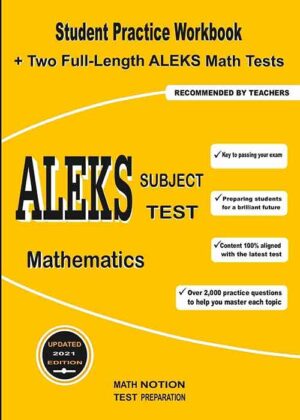 ALEKS Subject Test Mathematics: Student Practice Workbook + Two Full-Length ALEKS Math Tests Original price was: $18.99.$12.99Current price is: $12.99.Download
 ALEKS Math Practice Book 2020: Extra Exercises and Two Full Length ALEKS Math Tests to Ace the Exam Original price was: $18.99.$12.99Current price is: $12.99.Download
 PERT Math Workbook: The Most Effective Exercises and Review PERT Math Questions Original price was: $18.99.$12.99Current price is: $12.99.Download
 6 PERT Math Practice Tests: Extra Practice to Achieve a Crack Score Original price was: $18.99.$12.99Current price is: $12.99.Download
 Accuplacer Math Workbook: Exercises, Activities, and Two Full-Length Accuplacer Math Practice Tests Original price was: $18.99.$12.99Current price is: $12.99.Download
 ALEKS Math Score Explained: What Is a Good Score?
 IAR Quadratic Equations Practice — Illinois Guide
 CMAS Scatter Plots Practice — Colorado Guide
 OST Pre-Calculus Practice — Ohio Guide
 SBAC Congruence and Similarity Practice — California Guide
ALEKS Math Test: How It Works and How to Prepare

If a college has asked you to take ALEKS before registering for math, you’ve met one of the most widely used placement tests in the country, and one that works unlike any test you’ve probably seen before. Understanding the ALEKS math test ahead of time matters because your result decides which math course you’ll start in, from developmental math all the way up to calculus. A higher placement can save you a semester and real tuition dollars, so a little preparation goes a long way. This guide explains what ALEKS is, how its unusual format works, what it covers, and exactly how to get ready.
The most effective way to raise your placement is steady ALEKS math practice on the specific skills the assessment measures. Below we’ll walk through the format, the content, how scoring and placement work, common mistakes, a study plan, and the workbook that pulls your ALEKS math prep together so you can study with confidence.
What ALEKS is and why colleges use it
ALEKS stands for Assessment and Learning in Knowledge Spaces, and it’s an online, adaptive system used by many colleges to place incoming students into the right math course. Unlike a traditional test that gives everyone the same questions, ALEKS builds a personalized picture of exactly which math topics you’ve mastered and which you haven’t, then uses that to recommend a placement.
Colleges like ALEKS because it’s efficient and precise, and because it comes with a built-in learning component that lets students improve before retesting. For you, the key point is that ALEKS isn’t pass-or-fail, it’s a placement tool, and where you land directly affects how quickly you move through your math requirements. That makes preparing for it a genuinely worthwhile investment.
How the ALEKS format is different
The biggest surprise for most students is that ALEKS is not multiple choice. Instead of picking from options, you type in your actual answers using an on-screen input tool, which means you can’t guess your way through, you have to genuinely know how to work each problem. This open-response format gives a much more honest measure of your skills.
ALEKS is also adaptive, adjusting the questions based on your responses to zero in on the boundary of what you know, usually within about thirty questions. There’s no time pressure of the racing kind, but you should plan to focus for the full session. Knowing this format in advance is important, because practicing by actually solving problems, not just recognizing answers, is exactly what ALEKS rewards.
What the ALEKS math test covers
ALEKS spans a wide range of math, and the assessment draws from whatever level fits you. The content includes arithmetic and the foundations of number sense, then moves through pre-algebra and algebra, equations, inequalities, exponents, polynomials, and functions. Depending on your level, it can reach into geometry, coordinate geometry, and trigonometry, all the way up to precalculus topics.
Because the assessment adapts, you won’t see every topic; it focuses on the band around your current ability. But that breadth is exactly why broad, well-organized practice helps so much, you want to be solid across arithmetic and algebra at minimum, since those underpin the higher placements. A complete workbook lets you shore up each layer in order so gaps don’t drag your placement down.
How ALEKS scoring and placement work
ALEKS reports a score from 0 to 100, representing the percentage of the course material you’ve demonstrated mastery of. Colleges set their own cutoffs that map score ranges to specific courses, so a certain score might place you into college algebra, a higher one into precalculus, and a higher one still into calculus. Lower scores route you into developmental or preparatory math first.
Because each school sets its own thresholds, it’s smart to find your college’s ALEKS placement chart and identify the score you need for the course you want. Then aim comfortably above it. Many schools also let you use the ALEKS Prep and Learning Module to study and retake the assessment for a higher placement, which rewards preparation directly.
Use the Prep and Learning Module
A feature unique to ALEKS is that after your initial assessment, you typically get access to a Prep and Learning Module, a personalized set of lessons targeting exactly the topics you missed. Many colleges allow multiple attempts at the assessment, with required study time in the module between tries, so you can genuinely raise your placement rather than being stuck with a first result.
This changes the strategy entirely: ALEKS is one of the few placement tests where studying after your first attempt can directly improve your outcome. Pairing the module with focused outside practice on your weak areas is a powerful combination, and it means a disappointing first score is just a starting point, not a verdict, as long as you put in the work.
Why a dedicated workbook helps
While the Prep and Learning Module is useful, many students benefit from a structured workbook alongside it, because a book lets you review concepts thoroughly, at your own pace, with clear explanations in one place. A well-built workbook lays the material out so each concept builds on the one before, which prevents the frustrating experience of hitting a problem that assumed a skill you never solidified.
A workbook also makes practice portable and screen-free when you want it, and gives you worked-out solutions to learn from. Used together with the online module, it covers both the breadth and the depth of ALEKS math prep, helping you build the genuine, type-it-in-yourself fluency the assessment demands.
Clear lessons and step-by-step explanations
Because ALEKS requires you to produce answers rather than recognize them, you need real understanding, not just familiarity. The right workbook supports this with plain-language lessons that explain each concept before the practice begins, and step-by-step answer explanations that show the full method, not just the final result.
This matters because an answer key with only final answers can’t teach you how to get there. Worked solutions let you find exactly where your approach went wrong, understand the correct steps, and close the gap, which is how you build the ability to solve problems independently. For a test where you type your own answers, that depth of understanding is essential.
Common mistakes and how to avoid them
ALEKS test-takers tend to stumble in a few predictable ways. The first is treating it like a multiple-choice test and being caught off guard by having to enter answers directly, practicing real problem-solving prevents this. The second is neglecting fundamentals; weak arithmetic or basic algebra caps your placement no matter how much you know at higher levels.
A third mistake is skipping the Prep and Learning Module and not retaking the assessment when retakes are allowed, leaving an easy placement bump on the table. Avoiding these traps comes down to preparing genuinely, shoring up your foundations, and using every attempt the school permits. Thorough ALEKS math practice turns vague weaknesses into the specific, demonstrable skills the assessment scores.
A simple study plan for ALEKS
Start by taking the assessment honestly to see where you land and which topics the module flags. In the first week or two, focus on solidifying arithmetic and basic algebra, since these underpin everything and often offer the quickest gains. Work problems by hand, typing-style, so you’re practicing the way ALEKS will ask.
Over the following weeks, move up through equations, polynomials, functions, and whatever higher topics your target placement requires, using both the module and a workbook. Then, if your school allows, retake the assessment after meeting the required study time. Short, regular sessions beat cramming, because the skills consolidate with steady, spaced repetition, and ALEKS measures durable mastery, not last-minute memorization.
The workbook that pulls your prep together
The most reliable way to build real ALEKS readiness is a workbook written for the math the assessment covers. The ALEKS Subject Test Mathematics workbook walks through the arithmetic, algebra, and higher-level skills ALEKS uses to place you, with clear lessons, ample practice, and step-by-step answer explanations you can follow on your own. It’s an instant download, so you can start tonight and aim for the highest placement you’re capable of. Browse all our math practice books → to find the right fit.
Why the first attempt is just a starting point
It’s worth repeating, because it changes how you should approach the test: with ALEKS, your first score rarely has to be your final one. Most colleges build in multiple attempts paired with required study time in the learning module, which means the system is explicitly designed to reward students who go back and learn what they missed. Walking in for the first attempt without preparation, then using the module and a workbook to climb, is a completely legitimate, effective strategy.
This is very different from a one-shot exam, and it should take a lot of pressure off. Instead of fearing a low initial placement, treat that first attempt as a diagnostic that tells you exactly where to focus. The students who end up in higher math courses are usually not the ones who happened to know everything on day one, but the ones who used every attempt and studied deliberately in between.
Building genuine, type-it-in fluency
Because ALEKS makes you produce answers rather than choose them, the goal of your ALEKS math practice should be genuine fluency, the kind where you can work a problem start to finish without prompts. That means practicing with a pencil and paper, or typing answers yourself, rather than passively reading solutions. The act of struggling through a problem and reaching the answer is what builds the skill ALEKS measures.
A good way to test yourself is to cover the worked solution, attempt the problem cold, and only then check your steps against the explanation. If you got stuck, note exactly where and revisit that concept. Repeating this across the arithmetic, algebra, and higher-level topics in your target range steadily turns shaky recognition into the solid, independent problem-solving that earns a strong placement.
Frequently asked questions
Is the ALEKS math test multiple choice?
No. ALEKS is open-response, so you type in your actual answers using an on-screen tool. That’s why practicing real problem-solving, not just recognizing answers, is essential.
What is a good ALEKS score?
ALEKS scores run 0 to 100, and each college sets its own cutoffs for course placement. Check your school’s chart and aim comfortably above the score for the course you want.
Can I retake the ALEKS placement test?
Usually yes. Many colleges allow multiple attempts with required study time in the Prep and Learning Module between tries, so preparation can directly raise your placement.
How long should I prepare for ALEKS?
A few focused weeks is realistic, especially if you shore up arithmetic and algebra first and practice by working problems the way ALEKS asks you to.
Math Notion makes standards-aligned math workbooks and test prep for learners at every level and across all 50 states. See the full collection.
Posted by Math Notion Team · Published on September 25, 2021