Math Articles, tips & study guides
 SBAC Math Practice Grade 8: Complete Content Review Plus 2 Full-length SBAC Math Tests Original price was: $18.99.$12.99Current price is: $12.99.Download
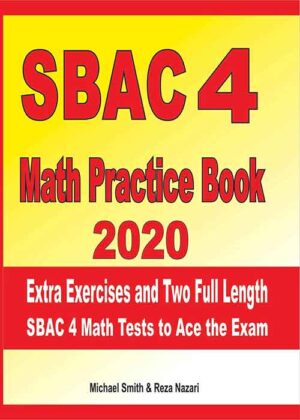 SBAC Grade 4 Math Practice Book 2020: Extra Exercises and Two Full Length SBAC Math Tests to Ace the Exam Original price was: $18.99.$12.99Current price is: $12.99.Download
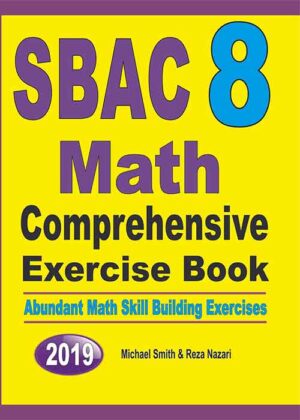 SBAC Grade 8 Math Comprehensive Exercise Book: Abundant Math Skill Building Exercises Original price was: $18.99.$12.99Current price is: $12.99.Download
 SBAC Subject Test Mathematics Grade 5: Student Practice Workbook + Two Full-Length SBAC Math Tests Original price was: $18.99.$12.99Current price is: $12.99.Download
 5th Grade SBAC Math Exercise Book: Review of Essential Skills and Concepts With 2 SBAC Math Practice Tests Original price was: $18.99.$12.99Current price is: $12.99.Download
 6 Full-length SBAC Grade 7 Math Practice Tests: Extra Test Prep to Help Ace the SBAC Grade 7 Math Test Original price was: $18.99.$12.99Current price is: $12.99.Download
 SBAC Grade 3 Math Comprehensive Exercise Book: Abundant Math Skill Building Exercises Original price was: $18.99.$12.99Current price is: $12.99.Download
 Nevada SBAC Math Test Anxiety: A Step-by-Step Plan
 SBAC Congruence and Similarity Practice — California Guide
 SBAC Scores Explained: Levels, Ranges, and the Highest Score
 CMAS Scatter Plots Practice — Colorado Guide
 OST Pre-Calculus Practice — Ohio Guide
7 SBAC Math Prep Habits for Nevada Students

📖 Reading time: 11 min
Quick answer: The most effective SBAC math prep for Nevada students combines weekly practice tests, targeted review of the five major math claim areas, and daily problem-solving routines — starting at least 6–8 weeks before the assessment date.
Who this is for: Nevada 6th graders and their parents preparing for the SBAC math assessment, classroom teachers looking for structured review strategies, and homeschool families who want a clear game plan for state test success.
Did you know that across all states using the Smarter Balanced Assessment Consortium (SBAC) system, math remains the subject where students consistently score below proficiency benchmarks — with many states reporting fewer than half of all tested students meeting or exceeding grade-level math standards? Nevada is no exception. According to data tracked by the U.S. Department of Education, the gap between math proficiency expectations and actual student performance is one of the most persistent challenges in K–12 education today.
That gap doesn’t close on its own. It closes when students follow the right preparation habits — consistently, over time, with the right focus areas. The good news is that SBAC math prep is very learnable. The test follows a predictable structure, covers defined math domains, and rewards students who practice deliberately rather than randomly.
In this post, you’ll learn exactly what the Nevada SBAC math test covers, how to structure your review, and which daily habits separate students who exceed the standard from those who fall short. Whether you’re a student working independently, a parent guiding your child through 6th grade math, or a teacher building a review unit, the strategies here are practical, specific, and ready to use today.
What the Nevada SBAC Math Test Actually Covers
Understanding the SBAC Math Framework
The Nevada SBAC math assessment measures student proficiency across four major claim areas: concepts and procedures, problem solving, communicating reasoning, and modeling and data analysis. Understanding these four claims — not just the math topics themselves — is the first step toward smarter, more targeted SBAC math prep.
The SBAC (Smarter Balanced Assessment Consortium) is a multistate assessment system built on the Common Core State Standards for Mathematics. Nevada uses the SBAC to measure student math proficiency at grades 3 through 8 and grade 11. At the 6th grade level — one of the highest-stakes years for foundational math — the test covers six major content domains: ratios and proportional relationships, the number system, expressions and equations, geometry, statistics and probability, and functions (introduced at grade 8). Each of these domains connects to real-world problem solving, which is why the test isn’t purely procedural.
As confirmed by the Nevada – SBAC Math Assessment page maintained by the Nevada Department of Education, student scores are reported on a scale from approximately 2000 to 3000, with grade-level proficiency thresholds defined for each grade. Knowing where the proficiency cutoff sits for your grade gives you a concrete goal to aim for during your prep period.
The test itself is administered in two parts: a computer adaptive test (CAT) and a performance task (PT). The CAT adapts in real time — if you answer a question correctly, the next question gets harder; if you miss one, it adjusts downward. This means there’s no single fixed test for every student. Your final score reflects both accuracy and the difficulty level of the questions you handled, which is why strong problem-solving skills matter far more than simple memorization.
The Six Math Domains in Plain Language
Before you can build an effective practice plan, you need to know what each domain actually asks of you. Here’s what 6th grade students should expect in each area:
- Ratios and Proportional Relationships: This domain asks students to understand and use ratios, rates, and proportions in real-world contexts. You’ll need to interpret tables, find unit rates, and solve percent problems — including percent of a whole, discount calculations, and simple markup problems. Many students underestimate this domain, but it carries significant weight on the test. Practice setting up ratios as fractions and cross-multiplying to solve for unknown values.
- The Number System: At 6th grade, the number system domain introduces negative integers and extends student understanding of fractions and decimals. You’ll divide fractions by fractions, locate numbers on a coordinate plane in all four quadrants, and apply absolute value. Fraction division trips up a huge number of students — the “keep, change, flip” method is a reliable mental math strategy worth mastering before test day.
- Expressions and Equations: This is early algebra. You’ll write expressions using variables, evaluate expressions by substituting given values, and solve one-step equations and inequalities. You’ll also need to read and write expressions from word problems — translating phrases like “6 more than a number” into algebraic notation. This skill appears frequently on the SBAC performance task.
- Geometry: The 6th grade geometry domain focuses on area, surface area, and volume. You’ll find areas of triangles, quadrilaterals, and polygons by composing and decomposing shapes. Surface area is calculated by finding the sum of the areas of all faces of a three-dimensional figure. Volume uses the formula V = l × w × h for rectangular prisms. Drawing and labeling net diagrams is a useful practice technique for surface area problems.
- Statistics and Probability: Students analyze data sets, calculate measures of center (mean, median, mode), and interpret measures of variability (range, mean absolute deviation). You’ll read dot plots, histograms, and box plots — and describe the shape, spread, and center of a data distribution in words. The SBAC performance task frequently uses statistics in context, so practice narrating what data actually means, not just computing the numbers.
What the Performance Task Demands
The performance task is often the part of the SBAC that surprises students the most. Unlike the CAT, the PT gives you an extended multi-part problem set connected to a real-world scenario. You might be asked to analyze a school’s budget, plan a garden layout, or compare data from two communities. These problems require you to show your mathematical reasoning in writing — not just circle an answer.
Strong performance on the PT depends on math fluency AND communication. Practice writing one or two complete sentences explaining why you chose a particular method or what your answer means in context. Graders on the performance task are looking for evidence of mathematical reasoning, not just a correct number. Students who skip explanations or write incomplete responses consistently score lower on this portion of the assessment.
Nevada SBAC Study Guide: How to Structure Your Prep
Building a Realistic Math Review Schedule
The most effective Nevada SBAC study guide structure divides your prep into three phases: diagnostic, targeted review, and full-length practice. Students who follow all three phases — rather than jumping straight to practice tests — consistently perform better because they identify weak areas early and fix them before test day.
Most students need 6 to 8 weeks of consistent preparation to see meaningful score improvement. That doesn’t mean hours of homework every night — it means 30 to 45 focused minutes, five days a week, with a clear goal for each session. Unfocused studying, where you flip through random pages without a plan, builds much less skill than short, deliberate practice sessions tied to specific math domains.
Here’s how to structure the three phases for a typical 6-week SBAC math prep plan:
- Week 1 — Diagnostic Phase: Take one full SBAC math practice test under timed conditions. Don’t guess randomly — treat it like the real thing. Score your results and note which domains gave you the most trouble. This tells you exactly where to invest the bulk of your review time. Students who skip this step often spend too much time on topics they already understand and too little time on their actual weak spots.
- Weeks 2–4 — Targeted Domain Review: Spend two to three days per week reviewing your weakest domains in depth, and one to two days reinforcing your stronger areas so they don’t fade. Use worked examples, not just reading. Work through problems step by step, write out every calculation, and check your answers carefully. When you get a problem wrong, spend twice as long understanding why — that’s where real learning happens.
- Week 5 — Mixed Practice and Performance Task Prep: Shift to mixed problem sets that pull from multiple domains at once, mirroring the structure of the actual SBAC CAT. Practice at least two multi-part performance task scenarios to get comfortable writing mathematical explanations. Read sample scored responses from the Smarter Balanced website to understand what a 3-point response looks like compared to a 1-point response.
- Week 6 — Full Simulation and Review: Take a second full-length SBAC math practice test, again under timed conditions. Compare your results to Week 1. Identify any remaining gaps and focus your final days on those specific skill areas. Avoid cramming new content the night before the test — at that point, review and rest matter more than new learning.
Using a Nevada SBAC Study Guide Effectively
A printed study guide or math workbook works differently from a digital resource — and for many students, that difference matters. Writing by hand reinforces memory encoding in ways that clicking through digital practice doesn’t fully replicate. Research consistently supports the value of handwritten notes and worked problems for math retention, which is why educators often recommend supplementing digital practice with paper-based review.
For 6th grade students working through Nevada’s specific math standards, 6th Grade Nevada Math for Beginners provides structured, step-by-step coverage of the math concepts that appear on the SBAC — making it a natural companion to the domain-by-domain review strategy described above. It works equally well for classroom review, independent home practice, or homeschool families who want a Nevada-aligned resource without having to build their own curriculum from scratch.
When you use any study guide, treat it as an active tool, not a passive read. Work every example problem before looking at the solution. Cover the answer and try the problem yourself first — even if your attempt is incomplete. That productive struggle, where your brain works to retrieve and apply information, is what builds durable math skill rather than temporary familiarity.
📚 More from Math Notion
🎯 Recommended Math Book
6th Grade Nevada Math for Beginners — $14.99
Category: Others
Nevada Math
SBAC Success
Perfect for classroom learning, homeschooling, or extra practice at home.
7 SBAC Math Prep Habits That Drive Real Results
Strong SBAC math prep isn’t about working harder in the final week before the test — it’s about building the right daily habits over the weeks leading up to it. The students who exceed the standard consistently share these seven practices.
- Take a timed SBAC math practice test first. Before reviewing a single concept, find out which domains actually need your attention. Sit down with a full-length SBAC math practice test — timing yourself as you would on the real assessment. When you finish, score each section by domain and create a simple list: strong areas, weak areas, and areas that need just a little polish. This diagnostic step saves you from wasting days reviewing content you already understand well. Students who skip this step often over-prepare for easy topics and under-prepare for the ones that cost them points.
- Practice number sense and mental math daily. The SBAC does allow a calculator for certain portions, but the non-calculator section tests raw number sense — your ability to work with integers, fractions, decimals, and percents without digital help. Spend five minutes each morning on mental math drills: estimate products, simplify fractions, or calculate 15% of a number in your head. Over six weeks, this habit builds the kind of fluency that makes the test feel manageable rather than overwhelming. Number sense is the foundation underneath every other math skill — strengthen it and every domain gets easier.
- Write out every step of every problem. Many students lose partial credit on the SBAC performance task because they jump to an answer without showing how they got there. Get into the habit of writing every step — even the ones that feel obvious. Label your variables, write the formula before you plug in numbers, and check your units. This habit serves two purposes: it makes it easier to catch your own errors, and it prepares you for the PT’s written explanation components. Graders can only score what they can see, so visible reasoning always pays off.
- Use a math cheat sheet to organize formulas — then put it away. At the start of your review, create a one-page math cheat sheet of every formula and key fact you need for the test: area formulas, the fraction division rule, the order of operations, integer rules, the mean formula, and so on. Study it actively — quiz yourself, cover sections, and see how many formulas you can write from memory. Then, once you’ve genuinely learned them, put the cheat sheet away during practice problems. The point isn’t to memorize a document; it’s to use the organization process to drive learning into long-term memory.
- Review wrong answers more than right ones. After every practice session, spend at least as much time on the problems you got wrong as on the total set you completed. For each error, ask three questions: Did I misread the problem? Did I use the wrong method? Or did I use the right method but make a calculation mistake? Each error type has a different fix. Misreading problems is often cured by underlining key words and re-reading before answering. Wrong methods require concept review. Calculation mistakes are caught by slowing down and double-checking arithmetic. Categorizing your errors turns mistakes into a roadmap.
- Practice interpreting graphs, tables, and data displays. Data analysis questions appear throughout the SBAC — in the CAT and the performance task alike. Many students skip deep practice of this area because it feels less like “math” and more like reading. That’s exactly why it’s an opportunity. Practice reading dot plots, histograms, and box plots until you can instantly identify the mean, median, range, and any outliers. Practice making claims: “The data is skewed left, which means most students scored above the median.” That kind of interpretive language appears in high-scoring performance task responses.
- Simulate test conditions at least twice before the real assessment. Taking practice tests at your kitchen table with music playing is not the same as sitting in a quiet classroom with a time limit and a proctor. In the weeks before the SBAC, take at least two full-length practice tests under real conditions: quiet room, no phone, strict time limits. This practice reduces test-day anxiety significantly. When the actual test environment feels familiar rather than foreign, your brain spends its energy on the math — not on adjusting to a stressful new situation. Students who simulate test conditions consistently report feeling more confident and in control on test day.
Beyond these seven habits, one additional strategy deserves mention: don’t wait until you feel “ready” to take a practice test. Many students delay their first practice attempt because they’re afraid of a low score. That fear is understandable, but a low first score is exactly the kind of information that makes your preparation more effective — not less. Treat every practice attempt as data, not as a judgment of your ability.
Finally, if you’re a parent supporting a 6th grader through this process, the most powerful thing you can do is create consistency. Thirty minutes at the same time every day — before dinner, after school, or first thing in the morning — builds a math routine that reduces resistance and increases follow-through. The math itself gets easier when the habit of sitting down to practice it no longer requires a negotiation.
Worked Examples: SBAC-Style Math Problems
The best way to understand how SBAC math prep translates into real test performance is to work through representative problems. Each example below mirrors a question type that commonly appears on the Nevada SBAC math assessment at the 6th grade level.
Example 1: Ratio and Unit Rate Problem
Problem: A student reads 84 pages in 3 hours. At this rate, how many pages will the student read in 7 hours?
Step 1: Find the unit rate (pages per hour). Divide the total pages by the number of hours: 84 ÷ 3 = 28 pages per hour.
Step 2: Multiply the unit rate by the new number of hours: 28 × 7 = 196 pages.
Answer: The student will read 196 pages in 7 hours. On the SBAC, this type of question often appears in a table or real-world context. Always identify the unit rate first — it’s the key to solving any rate or proportion problem efficiently.
Example 2: Expressions and Equations (Word Problem to Algebra)
Problem: A school store sells notebooks for $2.50 each. Marcus has $18.00. Write and solve an equation to find the greatest number of notebooks Marcus can buy.
Step 1: Define a variable. Let n = number of notebooks.
Step 2: Write the inequality. Marcus can spend at most $18.00, so: 2.50n ≤ 18.00.
Step 3: Solve for n. Divide both sides by 2.50: n ≤ 7.2.
Answer: Since Marcus can only buy whole notebooks, he can buy a maximum of 7 notebooks. The SBAC performance task frequently embeds this kind of “real-world inequality” problem inside a longer scenario. Practice identifying the constraint (the “at most” or “at least” language) and translating it into inequality notation before solving.
Example 3: Statistics — Mean and Interpretation
Problem: A student scored the following points on five math quizzes: 72, 85, 90, 68, and 80. What is the mean score? If the student scores 95 on the sixth quiz, how does the mean change?
Step 1: Find the mean of the first five scores. Add all scores: 72 + 85 + 90 + 68 + 80 = 395. Divide by 5: 395 ÷ 5 = 79.
Step 2: Find the new mean with the sixth score included. Add 95: 395 + 95 = 490. Divide by 6: 490 ÷ 6 ≈ 81.67.
Answer: The original mean is 79. After the sixth quiz, the mean rises to approximately 81.7. On the SBAC, students are often asked to explain what this change means in context — for example, “The student’s average improved by about 2.7 points, suggesting their performance is trending upward.” Practice writing that interpretive sentence, because the performance task will ask for exactly that level of explanation.
Frequently Asked Questions
What math topics are on the Nevada SBAC math test for 6th grade?
The Nevada SBAC math test for 6th grade covers six content domains: ratios and proportional relationships, the number system, expressions and equations, geometry, and statistics and probability. These domains align with the Common Core State Standards for Mathematics. The test includes both a computer adaptive portion and a performance task, so students need both procedural fluency — knowing how to calculate — and conceptual understanding, which means explaining why a method works in written form. Nevada SBAC math prep that covers all five domains gives students the best preparation for both test components.
How long is the SBAC math test, and can students use a calculator?
The 6th grade SBAC math assessment is typically administered across two sessions: the computer adaptive test (CAT) and the performance task (PT). Total testing time is approximately 120 minutes for the math CAT, with the performance task adding additional time. Students may use a calculator for designated portions of the CAT and the performance task, but not for all sections. The non-calculator portion tests number sense, mental math, and arithmetic fluency directly — which is why daily non-calculator practice is a critical part of any thorough Nevada math test preparation plan.
When is the best time to start SBAC math prep in Nevada?
The best time to start SBAC math prep is 6 to 8 weeks before the scheduled test window. In Nevada, the SBAC is typically administered in the spring. Starting in late February or early March gives most 6th graders enough time to complete a diagnostic test, work through targeted domain review, and take at least two full-length simulated practice tests before the real assessment. Students who start earlier have more flexibility to address gaps without time pressure, while those starting later should prioritize their weakest domains and focus exclusively on high-weight content rather than trying to review everything equally.
Key Takeaways
- The Nevada SBAC math test covers six core domains at the 6th grade level — knowing which ones carry the most weight on the assessment helps you allocate your study time wisely.
- Effective SBAC math prep follows three phases: diagnostic, targeted domain review, and full simulation — students who follow this structure consistently outperform those who study without a plan.
- Daily habits matter more than marathon cramming sessions — 30 to 45 minutes of focused, deliberate practice five days a week builds more durable math skill than sporadic long sessions.
- The performance task requires written mathematical reasoning, not just correct answers — practice writing one to two sentences explaining your thinking after every multi-step problem you solve.
Strong SBAC math prep comes down to knowing what’s on the test, building a structured review plan, and practicing with the same conditions you’ll face on test day. Every tip in this post — from diagnostic testing to data analysis practice to written explanation habits — is something you can act on right now, today, without waiting for a perfect moment or a magic shortcut.
If you’re looking for a structured, Nevada-aligned resource to work through alongside your review, visit mathnotion.com/math-practice/ to explore the full collection of math test prep books built specifically for students at every grade level. The right resource, combined with the right habits, makes a measurable difference.
SBAC math practice workbooks for Nevada
The fastest way to turn this guide into results is steady practice. Our Nevada math workbooks are built for SBAC test prep, with full-length Nevada SBAC math practice, worksheets, and step-by-step answer explanations — ideal for homeschool, classroom, or after-school SBAC math workbook.
- 6th Grade Nevada Math Practice Workbook
- 7th Grade Nevada Math Practice Workbook
- 8th Grade Nevada Math Practice Workbook
Browse all Math Notion math practice books →
Official source: For the latest test details and dates, visit the Smarter Balanced assessment consortium.
Posted by Math Notion Team · Published on May 12, 2026