Math Articles, tips & study guides
 South Carolina Algebra 1 for Beginners Original price was: $22.99.$16.99Current price is: $16.99.Download
 8th Grade South Carolina Math for Beginners Original price was: $21.99.$14.99Current price is: $14.99.Download
 7th Grade South Carolina Math for Beginners Original price was: $21.99.$14.99Current price is: $14.99.Download
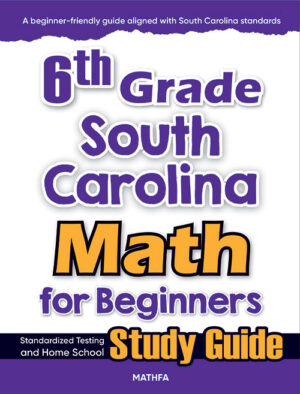 6th Grade South Carolina Math for Beginners Original price was: $21.99.$14.99Current price is: $14.99.Download
 South Carolina Algebra II for Beginners – Algebra 2 Test Prep & Study Guide Original price was: $22.99.$18.99Current price is: $18.99.Download
 6th Grade Nevada Math for Beginners Original price was: $21.99.$14.99Current price is: $14.99.Download
 SDCA Math Prep: South Dakota Student Guide
 WVGSA Math Prep: West Virginia Student Guide
 7 MCAs Math Prep Tips for Minnesota Students
 STAAR Math Test Prep for Grades 6-8: A Parent’s Guide (2026)
 7 Proven Accuplacer Math Prep Strategies
6th Grade South Carolina Math: SC READY Guide (2026)

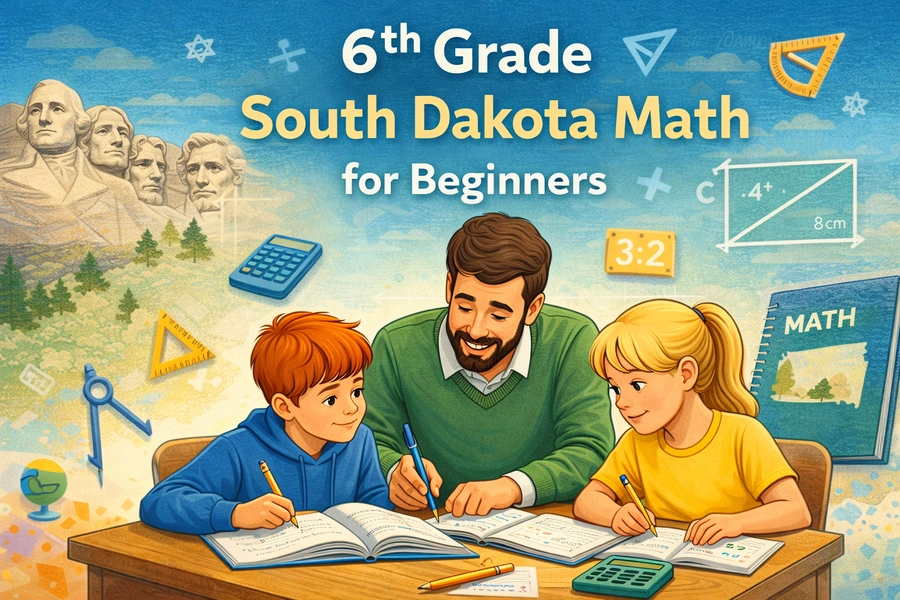
Sixth grade is a turning point in math, the year arithmetic begins evolving into algebraic thinking, and for South Carolina families it helps to know exactly what’s ahead. This guide to 6th grade South Carolina math walks through what your child will learn, how it connects to the South Carolina College- and Career-Ready Standards and the SC READY test, and how to help them build a strong foundation. Whether your sixth grader is thriving or struggling, understanding the year’s math, and supporting it with steady practice, sets them up for success now and in the grades to come.
South Carolina sixth-grade math follows the South Carolina College- and Career-Ready Standards and is assessed on the SC READY assessment, so the skills your child builds this year matter both for daily learning and for the state test. Below we’ll cover the key topics, why sixth grade is so important, how to help at home, and how a South Carolina-aligned workbook and worksheets make 6th grade math practice straightforward.
Why sixth grade math matters
Sixth grade is a pivotal year in a student’s math journey. It’s where the concrete arithmetic of the elementary years starts becoming the abstract reasoning of algebra, with ratios, negative numbers, and expressions all appearing. Mastering sixth-grade math builds the foundation for seventh and eighth grade and, ultimately, for high-school algebra.
This makes sixth grade a year worth supporting carefully. Gaps that form now can compound, making later math harder, while a solid sixth-grade foundation makes everything that follows smoother. Understanding the importance of this year helps South Carolina families give it the attention it deserves rather than treating it as just another grade.
The South Carolina standards in sixth grade
South Carolina sixth-grade math is organized around the South Carolina College- and Career-Ready Standards, which define what students should master. These cover several connected areas: proportional relationships and ratios, the number system including rational numbers, expressions and equations, geometry and measurement, and data analysis. Together they form a coherent set of skills that build on fifth grade and prepare students for seventh.
Because South Carolina assesses these standards on the SC READY, knowing them helps you understand both what your child is learning and what they’ll be tested on. The standards aren’t arbitrary; they’re a carefully sequenced progression, and a workbook aligned to them ensures your child practices exactly the right material for the grade.
Ratios and proportional relationships
One of the signature topics of sixth grade is ratios and rates. Students learn to understand a ratio, work with unit rates, and solve real-world problems involving proportional relationships, like finding the better deal or scaling a recipe. This is genuinely new thinking, comparing quantities in a structured way, and it’s central to the South Carolina sixth-grade curriculum.
Ratios and rates are foundational because they underpin the proportional reasoning that dominates seventh grade and appears throughout higher math and everyday life. Sixth graders who master this topic gain a powerful tool, while those who struggle with it often find seventh grade difficult, which is why it deserves focused attention and practice.
The number system and negative numbers
Sixth grade extends the number system in important ways. Students divide fractions by fractions, work fluently with multi-digit decimals, and, crucially, are introduced to negative numbers and the full number line. Understanding integers, ordering them, and plotting them on the coordinate plane is a major sixth-grade milestone in South Carolina math.
Negative numbers can be a conceptual hurdle, since they’re more abstract than the counting numbers students know well. Taking time to build a solid understanding here pays off enormously, because negative numbers appear constantly in algebra. A child comfortable with integers in sixth grade is well-prepared for the algebraic work ahead.
Expressions and equations
Sixth grade introduces the heart of algebraic thinking: expressions and equations. Students learn to write and evaluate expressions with variables, understand what a variable represents, and solve simple one-step equations. This is the bridge from arithmetic to algebra, and it’s one of the most important transitions in all of math education.
Grasping that a letter can stand for an unknown number, and that an equation expresses a relationship to solve, is a genuine shift in thinking. Sixth graders who understand expressions and equations conceptually, not just procedurally, build the foundation that makes seventh-grade and high-school algebra approachable rather than mysterious.
Geometry and measurement
Sixth-grade geometry focuses on area, surface area, and volume. Students find the area of triangles and other polygons, calculate the volume of rectangular prisms, and work with nets and surface area. They also work on the coordinate plane, plotting points and connecting geometry to the number system, all aligned to the South Carolina standards.
This geometry builds spatial reasoning alongside computational skill, and it connects to the real world in tangible ways, measuring spaces, packaging, and design. A solid grasp of these concepts prepares students for the more advanced geometry of later grades and reinforces the formulas and reasoning they’ll use repeatedly.
Data and statistics
Sixth graders are introduced to statistical thinking: understanding what makes a statistical question, summarizing data with measures like mean, median, and range, and displaying data with dot plots, histograms, and box plots. This introduces the data-literacy skills that matter increasingly in school and modern life, and that appear on the SC READY.
Learning to interpret and describe data is a valuable, practical skill. Sixth grade lays the groundwork by teaching students to think about variability and typical values, which deepens in later grades. Practicing reading and summarizing data helps cement this important strand of the South Carolina sixth-grade curriculum.
How sixth grade prepares for the future
Everything in sixth-grade math points forward. The ratios lead to seventh-grade proportional reasoning, the integers and expressions lead to algebra, and the geometry and statistics deepen in every later grade. Sixth grade is, in a real sense, the launchpad for middle-school and high-school math in South Carolina.
This is why a strong sixth-grade year matters so much. A student who masters this material enters seventh grade ready to build, while one with gaps spends later years playing catch-up. Supporting sixth-grade math well is one of the highest-value investments a South Carolina family can make in a child’s long-term math success.
How to help your child at home
The most effective support is a short, consistent practice routine. Fifteen to twenty minutes a few times a week reinforces what your child is learning and prevents gaps from forming. A South Carolina-aligned workbook makes this easy, because the content matches exactly what your child is studying and what the SC READY will assess.
Beyond practice, talk through math in everyday life, ratios while cooking, percentages while shopping, so the skills feel real and useful. Keep the tone encouraging; sixth graders who feel capable take on hard problems instead of freezing. Steady practice plus a supportive attitude does more than any amount of pressure.
Practice with grade 6 worksheets
Targeted worksheets are perfect for reinforcing sixth-grade skills. Math Notion’s free Grade 6 math worksheets cover the ratios, number system, expressions, geometry, and statistics South Carolina sixth graders learn, so you can practice exactly the right material at home and target the standards the SC READY assesses.
Browse the full library on our math worksheets page for more practice. Have your child work a focused set, then review it together, especially the misses, to turn each mistake into a fixable lesson. You can also reinforce foundations with our Grade 5 worksheets or preview what comes next with the Grade 7 worksheets. This steady, targeted practice is one of the most effective ways to build a strong sixth-grade foundation.
Common sixth-grade sticking points
Certain sixth-grade topics trip up students predictably. Negative numbers and the integer rules can be confusing at first. Dividing fractions, especially understanding why the procedure works, challenges many. And the leap to working with variables and expressions feels abstract for students used to concrete arithmetic.
For each, patient, targeted practice helps. Spend extra time on negative numbers until the number line feels natural, work plenty of fraction-division problems with understanding, and ease into expressions with simple, concrete examples first. Addressing these sticking points directly prevents them from becoming lasting weaknesses.
Supporting struggling and advanced sixth graders
If your sixth grader is struggling, the key is to identify exactly where the gap is, often a fifth-grade fundamental like fractions, and shore it up before pushing forward, since sixth grade builds on earlier skills. Targeted practice on the specific weak area is far more effective than general review, and it usually resolves the difficulty faster than you’d expect.
For students who find sixth-grade math easy, the goal is to keep them challenged and engaged with deeper problems and applications, so they stay interested and keep growing. A good South Carolina-aligned workbook serves both: it provides clear instruction for those who need to build, and plenty of practice for those ready to stretch.
Building confidence in sixth grade
Beyond the specific topics, sixth grade is a crucial year for a child’s math confidence. As the work grows more abstract, some students start telling themselves they’re “not a math person”, a belief that can become self-fulfilling. Countering that with encouragement, and with the steady experience of working hard at a problem and succeeding, matters enormously for a South Carolina sixth grader.
Confidence grows through small, repeated wins, so start practice at a level where your child can succeed and build difficulty gradually. Celebrate progress, treat mistakes as a normal part of learning, and keep the message clear that math ability grows with effort. A sixth grader who believes they can improve, backed by steady 6th grade math practice, is far more likely to thrive through middle school, the SC READY, and beyond.
The workbook that builds a strong foundation
For complete, standards-aligned support, a workbook ties the whole year together. The 6th Grade South Carolina Math for Beginners covers exactly the ratios, number system, expressions, geometry, and statistics South Carolina sixth graders learn, with clear lessons and step-by-step answer explanations a parent can follow even if it’s been years since your own math classes.
Used alongside the free Grade 6 worksheets, a workbook gives your child both complete instruction and targeted practice, the combination that builds a strong sixth-grade foundation and prepares them for the SC READY. It’s an instant download, so you can start tonight. Browse the full South Carolina math collection → to find your child’s grade.
Frequently asked questions
What math do sixth graders learn in South Carolina?
Ratios and proportional relationships, the number system including negative numbers, expressions and equations, geometry and measurement (area, surface area, volume), and data and statistics, all aligned to the South Carolina College- and Career-Ready Standards.
Why is sixth-grade math so important?
It’s the transition from arithmetic to algebraic thinking and the foundation for seventh grade, eighth grade, and high-school algebra. Gaps now compound, while a strong year sets up future success.
How is sixth-grade math tested in South Carolina?
South Carolina assesses its math standards on the SC READY, so the sixth-grade skills your child learns are both classroom content and tested material.
How can I help my sixth grader with math?
Build a short, consistent practice routine with a South Carolina-aligned workbook and Grade 6 worksheets, connect math to everyday life, address weak spots directly, and keep your encouragement steady.
Math Notion makes standards-aligned math workbooks and test prep for learners at every level and across all 50 states. See the full collection.
Posted by Math Notion Team · Published on December 20, 2025