Math Articles, tips & study guides
 6 Full-Length TSI Math Practice Tests: Extra Test Prep to Help Ace the TSI Math Test Original price was: $18.99.$12.99Current price is: $12.99.Download
 8th Grade District of Columbia Math for Beginners Original price was: $21.99.$14.99Current price is: $14.99.Download
 TSI Math Comprehensive Exercise Book Original price was: $18.99.$12.99Current price is: $12.99.Download
 TSI Math Workbook: Essential Learning Math Skills Plus Two Complete TSI Math Practice Tests Original price was: $18.99.$12.99Current price is: $12.99.Download
 6th Grade District of Columbia Math for Beginners Original price was: $21.99.$14.99Current price is: $14.99.Download
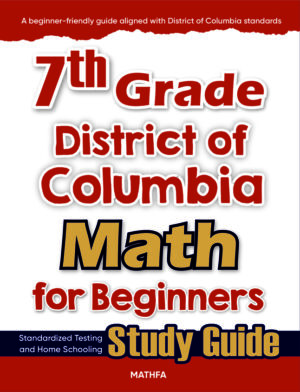 7th Grade District of Columbia Math for Beginners Original price was: $21.99.$14.99Current price is: $14.99.Download
 TSI Math Practice Book 2020: Extra Exercises and Two Full Length TSI Math Tests to Ace the Exam Original price was: $18.99.$12.99Current price is: $12.99.Download
 7 Things Nobody Tells You About GRE Math Prep
 WVGSA Math Prep: West Virginia Student Guide
 IAR Quadratic Equations Practice — Illinois Guide
 WVGSA Math Prep: West Virginia Student Guide
 CMAS Scatter Plots Practice — Colorado Guide
GMAT Math Prep: Pass on Your First Try


Smart GMAT math prep is the difference between guessing and confidently passing the quant section.
📖 Reading time: 11 min
Roughly two-thirds of business school applicants take the GMAT more than once — yet the highest scorers share one habit: they treat the quantitative section like a strategy game, not a math test. If you’re staring down a blank practice book wondering where to start, you’re not alone, and the path forward is more structured than you might think.
This guide walks you through everything you need for serious GMAT math prep, from the exact question types and scoring rules to a sample problem with full solution, common mistakes, and two study schedules you can start today. According to the NAEP – Nation’s Report Card, U.S. adult math proficiency has declined in recent years, which means even strong students often arrive at GMAT prep with foundational gaps that need filling.
The good news? GMAT quantitative questions test a relatively narrow band of arithmetic, algebra, and word problem reasoning — concepts most test-takers learned in high school. With focused math practice and the right strategies, passing on your first try is realistic. Let’s break down exactly how to get there.
What the GMAT Math Section Covers and How It’s Scored
Section Format and Content Domains
The GMAT Focus Edition Quantitative Reasoning section contains 21 multiple-choice questions to be completed in 45 minutes — about 2 minutes 9 seconds per question. The GMAT (Graduate Management Admission Test) is a computer-adaptive exam, meaning the difficulty of each question adjusts based on your previous answers. That single fact changes how you approach the entire section.
Unlike older versions of the test, the current GMAT quantitative section focuses entirely on Problem Solving — Data Sufficiency questions have moved to the Data Insights section. The math content stays tightly focused on arithmetic, algebra, and word problems. You won’t see geometry, trigonometry, or advanced statistics questions, and calculators are not permitted on this section.
Scoring on the GMAT Focus uses a 60–90 scale per section, with the total score ranging from 205 to 805. A competitive quantitative score for top MBA programs typically falls in the 82–90 range, while a passing score for most programs sits around 75–80. Your section score reflects both accuracy and the difficulty level of the questions you answered correctly.
To build genuine math fluency for this section, focus your math practice on these core areas:
- Arithmetic and number properties — integers, primes, divisibility, fractions, decimals, percentages, ratios, and exponents. These appear in roughly 40% of questions and form the foundation for almost every other problem type.
- Linear and quadratic algebra — solving equations, factoring expressions, working with inequalities, and manipulating variables. Master factoring patterns like the difference of squares before test day.
- Word problem translation — rate, work, mixture, distance, and interest problems. The hardest part is usually translating English into algebraic equations, not the math itself.
- Statistics fundamentals — mean, median, mode, range, and standard deviation conceptually. You won’t calculate complex standard deviations, but you’ll need to reason about how data sets behave.
How Adaptive Scoring Changes Your Strategy
Because the GMAT adapts to your performance, the first 5–7 questions carry disproportionate weight in determining your scoring band. Rushing early questions to “save time” for harder ones later is a strategic mistake — those early questions set the ceiling for your final score.
That said, you cannot skip questions or return to previous ones in the same way as paper tests. Once you answer and confirm, that answer is locked. This forces a different mindset: every question matters, but no single question is worth sacrificing your pacing to perfect.
Heavy penalties also apply for unanswered questions at the end of the section. If you run out of time with five questions blank, your score drops far more than if you’d guessed quickly on those same questions. Always answer every question, even if you guess.
Pacing Strategy and the Top 5 Question Types
The 2-Minute Rule and Time Benchmarks
The most effective GMAT math pacing approach uses fixed time benchmarks: aim to complete 7 questions every 15 minutes. With 21 questions in 45 minutes, this rhythm leaves a small buffer for harder problems while preventing the runaway clock that derails most test-takers.
If a question takes more than 2 minutes 30 seconds, make an educated guess and move on. Comparing data from official GMAT prep platforms shows that students who spend over 3 minutes on a single question typically miss 2–3 follow-up questions due to time pressure. International benchmarks from the TIMSS – Trends in International Mathematics & Science Study consistently show that pacing discipline distinguishes high scorers from the rest, regardless of raw math knowledge.
The five question types you’ll encounter most often on the GMAT quantitative section are:
- Number properties — Questions about integers, factors, multiples, primes, and remainders. Example: “If n is a positive integer and n² is divisible by 72, what is the smallest positive integer that n must be divisible by?”
- Algebraic word problems — Translation-heavy problems involving rates, work, mixtures, and distance. The math is rarely complex, but the setup demands careful reading and variable assignment.
- Percent and ratio problems — Calculating percentage changes, ratio comparisons, and proportional relationships. These appear across business contexts like profit margins, discounts, and population growth.
- Equations and inequalities — Solving linear and quadratic equations, systems of equations, and inequality manipulation. Watch for sign-flipping when multiplying inequalities by negative numbers.
- Statistics and sets — Mean, median, weighted averages, and overlapping set problems often solved with Venn diagrams or matrix tables.
For test-takers who want structured practice that builds the foundational arithmetic and pre-algebra skills the GMAT assumes you already have, 7th Grade District of Columbia Math for Beginners walks through fractions, ratios, percentages, and basic algebra step by step. It’s especially useful if you’ve been out of school for several years and need to rebuild number sense before tackling GMAT-level questions.
🎯 Recommended Math Book
7th Grade District of Columbia Math for Beginners — $14.99
Category: 7th Grade
Comprehensive 7th Grade Math Study Guide & Workbook
Perfect for classroom learning, homeschooling,
or extra practice at home.
Recognizing Question Patterns Quickly
Strong GMAT quantitative performers don’t solve every problem from scratch — they recognize patterns within seconds. A question mentioning “consecutive integers” almost always involves divisibility rules. Anything about “average speed for a round trip” requires the harmonic mean formula, not the simple average.
Build a personal pattern bank during your math practice test sessions. Each time you encounter a problem type, note the trigger phrase and the standard approach. Within 4–6 weeks of consistent practice, your pattern recognition becomes nearly automatic, freeing mental bandwidth for the genuinely tricky questions.
GMAT Math Tips: Study Schedules and Common Mistakes
The most effective GMAT math prep balances content review, timed math practice, and error analysis. Here are seven actionable tips you can apply immediately:
- Take a diagnostic test before studying anything. Use an official GMAT practice test from mba.com to establish your baseline. This single session reveals which content areas need the most attention. Without a diagnostic, you risk spending weeks reviewing topics you’ve already mastered while neglecting your real weak spots.
- Build an error log from day one. For every question you miss, record the question type, the specific mistake (concept gap, careless arithmetic, misread question), and the correct approach. Review this log weekly. Most repeated GMAT errors come from the same 3–4 personal blind spots, not from random gaps.
- Practice mental math daily for 10 minutes. Since calculators aren’t allowed, computational speed matters. Drill multiplication tables through 20×20, common percentages (12.5%, 16.67%, 37.5%), and squares through 25². This small daily habit saves 10–15 seconds per question on test day.
- Master Plug-In and Backsolving techniques. Many algebra problems solve faster by plugging answer choices back into the question than by setting up equations. When variables appear in the answer choices, pick concrete numbers (often 2, 3, or 100 for percent problems) and test each option. This strategy alone can save 30+ seconds per question.
- Time every practice session, even short ones. Untimed practice builds knowledge but not test-readiness. Set a 2-minute timer for individual questions and a 45-minute timer for full sections. The pressure of the clock changes how you think — and you need to train under that exact pressure.
- Review correct answers as carefully as wrong ones. If you got a question right but felt unsure, that’s a knowledge gap waiting to bite you. Read the official explanation even when your answer matched. Often there’s a faster method you didn’t see, and learning that method pays off across dozens of similar questions.
- Simulate test conditions weekly. Once a week, take a full quantitative section under strict timing, no calculator, no breaks, no music. This builds the stamina and focus you’ll need for the real exam, where mental fatigue compounds across 21 consecutive questions.
4-week study schedule works well for test-takers with strong math foundations who need a focused refresh. Week 1: diagnostic plus arithmetic and number properties review. Week 2: algebra and word problems with daily timed sets. Week 3: statistics, ratios, and mixed practice. Week 4: full-length practice tests, error log review, and test-day rehearsal.
8-week study schedule suits test-takers rebuilding skills from a longer break. Weeks 1–2: arithmetic foundations including fractions, decimals, and percentages with a free study guide for daily drills. Weeks 3–4: algebra fundamentals and equation solving. Weeks 5–6: word problems, rates, and statistics. Weeks 7–8: full timed sections, pattern recognition refinement, and review.
Common mistakes to avoid include rushing the first 7 questions, skipping the error log, ignoring mental math practice, neglecting word problem translation skills, and over-relying on official guide questions while skipping topic-specific drills. Every one of these mistakes is preventable with deliberate practice habits.
Worked Examples: GMAT Quantitative Walkthroughs
Example 1: Number Properties Problem
Problem: If n is a positive integer and n² + 12n + 35 is divisible by 9, what is the smallest possible value of n?
Step 1: Factor the expression. n² + 12n + 35 = (n + 5)(n + 7).
Step 2: For the product to be divisible by 9, either one factor is divisible by 9, or both factors share a factor of 3 (since 3 × 3 = 9). The two factors differ by 2, so they cannot both be multiples of 3.
Step 3: Test the smallest values. If n = 4, then (9)(11) = 99, which is divisible by 9. Check: 99 ÷ 9 = 11. ✓
Answer: n = 4. This problem rewards factoring fluency over brute-force computation — a hallmark of well-designed GMAT quantitative questions.
Example 2: Rate and Work Word Problem
Problem: Pump A can fill a tank in 6 hours. Pump B can fill the same tank in 4 hours. If both pumps work together, how many hours will it take to fill the tank?
Step 1: Convert times to rates. Pump A’s rate = 1/6 tank per hour. Pump B’s rate = 1/4 tank per hour.
Step 2: Add rates when working together. Combined rate = 1/6 + 1/4 = 2/12 + 3/12 = 5/12 tank per hour.
Step 3: Time = 1 ÷ rate = 1 ÷ 5/12 = 12/5 hours.
Answer: 12/5 hours, or 2 hours 24 minutes. The key insight: rates add directly, but times don’t. This single principle solves dozens of GMAT work problems.
Example 3: Percent Change Problem
Problem: A stock price increases by 25% in January, then decreases by 20% in February. What is the net percent change over the two months?
Step 1: Pick a concrete starting value. Let the original price = $100.
Step 2: Apply the January increase. $100 × 1.25 = $125.
Step 3: Apply the February decrease to the new price. $125 × 0.80 = $100.
Answer: 0% net change. Counterintuitively, a 25% increase followed by a 20% decrease (or vice versa) returns to the starting value because the percentages apply to different bases. Recognizing this pattern saves significant time on test day.
📚 More from Math Notion
Frequently Asked Questions
How long should GMAT math prep take to pass on your first try?
Most successful first-time test-takers spend 8–12 weeks on focused GMAT math prep, studying 10–15 hours per week. The exact timeline depends on your starting math skills and target score. Test-takers with recent quantitative coursework often pass in 4–6 weeks, while those returning to math after years away typically need the full 12 weeks to rebuild fluency, complete enough practice test questions, and build pacing stamina.
What is a passing score for the GMAT quantitative section?
A passing GMAT quantitative score for most MBA programs falls between 75 and 80 on the GMAT Focus 60–90 scale. Top-tier business schools typically expect quantitative scores of 82 or higher. Your target score should reflect the average admitted student score at your goal programs — these statistics are published openly by most schools, making it easy to set a realistic, school-specific GMAT math prep goal.
Why do test-takers fail GMAT math even when they know the content?
The most common reason test-takers fail GMAT math despite knowing the content is poor pacing and weak pattern recognition. Knowing how to solve a problem isn’t enough when you have only 2 minutes per question. Successful GMAT math tips emphasize timed practice, an error log, and mental math drills — habits that convert raw knowledge into test-day performance under pressure.
Key Takeaways
- The GMAT Focus quantitative section contains 21 questions in 45 minutes, scored 60–90, focused on arithmetic, algebra, and word problems with no calculator allowed.
- Effective GMAT math prep combines daily mental math drills, an error log, timed practice sets, and weekly full-section simulations under real test conditions.
- Pattern recognition for the top 5 question types — number properties, algebraic word problems, percents and ratios, equations, and statistics — is what separates first-try passers from repeat test-takers.
- Test-day success depends on pacing discipline, answering every question, and managing anxiety with breathing techniques and a strict 2-minute rule per problem.
Smart GMAT math prep is less about memorizing formulas and more about building speed, accuracy, and confidence through deliberate practice. Whether you choose the 4-week sprint or the 8-week build, consistent daily effort with the right resources will get you to a passing score on your first attempt. Browse the full Math Notion math book collection to find the right workbook for your current level and start your prep today.
GMAT math prep resources
Pair these strategies with focused practice. Explore Math Notion math workbooks and full-length practice tests for GMAT quant practice and GMAT math practice test — with step-by-step answer keys built for homeschool and self-study.
Browse all Math Notion math practice books →
Official source: For the latest test details and dates, visit the official GMAT exam site (mba.com).
Posted by Math Notion Team · Published on May 10, 2026