
Entering the 6th grade marks an exciting transition for students in Washington — from elementary arithmetic to deeper math concepts. This guide is for students, parents, and educators who want a clear overview of what 6th Grade Math in Washington includes, how to study effectively, and what skills to expect.
What Are the Washington State 6th Grade Math Standards?
The 6th Grade mathematics curriculum in Washington is designed to build strong foundational skills that prepare students for middle and high school math. The key domains typically include:
- Ratios and Proportional Relationships — understanding ratios, equivalent ratios, unit rates, and solving real-life problems involving proportions.
- The Number System — working with fractions, decimals, and how they relate; performing operations (addition, subtraction, multiplication, division) with these numbers.
- Expressions and Equations — writing, interpreting, and evaluating algebraic expressions; solving simple one-variable equations.
- Geometry — understanding area, surface area, volume, classification of shapes, and introducing basic spatial reasoning.
- Statistics and Data Analysis — collecting, organizing, and interpreting data; understanding mean, median, mode, range; reading graphs and charts.
These domains reflect common expectations across many Washington classrooms and help ensure that all students develop the mathematical understanding needed for future courses.
Core Math Topics — What You’ll Learn in 6th Grade WA
1. Ratios, Rates, and Proportional Thinking
Students learn to compare quantities using ratios (e.g., “3 to 4”, or “5:2”), simplify ratios, and compute unit rates such as miles per hour or cost per item.
Example: If 8 liters of juice cost $12, how much does 1 liter cost? Answer: $1.50 per liter.
2. Fractions and Decimals
By 6th grade, students should be comfortable adding, subtracting, multiplying, and dividing fractions and decimals. They also learn to convert between fractions and decimals and compare them.
3. Algebra: Expressions and Equations
Algebraic thinking begins here. Students learn to:
- Write expressions like
2x + 5and evaluate them for given values ofx. - Solve simple equations such as
3x + 4 = 19to findx.
4. Geometry Basics
Geometry topics include understanding area of polygons (triangles, rectangles, etc.), surface area and volume of three-dimensional shapes, and using units of measure correctly.
Example: A box with dimensions 4 cm × 3 cm × 2 cm has volume 4 × 3 × 2 = 24 cubic centimeters.
5. Data, Statistics & Probability
Students begin exploring data: how to collect it, display it (bar graphs, line plots), and interpret it. They learn to calculate mean (average), median, mode, and range, and draw simple conclusions from data sets.
Example: For data set {2, 4, 6, 8, 10} → Mean = 6, Median = 6, Range = 8.
Study Tips for Mastering 6th Grade Math
- Practice Consistently: Spending a few minutes each day on math helps reinforce skills better than last-minute cramming.
- Use Visual Models: Drawing fraction bars, number lines, geometric diagrams, or graphs helps in understanding abstract concepts.
- Explain What You Learn: Teaching a concept to someone (a friend or family member) is a great way to ensure you understand it thoroughly.
- Show Your Work: Writing every step clearly builds good habits and makes it easier to check work later.
- Use Interactive Tools: Online platforms, math games, and printable worksheets make practice more fun and engaging.
Recommended Resources & Practice Materials
📘 Math Notion Workbooks — Our workbooks aligned with Washington standards include step-by-step lessons, examples, and practice problems to build confidence and mastery.
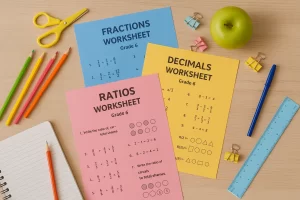
📄 Printable Worksheets & Practice Sheets — Use worksheets for fractions, decimals, ratios, geometry, and data analysis to reinforce daily learning.
🌐 Online Platforms — Consider using free or subscription-based platforms that offer adaptive exercises and instant feedback for 6th grade math.
Conclusion
6th Grade math in Washington is a crucial stepping-stone — mastering ratios, fractions, algebraic thinking, geometry, and data literacy sets a strong foundation for middle school, high school, and beyond. With consistent practice, visual tools, clear thinking, and good study habits, math becomes not only manageable, but also enjoyable and meaningful.
At Math Notion, we believe every student can succeed with the right support and resources. Let’s make learning math simple, engaging, and empowering!
Mathfa – Trusted by families, recommended by educators.